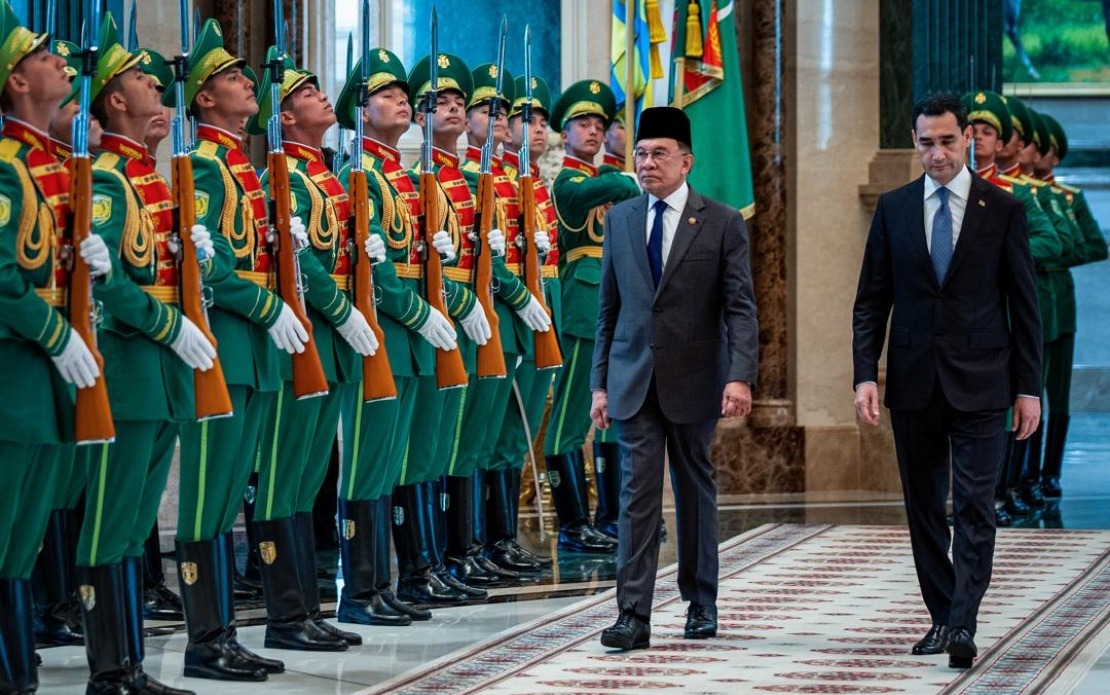
Prime Minister Datuk Seri Anwar Ibrahim received the full ceremonial treatment upon arrival at Turkmenistan's Presidential Palace in Ashgabat on June 19, underscoring the significance Malaysia places on strengthening diplomatic relations with Central Asia. The elaborate reception, featuring a guard of honour and the simultaneous playing of both national anthems, signals a formal opening of engagement between Kuala Lumpur and Ashgabat following Anwar's assumption of the premiership in November 2022. This marks the first occasion since then that a Malaysian prime minister has made an official state visit to Turkmenistan, a gas-rich nation strategically positioned along historical Silk Road corridors.
President Serdar Berdimuhamedov personally received Malaysia's leader, a gesture that reflects the host nation's interest in cultivating bilateral partnerships. The formal protocol extended to Anwar included presentations to Turkmenistan's entire cabinet and senior government officials, followed by reciprocal introductions of the Malaysian delegation. Such ceremonial exchanges, whilst observant of diplomatic convention, typically precede substantive discussions on trade, investment, and regional cooperation frameworks. The structured nature of these encounters provides ground for senior officials from both sides to assess alignment on key strategic priorities.
The two-day visit, which commenced on June 18, was conducted at the explicit invitation of President Berdimuhamedov, underscoring Turkmenistan's interest in deepening ties with Southeast Asia's largest economy. For Malaysia, the engagement represents a deliberate pivot towards Central Asian markets and geopolitical engagement beyond its traditional Indo-Pacific focus. Turkmenistan, whilst less prominent in Malaysian foreign policy discourse than Gulf Arab states or East Asian nations, possesses significant energy reserves and serves as a gateway to broader Central Asian economic zones. The timing of Anwar's visit reflects Malaysia's broader strategic recalibration under his administration.
Following the ceremonial reception, Anwar and Berdimuhamedov held a private bilateral meeting before reconvening for formal talks encompassing matters deemed of mutual concern. Details of substantive discussion points remain undisclosed in official releases, though such engagements typically address energy cooperation, investment opportunities, and regional security frameworks. Malaysia has been progressively expanding its footprint in Central Asia through trade and diplomatic initiatives, and Turkmenistan represents a potentially significant partner given its hydrocarbon wealth and regional influence within the Caspian Basin and broader Asian connectivity initiatives.
The visit carries implications beyond bilateral relations, signalling Malaysia's intent to position itself as a bridge between Southeast Asia and Central Asia. As regional powers compete for influence across Asia's interior, Malaysia's diplomatic overtures demonstrate commitment to participating in broader continental frameworks. This approach aligns with Anwar's broader foreign policy doctrine emphasizing South-South cooperation and diversification of Malaysia's international partnerships beyond traditional Western alignments. Turkmenistan's relatively isolated position in international affairs, owing to its official policy of permanent neutrality, makes such engagement from non-aligned nations particularly valuable.
Turkmenistan's significance extends beyond energy reserves; the nation controls critical transit routes for regional connectivity initiatives and represents a potential market for Malaysian services, technology, and manufactured goods. Conversely, Malaysian investment in Turkmenistan's energy sector or infrastructure development could yield substantial returns whilst strengthening bilateral ties. The presidential invitation underscores Ashgabat's receptiveness to deepening relations with Kuala Lumpur, potentially opening avenues for Malaysian businesses seeking Central Asian expansion opportunities. Such commercial dimensions often underpin sustained diplomatic engagement between nations.
For Southeast Asia more broadly, Malaysia's outreach to Central Asia reflects a regional recognition that economic and geopolitical dynamism increasingly extends beyond traditional maritime focus areas. Central Asia's integration into China's Belt and Road Initiative and evolving energy markets create both opportunities and competitive pressures. Malaysia's independent diplomatic positioning, neither fully aligned with Washington nor Beijing, enables it to engage Central Asian nations on relatively neutral terms. This balancing act remains central to Malaysian foreign policy under Anwar's leadership.
The formal structure of Anwar's reception, whilst ceremonial in appearance, conveys substantive messages about international status and bilateral importance. That Turkmenistan extended such honours reflects recognition of Malaysia's standing as a major Southeast Asian economy and potential partner in regional development. Conversely, Malaysia's commitment to engaging distant Central Asian nations demonstrates expansionist foreign policy ambitions under current leadership. These gestures, though ritualistic, establish momentum for future diplomatic and commercial exchanges.
Looking forward, the visit likely establishes a foundation for expanded institutional engagement between Malaysian and Turkmen governments. Follow-up mechanisms such as joint commissions, regular ministerial consultations, or working groups on specific sectors typically emerge from initial high-level visits. Energy cooperation, given Turkmenistan's hydrocarbon abundance and Malaysia's regional energy trading experience, represents a particularly promising area for development. Technology transfer and infrastructure collaboration could further deepen bilateral partnership across multiple sectors.
The broader context of Malaysia's Central Asian engagement reflects Anwar's vision for a more internationally active Malaysia capable of engaging diverse partners and regions. By contrast with some predecessors' relative concentration on traditional allied nations, the current administration has demonstrated willingness to undertake diplomatic missions to less-visited nations. This Turkmenistan visit exemplifies such strategic recalibration, positioning Malaysia as an active participant in continental-scale developments rather than a primarily regional player. The implications for Malaysian business communities, particularly those seeking international expansion, extend beyond formal bilateral relations into tangible commercial opportunities within Central Asian markets.