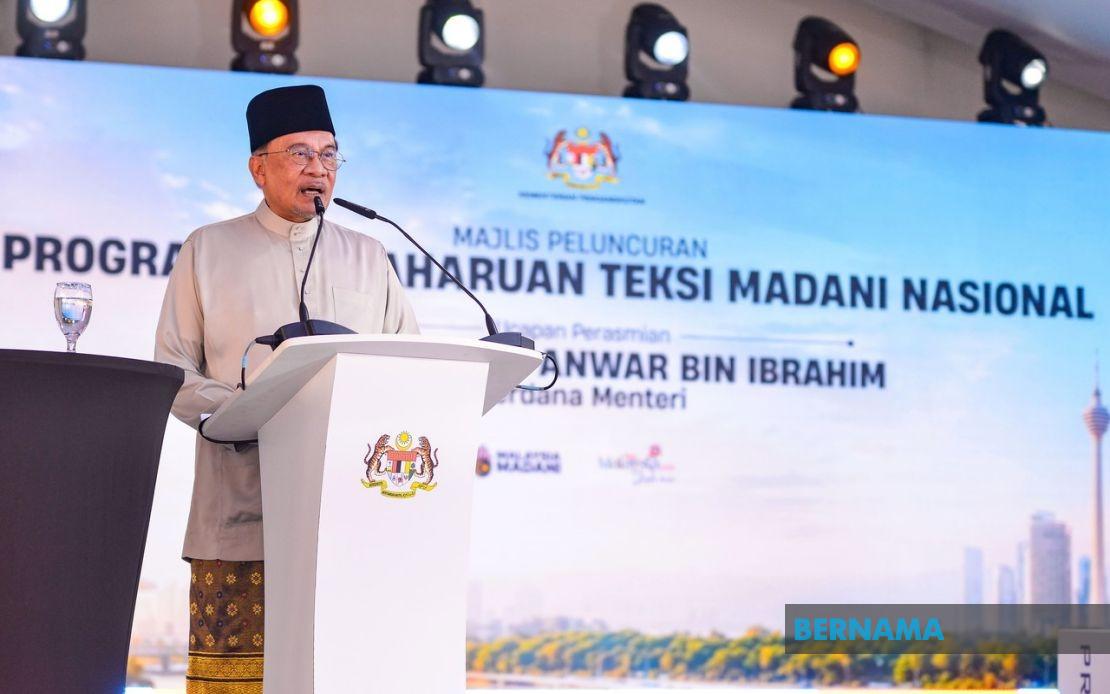
Prime Minister Datuk Seri Anwar Ibrahim has unveiled a further RM10 million in government support for Malaysia's struggling taxi sector, signalling intensified commitment to modernising the country's public transport backbone. The fresh allocation comes barely months after the initial RM10 million commitment unveiled in Budget 2026 for the National MADANI Taxi Reform Programme, reflecting unusually swift policy acceleration driven by what the government characterises as overwhelming demand from the driver community. Anwar, who doubles as Finance Minister, made the announcement at Dataran Merdeka during the formal launch of the reform initiative, with senior figures including Transport Minister Anthony Loke and Chief Secretary to the Government Tan Sri Shamsul Azri Abu Bakar in attendance.
The taxi industry has long represented a structural challenge for Malaysian policymakers. Operating margins have compressed as ride-hailing apps like Grab fundamentally disrupted traditional transportation economics, leaving countless operators managing ageing vehicle fleets they can neither afford to replace nor safely maintain. Many taxis plying Malaysian roads are over a decade old, presenting escalating maintenance costs, environmental concerns, and reliability issues that frustrate both drivers and passengers. The government's two-tranche approach to funding suggests recognition that piecemeal intervention will not suffice, though the total commitment of RM20 million remains modest relative to the scale of the modernisation challenge facing an estimated 60,000 licensed taxi vehicles nationwide.
Beyond the cash injection, the administration has negotiated a parallel agreement with Proton and the Transport Ministry to establish bespoke financing arrangements for taxi operators seeking to purchase the Proton S70. This partnership represents a calculated industrial policy decision, simultaneously supporting Malaysia's struggling national car manufacturer whilst offering drivers a domestically-produced alternative to imported vehicles. The S70, positioned as a mid-range sedan with modern safety and efficiency features, aligns with government objectives to boost domestic manufacturing resilience. Importantly, the dedicated financing scheme suggests that conventional commercial lending—where taxi operators typically encounter restrictive terms and elevated interest rates—will be circumvented through structured government-backed arrangements, materially improving affordability.
The timing of this announcement reflects broader economic and political imperatives. The taxi sector employs tens of thousands of Malaysians directly and represents a crucial component of urban mobility infrastructure, yet has faced sustained pressure from the gig economy. Allowing the sector to deteriorate further would impose social costs through unemployment, reduced service quality, and increased congestion as poorly-maintained vehicles break down more frequently. From Anwar's perspective, visible investment in taxi reform delivers tangible evidence of government responsiveness to ordinary workers, a political message particularly resonant in urban constituencies where taxi drivers and their families represent concentrated voting blocs.
The rollout mechanics remain partially undisclosed, but the Vehicle Replacement Matching Grant Programme suggests a matching-fund model where government contributions are conditional upon operator co-investment. Such structures encourage beneficiary commitment whilst containing fiscal exposure. However, implementation will prove critical: previous vehicle replacement schemes have occasionally foundered on cumbersome approval processes, inadequate outreach, or financing terms that drivers ultimately reject as unviable. The Transport Ministry and relevant financial institutions will need to streamline applications and ensure marketing reaches fragmented driver populations who may lack regular digital connectivity.
Regional implications merit consideration too. Singapore and Thailand have implemented more aggressive taxi modernisation programmes, with some jurisdictions mandating vehicle replacement within specified timeframes. Malaysia's softer, incentive-based approach reflects different governance philosophies but risks allowing technological and service-quality gaps to widen. Neighbouring countries' experiences suggest that success requires sustained commitment beyond initial funding announcements, including driver retraining programmes, digital platform integration, and fare-adjustment mechanisms that allow operators to recover modernisation investments.
The inclusion of Hannah Yeoh, Minister in the Prime Minister's Department (Federal Territories), underscores that taxi reform extends beyond national transport policy into urban management. Federal Territories encompass Kuala Lumpur, where taxi services face particular intensity of competition from ride-hailing platforms and where service quality directly impacts Malaysia's international image. The ceremonial launch at Dataran Merdeka—symbolically important national ground—signals political seriousness rather than routine administrative routine.
Stakeholders will scrutinise implementation against three metrics: uptake rates among drivers, the final specifications of Proton S70 units delivered, and whether financing terms prove genuinely affordable without hidden costs. Early enthusiasm for initial allocations does not guarantee sustained participation if application processes prove burdensome or if drivers conclude that monthly repayments remain unsustainable. The success of this initiative will substantially influence public confidence in the government's capacity to manage sector-specific industrial challenges, particularly as Malaysia navigates longer-term structural transitions away from commodities-dependent economic models.
Anwar's personal involvement and dual ministerial portfolio suggest this file has elevated importance within the cabinet hierarchy. Finance Ministry ownership ensures budget allocations receive protective status against competing demands, whilst the Prime Minister's direct championing indicates willingness to expend political capital on this constituency. This positioning may facilitate subsequent tranches of funding if initial outcomes prove encouraging, offering hope to drivers who have endured years of deteriorating circumstances. However, the underlying tension remains: whether RM20 million in subsidies and attractive financing can fundamentally rebalance economics that fundamentally favour ride-hailing platforms' technology-driven efficiency advantages.

