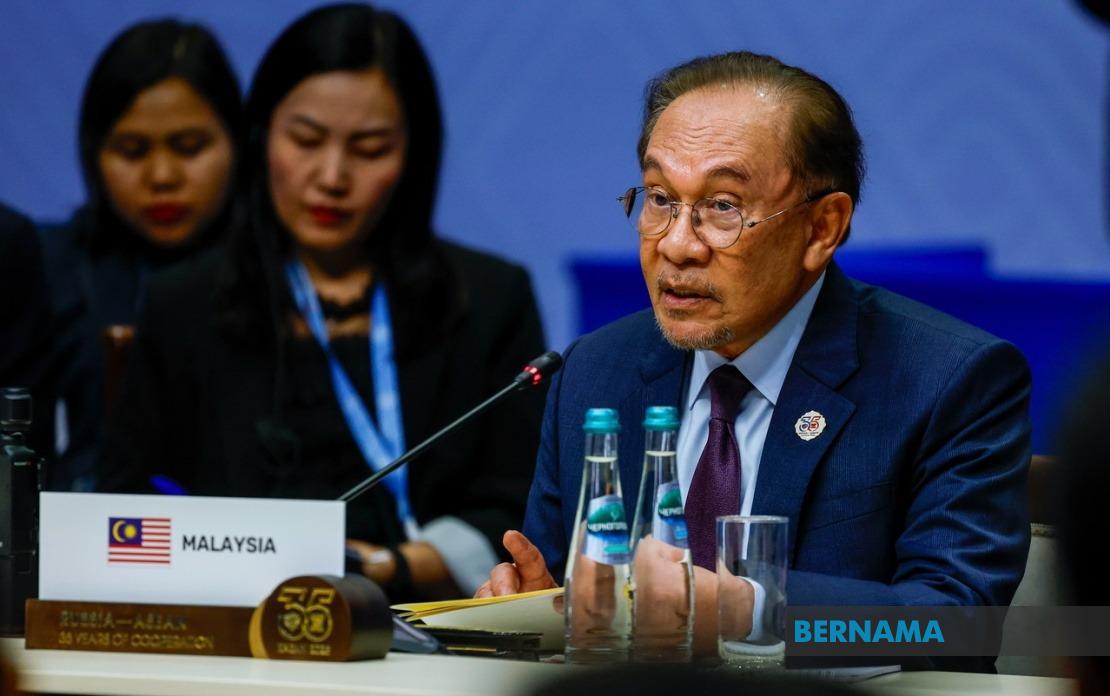
Prime Minister Datuk Seri Anwar Ibrahim has appealed to ASEAN and Russia to expand their strategic partnership across multiple sectors, using the occasion of a historic commemorative summit in Kazan to spotlight shared opportunities in an increasingly turbulent geopolitical landscape. Speaking during a plenary session of the ASEAN-Russia Commemorative Summit, Anwar positioned dialogue and diplomacy as indispensable tools for navigating the world's mounting tensions and unresolved conflicts, reinforcing Malaysia's longstanding commitment to peaceful resolution of disputes through international law and mutual respect.
The summit represents a milestone moment for both blocs, coinciding with the 35th anniversary of formal ASEAN-Russia relations, which were established in 1991 with a founding meeting in Kuala Lumpur. This commemorative gathering has been elevated to the highest diplomatic level, drawing Philippines President Ferdinand Marcos Jr, who holds the rotating ASEAN Chair for 2024, alongside leaders and senior representatives from all ten ASEAN member states. The two-day forum in Russia's volga region city provides both sides with a rare opportunity to assess three and a half decades of engagement and chart a renewed pathway for cooperation extending to 2030.
Anwar articulated a comprehensive agenda for deeper engagement, identifying several priority domains where ASEAN and Russia possess complementary interests and capabilities. Beyond traditional economic ties, he emphasised the strategic importance of collaboration in digital infrastructure and artificial intelligence, recognising that technological advancement will increasingly define competitive advantage in the region. Science and technology partnerships also featured prominently in his remarks, alongside energy cooperation—a sector of particular relevance given Russia's resource wealth and ASEAN's growing energy demands. Food security emerged as another critical area, reflecting the vulnerabilities exposed during recent global supply chain disruptions that have affected Southeast Asian nations. The Malaysian leader also highlighted the halal industry as a distinctive avenue for cooperation, a sector where ASEAN nations maintain significant competitive advantages and where Russian engagement could unlock new market opportunities.
People-to-people exchanges formed an equally important pillar of Anwar's proposed framework, underscoring that sustainable partnerships rest not merely on governmental agreements but on robust cultural and social connections between citizens. Trade and investment cooperation, he suggested, should be revitalised to generate tangible economic benefits for ASEAN countries and Russian counterparts alike, implying that the current commercial relationship could be significantly expanded. This multi-dimensional approach reflects Malaysia's belief that resilient partnerships must extend across sectors and society layers rather than remaining confined to diplomatic channels.
The prime minister reiterated Malaysia's unwavering commitment to the principle that enduring peace emerges exclusively through dialogue, mutual understanding, and adherence to established international legal frameworks. This statement carries particular resonance given Malaysia's own experience navigating complex regional disputes and its consistent advocacy for rules-based international order. Anwar's emphasis on these principles suggests Malaysia views the ASEAN-Russia partnership as a potential stabilising force in a world witnessing increased polarisation and military posturing.
Anwar devoted specific attention to developments in West Asia, where Malaysia has long maintained distinctive diplomatic positions. He reiterated Malaysia's demand for an immediate end to violence in Gaza, reaffirmed the necessity of unimpeded humanitarian assistance reaching affected populations, and insisted on the restoration of Palestinian rights to self-determination. These positions align with Malaysia's historical solidarity with Palestinian causes and reflect broader Muslim-majority nation concerns about the humanitarian dimensions of the ongoing conflict. Additionally, Anwar condemned the expansion of Israeli military operations into Lebanon, signalling Malaysia's regional concern about escalating tensions that threaten wider destabilisation. Malaysia also firmly rejected any attacks on UNIFIL, the United Nations peacekeeping force operating in southern Lebanon, demonstrating commitment to international peacekeeping mechanisms.
Expressed in carefully calibrated diplomatic language, Anwar's confidence in ASEAN and Russia's potential underscores Malaysia's belief that the partnership remains fundamentally valuable despite broader geopolitical divisions that pit Western and Russian interests against one another. By framing cooperation as rooted in mutual respect and shared commitment to global peace and prosperity, Malaysia positions ASEAN as a force for stability that can engage Russia constructively without abandoning established Western partners—a delicate balancing act that has defined ASEAN's strategic approach.
The summit is expected to produce four significant outcome documents that will institutionalise the renewed partnership and provide frameworks for implementation over the coming years. The Kazan Declaration commemorating 35 years of relations will serve as a foundational document reaffirming both blocs' commitment to the relationship. Companion joint statements on energy cooperation and cultural cooperation will establish specific priorities, while a comprehensive plan of action for 2026–2030 will translate aspirations into concrete deliverables and timelines. These documents carry particular importance for Southeast Asian nations seeking to diversify partnerships and reduce dependency on any single power bloc.
For Malaysia specifically, the timing of this summit reflects broader strategic calculations about balancing multiple relationships in an era of great power competition. As the immediate past ASEAN Chair, Malaysia's fingerprints remain visible on ASEAN's diplomatic architecture and priorities. The emphasis on dialogue, multilateralism, and rules-based order reflects values Malaysia has consistently championed within ASEAN forums. By showcasing how ASEAN can maintain productive relationships with major powers including Russia—despite international sanctions and tensions—Malaysia reinforces its model of strategic autonomy and non-alignment.
The partnership framework extending to 2030 carries implications for regional stability and economic development that extend well beyond bilateral Malaysian-Russian concerns. Stronger ASEAN-Russia energy cooperation could provide alternative suppliers for Southeast Asian nations, potentially reducing vulnerability to supply disruptions. Enhanced collaboration in digital and artificial intelligence sectors could accelerate technological adoption across the region. Expanded trade relationships might offer new markets for ASEAN agricultural and manufactured products, while simultaneously creating investment opportunities for Russian entities in Southeast Asia's dynamic economies. These practical dimensions complement the diplomatic messaging, suggesting that the partnership pursues tangible mutual benefits rather than merely rhetorical solidarity.
Looking forward, the success of this renewed partnership will depend on translating ambitious frameworks into operational reality. Historical ASEAN-Russia engagement has often remained limited despite periodic declarations of strategic intention. The 2026–2030 plan of action will be tested by its ability to overcome structural impediments, including Western sanctions constraining Russian economic engagement, logistical challenges spanning the Eurasian landmass, and the priority different ASEAN nations assign to Russia among numerous bilateral and multilateral relationships. Nevertheless, Malaysia's prominent role in advancing this partnership demonstrates its continued commitment to non-aligned diplomacy and its belief that inclusive regional architecture remains possible even amid significant international tensions.

%22%2F%3E%3C%2Fpattern%3E%3C%2Fdefs%3E%3Crect%20width%3D%22100%25%22%20height%3D%22100%25%22%20fill%3D%22url(%23ph21o2sg)%22%2F%3E%3Crect%20width%3D%22100%25%22%20height%3D%22100%25%22%20fill%3D%22url(%23ph21o2sp)%22%2F%3E%3Ctext%20x%3D%2250%25%22%20y%3D%2250%25%22%20text-anchor%3D%22middle%22%20dominant-baseline%3D%22central%22%20fill%3D%22rgba(255%2C255%2C255%2C0.95)%22%20font-family%3D%22Georgia%2C%20'Times%20New%20Roman'%2C%20serif%22%20font-weight%3D%22700%22%20font-size%3D%22170%22%20letter-spacing%3D%22-0.02em%22%3EGabungan%3C%2Ftext%3E%3C%2Fsvg%3E)