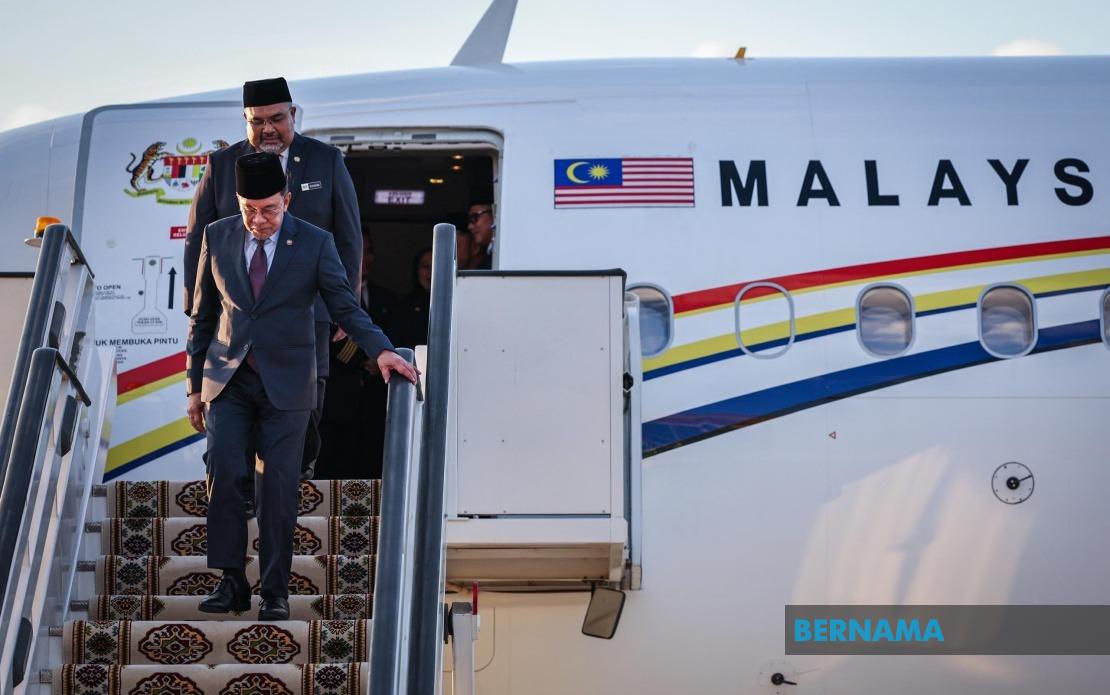
Prime Minister Datuk Seri Anwar Ibrahim touched down in Ashgabat on June 18 for a two-day official visit to Turkmenistan, capping off his broader Central Asian engagement that began in Kazan, Republic of Tatarstan. The aircraft arrived at Ashgabat International Airport at 8 pm local time, marking the commencement of high-level diplomatic discussions between Malaysia and this strategically positioned energy-rich nation. The visit represents a deliberate expansion of Malaysia's diplomatic footprint across Central Asia, a region increasingly important to the country's economic and geopolitical positioning.
Anwar was accompanied by a substantial ministerial contingent reflecting the economic significance of the engagement. Minister of Investment, Trade and Industry Datuk Seri Johari Abdul Ghani and Minister of Economy Akmal Nasrullah Mohd Nasir travelled alongside the prime minister, signalling that trade and investment matters would feature prominently on the agenda. This composition of the delegation underscores Malaysia's intention to leverage the visit for concrete commercial outcomes rather than protocol-driven formalities alone. The inclusion of senior economy ministry officials suggests discussions will extend beyond ceremonial aspects into substantive negotiations regarding bilateral economic frameworks.
The reception protocols reflected the diplomatic weight accorded to the visit. Malaysia's Ambassador to Turkmenistan Mohd Suhaimi Ahmad Tajuddin greeted the prime minister upon arrival, while the Turkmenistan side fielded Deputy Chairman of the Cabinet of Ministers for Oil and Gas Guvanch Agajanov, a senior position within Ashgabat's energy-centric governance structure. This selection of a high-ranking energy official to lead the welcoming delegation signals Turkmenistan's emphasis on sectors aligned with its economic priorities and likely indicates that energy cooperation will constitute a major discussion point during the bilateral meetings.
The visit itself carries considerable symbolic weight within Malaysia's diplomatic narrative. This marks Anwar's inaugural official visit to Turkmenistan and represents merely the fifth such visit by a Malaysian prime minister to the nation since formal bilateral relations were established. The relative rarity of top-level Malaysian visits underscores the historical limitations in engagement between Kuala Lumpur and Ashgabat, suggesting that current momentum represents a genuine effort to deepen ties. The formal invitation from Turkmenistan President Serdar Berdimuhamedov follows his reciprocal visit to Malaysia in December 2024, establishing a pattern of high-level diplomatic exchange that had previously been sporadic.
The itinerary for June 19 demonstrates the comprehensive scope of the bilateral engagement. The day opens with ceremonial proceedings at the Presidential Palace, including a welcoming ceremony and one-on-one discussions between Anwar and Berdimuhamedov before formal bilateral talks commence. The schedule incorporates both the ceremonial dimensions expected of state visits—including the signing of a joint statement and exchange of agreements and memoranda of understanding—alongside more informal engagement, such as the official luncheon and prayers at the Turkmenbashi Ruhy Mosque. The inclusion of Friday prayers represents a cultural acknowledgement of Turkmenistan's Islamic heritage and demonstrates Malaysia's respect for local customs.
A significant element of the visit involves the joint officiation of the Malaysia-Turkmenistan Forum at the Chamber of Commerce and Industry of Turkmenistan, which both leaders are expected to attend. This business-focused component appears designed to catalyse private sector engagement and create networking opportunities between Malaysian and Turkmen commercial entities. Such forums often yield practical outcomes regarding investment partnerships, technology transfer arrangements, and trade facilitation mechanisms that extend beyond government-to-government interactions. The emphasis on this commercial dimension reflects the underlying driver of the visit—advancing Malaysia's economic interests in Central Asia.
The trade statistics contextualising this diplomatic engagement reveal both the current modest scale and considerable growth potential of Malaysia-Turkmenistan economic relations. In 2025, Turkmenistan ranked as Malaysia's fourth-largest trading partner among Central Asian nations, with total bilateral trade reaching RM75.80 million. Malaysian exports accounted for RM75.50 million of this figure, representing a nine percent increase year-on-year. While these volumes remain relatively modest compared to Malaysia's trade relationships with major economies, the upward trajectory suggests expanding commercial momentum and potential for further growth as diplomatic channels strengthen and business networks deepen.
Petroliam Nasional Bhd (Petronas) constitutes the most substantial Malaysian presence in Turkmenistan, positioning the nation's flagship energy company as a critical bridge between the two countries. Petronas's cumulative investments in Turkmenistan have reached RM52.73 billion since 1996, making the company a major stakeholder in Turkmenistan's hydrocarbon sector. This long-established presence provides a foundation for broader bilateral economic cooperation and suggests that energy partnerships will likely remain central to future Malaysia-Turkmenistan relations. Anwar's visit, coming as Petronas faces evolving global energy dynamics and transition pressures, may involve discussions regarding the company's long-term investment strategy and role within Turkmenistan's energy landscape.
Turkmenistan's significance extends beyond its current trade volumes. The nation sits atop vast natural gas reserves—among the world's largest—and remains strategically positioned as a potential energy supplier for Asian markets seeking to diversify energy sources away from traditional suppliers. For Malaysia, engagement with Turkmenistan represents part of a broader strategy to cultivate relationships with resource-rich Central Asian nations and secure potential energy supply partnerships. The diplomatic intensity of Anwar's visit reflects recognition that Central Asia constitutes an increasingly important sphere for Malaysian economic and strategic engagement.
The broader context of Anwar's Central Asian tour—encompassing both Tatarstan and Turkmenistan—demonstrates Malaysia's deliberate effort to elevate its presence and influence within this region. These visits signal to Central Asian governments that Malaysia views them as important partners worthy of prime ministerial-level engagement. Such high-level attention often facilitates faster decision-making within government-to-government discussions and creates political momentum for bilateral cooperation initiatives that might otherwise progress slowly through standard diplomatic channels.
Looking forward, the outcomes of this visit will likely manifest in concrete ways across several domains. Potential areas for advancement include expanded investment frameworks for Petronas and other Malaysian enterprises, enhanced trade facilitation mechanisms, possible technology partnerships in energy and other sectors, and strengthened people-to-people connections through cultural and educational exchanges. The visit also provides an opportunity to explore Malaysian involvement in Turkmenistan's infrastructure development projects and to identify synergies between Malaysian expertise and Turkmenistan's development priorities.
For Malaysian readers and businesses, this diplomatic engagement carries practical implications. Strengthened bilateral relations typically facilitate easier market access, reduced regulatory friction for Malaysian companies seeking to operate in Turkmenistan, and enhanced investment protection mechanisms. The presence of senior economy ministers in the delegation suggests that trade agreements facilitating Malaysian exports and investment opportunities may emerge from these discussions. Companies in Malaysia's energy, construction, trading, and technology sectors should monitor outcomes from this visit for potential partnership and contracting opportunities.
The visit concludes the regional diplomatic swing and reflects Anwar's commitment to expanding Malaysia's engagement across Asia's lesser-traversed regions. By investing political capital in Central Asian engagement, Malaysia positions itself as a serious player in regional economic partnerships and ensures that its interests and perspectives are considered in the strategic calculations of Central Asian governments. As regional geopolitics evolve and energy markets shift, such foundational diplomatic work becomes increasingly valuable for long-term national interests.

%22%2F%3E%3C%2Fpattern%3E%3C%2Fdefs%3E%3Crect%20width%3D%22100%25%22%20height%3D%22100%25%22%20fill%3D%22url(%23ph21o2sg)%22%2F%3E%3Crect%20width%3D%22100%25%22%20height%3D%22100%25%22%20fill%3D%22url(%23ph21o2sp)%22%2F%3E%3Ctext%20x%3D%2250%25%22%20y%3D%2250%25%22%20text-anchor%3D%22middle%22%20dominant-baseline%3D%22central%22%20fill%3D%22rgba(255%2C255%2C255%2C0.95)%22%20font-family%3D%22Georgia%2C%20'Times%20New%20Roman'%2C%20serif%22%20font-weight%3D%22700%22%20font-size%3D%22170%22%20letter-spacing%3D%22-0.02em%22%3EGabungan%3C%2Ftext%3E%3C%2Fsvg%3E)