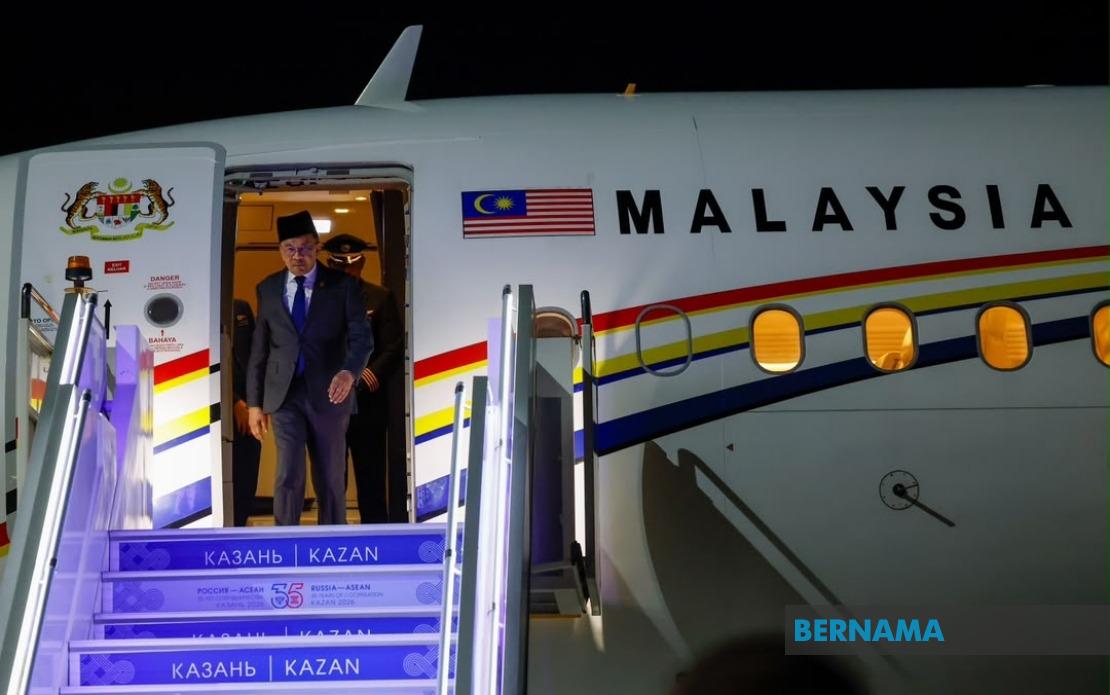
Prime Minister Datuk Seri Anwar Ibrahim touched down in Kazan on Tuesday evening to participate in a landmark diplomatic gathering that underscores Malaysia's continued commitment to strengthening ties between Southeast Asia and Russia during an era of geopolitical flux. His aircraft landed at Kazan International Airport at 10.20 pm local time, with the premier immediately entering a packed schedule ahead of the two-day ASEAN-Russia Commemorative Summit beginning June 17.
The delegation accompanying Anwar reflects the economic and strategic dimensions of this mission. Minister of Investment, Trade and Industry Datuk Seri Johari Abdul Ghani and Minister of Economy Akmal Nasrullah Mohd Nasir joined the prime minister, signalling that tangible commercial cooperation and investment partnerships feature prominently on the agenda. Their presence alongside officials from the Prime Minister's Office and the Foreign Ministry indicates a comprehensive approach to bilateral and multilateral engagement.
The summit arrives at a significant juncture for ASEAN-Russia relations. This year marks the 35th anniversary of formal ties between the 10-member Southeast Asian bloc and Moscow, with the relationship having been formally established in Kuala Lumpur in 1991. The commemorative nature of the gathering provides an opportune moment for both sides to evaluate the trajectory of cooperation over nearly four decades and to chart a more ambitious course for the partnership during the remainder of this decade and beyond.
According to statements from Malaysia's Ministry of Foreign Affairs, the meeting will address a remarkably broad spectrum of collaboration domains. Trade and investment cooperation sits at the foundation, reflecting the economic interdependencies that have developed between ASEAN economies and Russia. Energy cooperation, long a cornerstone of bilateral relations given Russia's position as a major energy supplier and the region's energy consumption patterns, will receive renewed focus. Food security has emerged as an increasingly critical concern for Southeast Asian nations, making Russia's agricultural capacity and willingness to engage in agricultural trade partnerships particularly relevant to the discussions.
The digital economy and technological advancement represent forward-looking dimensions of the proposed cooperation framework. As Southeast Asia rapidly accelerates its digital transformation—from fintech ecosystems in Singapore and Malaysia to e-commerce growth across the region—partnerships with technologically sophisticated partners become essential. Science and technology collaboration, alongside cultural and educational exchanges, reflect a commitment to deepening human connections and knowledge transfer between societies, not merely transactional government-to-government dealings.
Four substantive outcome documents are expected to emerge from the summit, providing institutional scaffolding for cooperative endeavours. The Kazan Declaration on the 35th Anniversary will serve as the ceremonial anchor, whilst the Joint Statement on Energy Cooperation and the Joint Statement on Cultural Cooperation will operationalise specific sectoral commitments. Most significantly, the Comprehensive Plan of Action to Implement the ASEAN-Russia Strategic Partnership 2026-2030 will establish a detailed roadmap for the next five years, moving beyond aspirational rhetoric into concrete timelines and deliverables that both ASEAN member states and Russia can be held accountable for achieving.
Anwar's engagement in Kazan extends beyond plenary sessions and collective declarations. Bilateral talks with Russian President Vladimir Putin are anticipated, offering the prime minister a platform to advance Malaysian and broader ASEAN interests directly with Russia's leadership. These conversations will likely touch on several themes that Anwar has consistently emphasised since assuming office in November 2022: the critical importance of dialogue and peaceful conflict resolution in an increasingly unstable international environment, support for economic resilience as nations navigate post-pandemic recovery and inflation challenges, and the deepening of people-to-people connections that can create enduring foundations for state relations.
This visit represents Anwar's third journey to Russia since taking office, illustrating the frequency and priority he has assigned to the relationship. His September 2024 attendance at the Eastern Economic Forum in Vladivostok introduced him to broader Russian business and government circles in a regional development context. The May 2025 official visit to Moscow proved more intensive, with substantive discussions with President Putin covering trade mechanics, investment frameworks, agricultural cooperation particularly relevant to Malaysia's food import requirements, education partnerships enabling student and academic exchanges, aerospace potential given Russia's technological capabilities, and energy arrangements essential to Malaysia's industrial competitiveness.
The timing of this Kazan summit carries geopolitical significance that extends beyond bilateral or even ASEAN-Russia relations. The international order continues experiencing structural shifts, with traditional alliances recalibrating and new partnerships emerging across regions. For Malaysia and ASEAN, engagement with Russia through institutionalised forums like this summit provides multiple strategic benefits: it preserves diplomatic channels during periods of global tension, it creates space for ASEAN Centrality to function meaningfully rather than as rhetorical positioning, and it enables Southeast Asian nations to maintain equidistant positioning between competing great powers rather than being forced into zero-sum choices.
Anwar's consistent messaging about advancing dialogue and peace in an increasingly complex global environment resonates directly with ASEAN's founding principle of non-interference in internal affairs and preference for negotiation over confrontation. By positioning ASEAN as a constructive partner willing to engage with all major powers, Malaysia helps sustain the bloc's credibility as a balancing force in regional affairs. This approach has particular relevance given ongoing tensions in various parts of the world and ASEAN's desire to insulate Southeast Asia from becoming a theatre for great power competition.
The focus on economic resilience and practical cooperation domains such as food security and energy reflects lessons learned from recent global disruptions. The COVID-19 pandemic exposed vulnerabilities in supply chains, whilst geopolitical tensions have demonstrated the fragility of assumptions about energy and food availability. For Malaysia, a trading nation highly dependent on imports of essential commodities, partnerships that diversify sourcing options and create stable commercial frameworks with Russia reduce dependence on any single source and enhance national economic security.
Cultural cooperation and people-to-people exchanges, whilst sometimes relegated to secondary status in diplomatic discourse, carry underestimated importance for relationship durability. These initiatives create networks of individuals across societies—artists, academics, students, entrepreneurs—who develop genuine understanding and empathy for the other side. Over decades, such networks become institutionalised, generating constituencies within each country that support continued engagement even when government relations face temporary strains. By prioritising these dimensions, Anwar and his ASEAN counterparts are investing in relationship resilience.
The Kazan summit ultimately represents an inflection point where ASEAN and Russia transition from reflecting on 35 years of relations to actively constructing the next chapter. For Malaysia, as ASEAN's current voice in this dialogue, the visit reinforces the nation's commitment to managing complex external relationships whilst maintaining strategic autonomy. As regional and global circumstances continue evolving unpredictably, the capacity to engage productively with multiple partners—including Russia—remains central to Malaysia's security and prosperity strategy.

%22%2F%3E%3C%2Fpattern%3E%3C%2Fdefs%3E%3Crect%20width%3D%22100%25%22%20height%3D%22100%25%22%20fill%3D%22url(%23ph21o2sg)%22%2F%3E%3Crect%20width%3D%22100%25%22%20height%3D%22100%25%22%20fill%3D%22url(%23ph21o2sp)%22%2F%3E%3Ctext%20x%3D%2250%25%22%20y%3D%2250%25%22%20text-anchor%3D%22middle%22%20dominant-baseline%3D%22central%22%20fill%3D%22rgba(255%2C255%2C255%2C0.95)%22%20font-family%3D%22Georgia%2C%20'Times%20New%20Roman'%2C%20serif%22%20font-weight%3D%22700%22%20font-size%3D%22170%22%20letter-spacing%3D%22-0.02em%22%3EGabungan%3C%2Ftext%3E%3C%2Fsvg%3E)