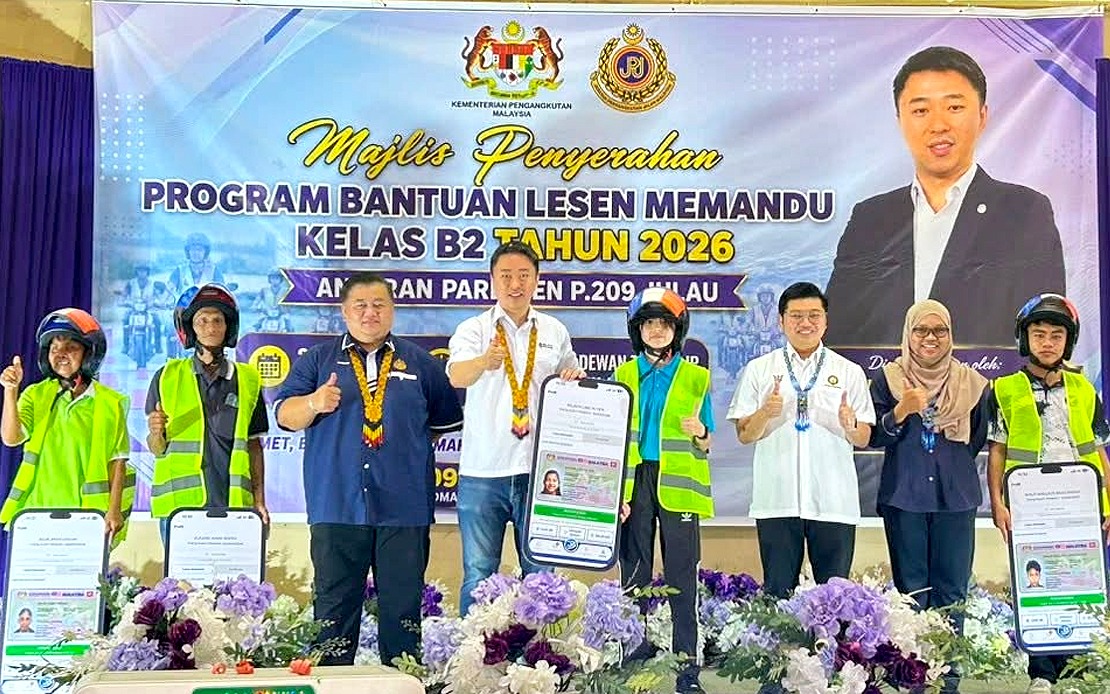
A major milestone was achieved in Sarikei today as 885 residents from the rural reaches of Julau parliamentary constituency successfully obtained their Class B2 Probationary Driving Licences through the Driving Licence Assistance Programme, unlocking access to subsidised fuel pricing for motorcycles and opening fresh economic opportunities in Malaysia's interior regions.
The initiative represents a significant intervention aimed at rural communities where two-wheelers remain the primary transport backbone, yet licensing barriers have historically prevented beneficiaries from accessing government fuel subsidies. For residents scattered across settlements like Rumah Ajau and Rumah Pom, the programme addresses a persistent friction point between aspiration and affordability that has constrained daily mobility and economic participation. The closure of the 2026 iteration of the scheme at Julau Closed Stadium marks the culmination of efforts that have fundamentally altered the transport calculus for hundreds of households in one of Sarawak's more remote constituencies.
Among the programme's beneficiaries is Bajik Undum, a 57-year-old woman from Rumah Ajau in Ulu Kuntau, Pakan, whose daily routine depended entirely on motorcycle travel to reach her orchard and transport harvested produce to market. She articulates the programme's human dimension with clarity: previous journeys to fuel stations meant paying inflated non-subsidised rates because she lacked a valid licence, a constraint that gnawed steadily at household finances. With her licence now secured, Bajik can access the same subsidised petrol pricing available to licensed riders elsewhere in Malaysia, translating into tangible monthly savings that cushion against the broader cost-of-living pressures affecting rural communities. At 57, she represents the oldest female participant, a distinction that underscores how the initiative draws across age groups and reflects no demographic bias in rural licensing gaps.
Kudang Jenggi, the programme's oldest male participant at 64, works as a bird's nest house caretaker in Bayong, Sarikei—a trade that demands regular motorcycle journeys to service facilities scattered across the region. His experience captures the legal anxiety that previously accompanied rural transport: passing police roadblocks without valid documentation created genuine apprehension despite years of riding experience. The licence confers not merely legal protection but psychological relief, freeing him to conduct work, visit family, and manage errands without the undercurrent of regulatory risk. Subsidised petrol access becomes the tangible economic benefit, yet the intangible gain—confidence to move freely—proves equally consequential in rural contexts where enforcement can feel capricious and community trust in institutions remains fragile.
For Daniel Padong, 45, who manages an oil palm smallholding in Ulu Amot, Pakan, the programme addresses a narrower but acute problem: transport costs directly erode agricultural margins already compressed by commodity price volatility. His daily commute to the plantation constitutes a fixed overhead, and recent petrol price movements have sharpened the urgency of cost containment. The licence permits him to tap subsidised rates, compressing daily fuel expenditure and preserving thin farming margins. His case exemplifies how rural licensing programmes intersect with agricultural productivity and rural household economic resilience—dimensions often overlooked in urban-centric policy discourse but critical to rural livelihoods.
The initiative unfolded under the stewardship of Julau MP Datuk Larry Sng Wei Shien, who also chairs the Malaysian Timber Industry Board, indicating that the programme received high-level parliamentary backing. The presence of Sarawak Road Transport Department director Norizan Jili at the closing ceremony signals administrative commitment to implementation and monitoring. Such joint participation suggests coordination between parliamentary representation and regulatory machinery, though the underlying question of why a driving licence assistance programme was necessary in 2026 points to enduring gaps in rural access to foundational transport documentation.
The broader context involves Malaysia's fuel subsidy regime, which extends discounted petrol to registered motorcycle riders meeting specified criteria. The subsidy aims to manage transport costs for lower-income groups, yet implementation has historically been uneven in rural areas where identification documentation requirements create barriers. The Julau programme appears designed to dismantle this specific obstruction by offering free or heavily subsidised licence acquisition, converting a cost prohibition into an achievable milestone.
Rural Sarawak presents distinctive challenges: dispersed settlement patterns, limited public transport infrastructure, and economies dependent on agriculture and forestry necessitate personal motorised transport. Yet licensing bureaucracies often function optimally in urban centres with accessible licensing offices, regular operating hours, and documentation-processing capacity. Communities in Ulu Kuntau or Pakan inhabit a different administrative reality where licence acquisition requires travel, time away from livelihood, and navigation of formal procedures that assume urban baseline competencies. By bringing the licensing programme to rural constituencies, the initiative removes friction and signals that rural transport needs merit direct policy attention.
The subsidy component carries its own significance. Malaysia's fuel subsidy system operates as a quasi-welfare mechanism, protecting households from petroleum price volatility while attempting to maintain fiscal sustainability. For rural motorcycle riders covering considerable daily distances, subsidised pricing can reduce monthly fuel costs by 15-20 percent—a material difference in household budgets where transport competes with food, health, and education spending. The 885 newly licensed riders now gain access to this protective mechanism, though the long-term fiscal implications of expanding subsidy beneficiaries will warrant monitoring.
The programme also hints at administrative innovation in service delivery. Rather than requiring rural residents to travel to urban licensing centres, authorities brought the programme to communities, suggesting that gap-closing need not always depend on individual initiative but can be addressed through administrative repositioning. Whether this model will persist beyond 2026 or influence broader licensing accessibility in rural Malaysia remains unclear, yet the Julau initiative demonstrates feasibility and community responsiveness.
Looking forward, the programme raises questions about replication and sustainability. If 885 rural residents in a single constituency required licence assistance, similar gaps likely persist across other remote regions in Sarawak and Peninsular Malaysia. Scaling the initiative would require sustained budgetary allocation, transport logistics, and administrative coordination. The enthusiasm evident in participant testimonies suggests demand exceeds current provision, indicating that future iterations may encounter even larger participant numbers.

