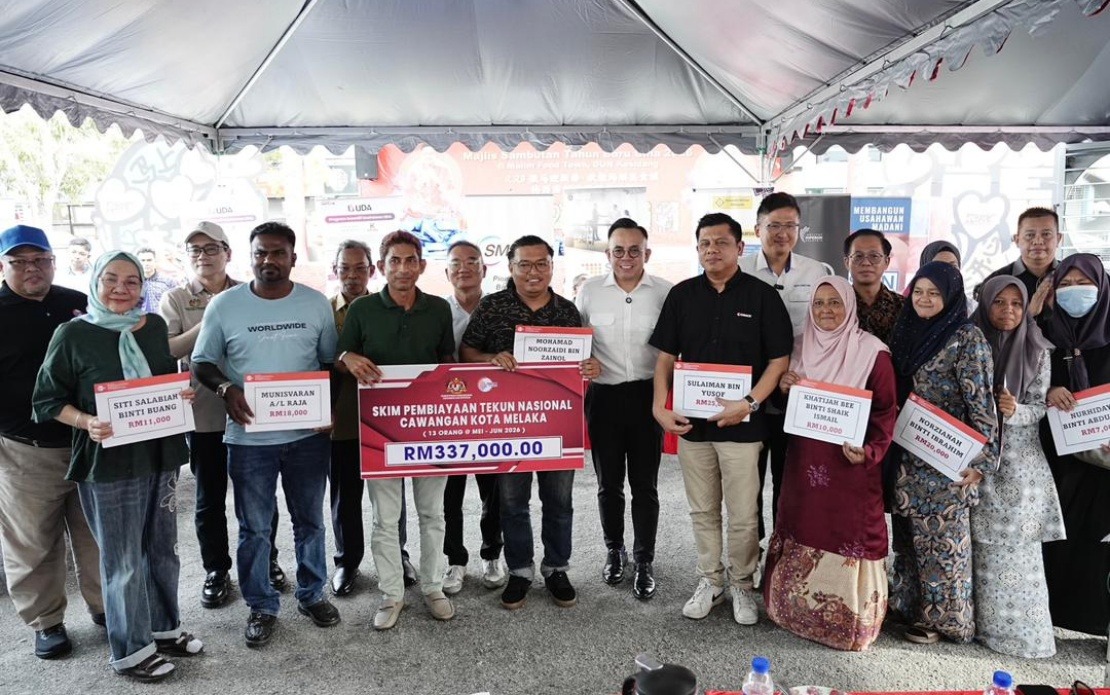
The Ministry of Entrepreneur Development and Cooperatives (KUSKOP) has injected confidence into Melaka's entrepreneurial ecosystem by approving nearly RM100 million in financing commitments to more than 4,300 business owners as of the end of May. This substantial capital injection underscores the federal government's ongoing determination to equip micro, small and medium enterprises (MSMEs) with the financial resources they require to scale operations, expand market reach, and ultimately contribute meaningfully to economic activity at both state and national levels.
According to KUSKOP's statement on the matter, the substantial financing allocation represents far more than a mere bureaucratic exercise in fund disbursement. Instead, it reflects a deliberate policy commitment rooted in the understanding that capital availability remains one of the most critical bottlenecks constraining MSME growth across Malaysia. By directing funds into the hands of entrepreneurs at ground level, the ministry is attempting to create multiplier effects throughout the economy, enabling businesses to hire workers, source materials from suppliers, and generate revenues that cycle back through local and national systems.
Minister Steven Sim has articulated this vision with particular emphasis on the downstream consequences of business financing. Speaking during his recent three-day working visit to Melaka, which culminated in his participation at the Hebatkan Perniagaan Malaysia Carnival (KHPM), Sim stressed that entrepreneurial growth translates into tangible benefits extending well beyond business proprietors themselves. When enterprises expand, they create employment opportunities for workers who might otherwise struggle to find stable income sources. Supply chains strengthen as local businesses procure goods and services from neighbouring firms, fostering interdependencies that solidify community economic networks.
The minister's perspective places particular weight on the circulation of capital within Malaysia's domestic economy. Rather than viewing financing as a one-time transfer of funds from government coffers to individual entrepreneurs, Sim conceptualises the process as initiating continuous economic circulation. Money allocated to business expansion enters wage payments, supplier invoicing, rent obligations, and consumer spending patterns that reverberate through formal and informal sectors alike. This circulation mechanism, he argues, forms the foundation for sustainable economic development that reaches beyond elite corporate layers to benefit ordinary Malaysians in diverse economic strata.
Tangible evidence of KUSKOP's commitment materialised during Sim's walkabout at Malim Food Town, where he presented nearly RM1 million in financing allocations to eighteen selected entrepreneurs through both TEKUN Nasional and SME Corp Malaysia. This public ceremony served dual purposes: acknowledging the diverse sectoral representation among successful applicants while simultaneously signalling government accessibility to aspiring business owners. The recipients represented a spectrum spanning food and beverages, wholesale distribution, professional services, construction contracting, retail operations, online commerce, automotive ventures, and miscellaneous service sectors.
The Melaka achievements occupy a significant position within broader national financing architecture. Across Malaysia's entire landscape, KUSKOP has approved RM5 billion in financing commitments during the first five months of the current year, touching approximately 180,000 entrepreneurs nationwide. These figures assume heightened importance when contextualised against the ministry's ambitious PowerUp10K initiative, which targets RM15 billion in total financing disbursements to MSMEs throughout the current calendar year. Such scaling suggests that current performance trajectories remain on track to meet or exceed departmental objectives.
For Malaysian entrepreneurs specifically and regional MSME ecosystems more broadly, this financing push carries profound implications. Access to formal credit has historically represented a persistent challenge for small business operators, particularly those lacking extensive collateral or established banking relationships. Government-backed financing schemes like KUSKOP's offerings partially bridge this gap by accepting entrepreneurial credibility as collateral proxy, thereby expanding the available capital pool to include operators who might otherwise face systematic exclusion from conventional banking channels. This democratisation of credit access potentially reshapes the demographic composition of Malaysia's business ownership landscape.
Simultaneously, the financing emphasis reflects strategic recognition that MSME vitality constitutes a cornerstone of employment generation and inclusive economic growth. As large multinational corporations increasingly concentrate operations in knowledge-intensive sectors requiring sophisticated technical expertise, MSMEs maintain particular relevance in providing entry-level employment opportunities, developing worker skills through apprenticeship structures, and maintaining economic activity in geographically dispersed communities beyond major urban centres. Strengthening MSME financing capacity thus serves broader national objectives extending far beyond the individual business domain.
Minister Sim has additionally emphasised Malaysia's competitive positioning within regional and global economic hierarchies. The nation's multicultural composition, comprising diverse racial communities, linguistic traditions, and cultural perspectives, generates distinctive advantages in terms of talent availability and market understanding. This diversity equips Malaysian entrepreneurs with innate capabilities for navigating cross-cultural business environments and maintaining operations spanning geographically dispersed markets. Foreign investors, Sim contends, recognise these advantages, rendering Malaysia increasingly attractive as a destination for capital inflows and business establishment. Simultaneously, locally-rooted entrepreneurs possess enhanced capacity to expand operations into neighbouring markets characterised by similar demographic compositions and consumer preferences.
The state-level concentration evident in the Melaka financing case study also reflects deliberate policy decentralisation. Rather than concentrating KUSKOP resources exclusively within major metropolitan centres like Kuala Lumpur and Selangor, the ministry has consciously distributed financing across Malaysia's constituent states. This geographic dispersion strategy acknowledges that entrepreneurial potential exists throughout the nation's administrative subdivisions and that exclusionary resource concentration would squander considerable economic dynamism in peripheral regions. Melaka's receipt of nearly RM100 million thus represents recognition of the state's legitimate claims to development resources and acknowledgment that entrepreneurial energy flourishes beyond Malaysia's most economically dominant zones.
Looking forward, the significance of KUSKOP's financing trajectory extends beyond immediate capital allocation metrics. The creation of pathways enabling entrepreneurs to access substantial funding without onerous collateral requirements potentially catalyses attitudinal shifts among potential business operators who previously perceived enterprise establishment as prohibitively risky or practically impossible. When government institutions demonstrate concrete commitment to supporting small business operators through capital provision, regulatory simplification, and public acknowledgment, broader populations may increasingly view entrepreneurship as a viable livelihood strategy rather than exceptional achievement restricted to privileged minorities. This psychological repositioning, though difficult to quantify, potentially constitutes KUSKOP's most significant long-term contribution to Malaysia's entrepreneurial ecosystem.
The KUSKOP initiative additionally provides policy lessons relevant to other Southeast Asian economies grappling with MSME development challenges. Malaysia's structured approach to financing distribution, combining national frameworks with state-level implementation and sectoral diversity encouragement, offers replicable models for neighbouring nations seeking to strengthen small business foundations. As regional economic integration deepens and competition intensifies for foreign investment capital, the nation's demonstrated commitment to supporting locally-rooted entrepreneurship strengthens its distinctive regional positioning and reinforces claims to inclusive economic development credentials.