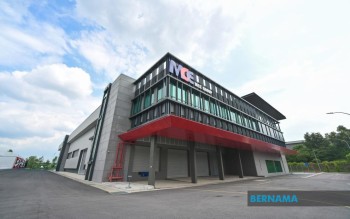
MCE Holdings Bhd has officially opened the MCE Auto Hub, a RM50 million state-of-the-art manufacturing complex in the UMW High Value Manufacturing Park at Serendah in Hulu Selangor, a development that signals confidence in Malaysia's automotive sector and represents the first phase of an ambitious RM200 million long-term expansion strategy. Investment, Trade and Industry Minister Datuk Seri Johari Abdul Ghani officiated the launch, underlining the federal government's support for the venture, which is expected to reshape how the nation approaches high-value automotive component manufacturing.
The facility spans 5.52 hectares and has been designed to function as an Industry 4.0-compliant manufacturing hub, incorporating advanced clean room production areas and tightly controlled environments necessary for producing sophisticated automotive electronics for both conventional internal combustion engine vehicles and the emerging electric vehicle segment. This dual capability positions MCE to capture opportunities across the entire automotive technology spectrum as the industry undergoes its most significant transformation in decades, a critical consideration for Malaysian suppliers aiming to remain competitive as global automakers accelerate electrification.
The MCE Auto Hub represents a strategic pivot for a company that has operated within Malaysia's automotive supply chain for over three decades. Since securing its first contract to supply remote alarm and central locking systems to the domestic market in 1990, MCE has systematically expanded from traditional automotive components into increasingly sophisticated electronics and mechatronic solutions. This evolution reflects the broader shift within Malaysia's tier-1 supplier ecosystem, where companies must continuously upgrade technical capabilities to maintain their position within global automotive supply chains.
According to MCE group managing director Dr Goh Kar Chun, the new facility will more than double the group's existing production capacity while significantly strengthening its engineering, design, research and development operations. The hub will serve as MCE's primary manufacturing and engineering centre, positioning the company to develop and produce high-value automotive electronics for customers across Malaysia, the broader ASEAN region, and international markets including the United States. This geographic diversification of customer base reduces dependence on any single market and provides revenue stability amid fluctuating demand cycles.
The facility's opening coincides with MCE's workforce expansion to 680 employees across its operations in Johor Bahru, Port Klang, and Serendah, with approximately 90 engineers now distributed throughout these locations. This concentration of engineering talent is significant for Malaysia's ambitions to retain higher-value activities within the country rather than having design and development work relocated to lower-cost jurisdictions. The presence of substantial engineering capacity suggests MCE intends to capture opportunities for original design manufacturing and original equipment manufacturing work, which command higher margins and create more skilled employment.
Johari emphasized during the ceremony that the investment demonstrates confidence in both MCE's trajectory and Malaysia's future as an automotive manufacturing destination. He underscored the importance of local suppliers pursuing manufacturing excellence through cultivation of engineering expertise and innovation, a message resonant with government efforts to position Malaysia as a regional technology hub rather than a low-cost assembly location. The minister's presence and rhetoric suggest the federal government views MCE's expansion as aligned with broader economic diversification goals and efforts to strengthen the advanced manufacturing sector.
The MCE Auto Hub's emphasis on supporting both internal combustion engine and electric vehicle production reflects recognition that Malaysia's automotive industry will operate across both technologies for at least the next decade. Rather than prematurely abandoning expertise in conventional vehicle component manufacturing, MCE has structured its capabilities to serve both market segments simultaneously. This pragmatic approach acknowledges that ASEAN countries, including Malaysia, will continue producing and consuming conventional vehicles long after developed markets complete their transition to electrification.
Dr Goh articulated a vision for Malaysia's automotive future built upon stronger collaboration between original equipment manufacturers, tier-1 suppliers, and broader ecosystem participants including semiconductor and electrical and electronics companies. This perspective identifies a critical gap in Malaysia's current automotive value chain: while the country hosts assembly plants for major international brands, the ecosystem of supporting suppliers and technology partners remains underdeveloped compared to established automotive manufacturing hubs. MCE's investment indirectly encourages other local companies to upgrade capabilities and position themselves as potential suppliers to sophisticated automotive manufacturing programmes.
The facility's location within the UMW High Value Manufacturing Park positions MCE alongside other industrial operators focused on advanced manufacturing, creating potential for supply chain integration and knowledge transfer. Such industrial parks can develop network effects where proximity to similar-minded manufacturers and supporting services enhances overall productivity and innovation capacity. For Malaysia's automotive sector, particularly in the Selangor region which houses significant manufacturing concentration, such clustering can reinforce the country's position as a serious automotive manufacturing location.
MCE's expansion also carries implications for Malaysia's localisation agenda within automotive manufacturing. As original equipment manufacturers operating in Malaysia face pressure to increase domestic content in vehicles, they require capable local suppliers capable of delivering sophisticated components. MCE's strengthened capabilities potentially enable greater integration of Malaysian-designed and manufactured components into vehicles produced domestically, reducing reliance on imports and increasing value retained within the country. This supports the government's stated aspiration to deepen Malaysia's position within automotive supply chains rather than remaining confined to low-value assembly roles.
The company's emphasis on serving ASEAN and international markets reflects the reality that Malaysia's domestic automotive market, while significant, cannot absorb the output of major manufacturing facilities. Instead, MCE must position itself within regional automotive networks where it can export components throughout Southeast Asia and potentially supply international original equipment manufacturers with offshore production operations. This outward orientation distinguishes MCE from purely domestic-focused suppliers and suggests ambitions to compete directly with established tier-1 suppliers across multiple markets.
The investment also occurs within a context of evolving regional dynamics in automotive manufacturing. Vietnam and Thailand have emerged as increasingly important automotive production locations, competing with Malaysia for investment and market share. MCE's expansion and capability enhancement represent efforts to ensure Malaysia remains competitive within this intensifying regional competition. The RM50 million initial investment, while substantial, positions MCE as a serious contender within advanced automotive electronics manufacturing, a segment where technological sophistication and engineering talent matter more than low labour costs.
Looking forward, MCE's planned additional RM150 million in future investment suggests sustained commitment to expanding manufacturing footprint and capabilities. This phased approach allows the company to assess market response to the initial facility while maintaining financial flexibility. For Malaysia's automotive sector, MCE's expansion trajectory offers an encouraging signal that domestic companies can successfully compete at higher levels of the automotive value chain, potentially inspiring similar investments from other suppliers and reinforcing Malaysia's positioning as a sophisticated automotive manufacturing destination rather than a declining low-cost assembly location.

