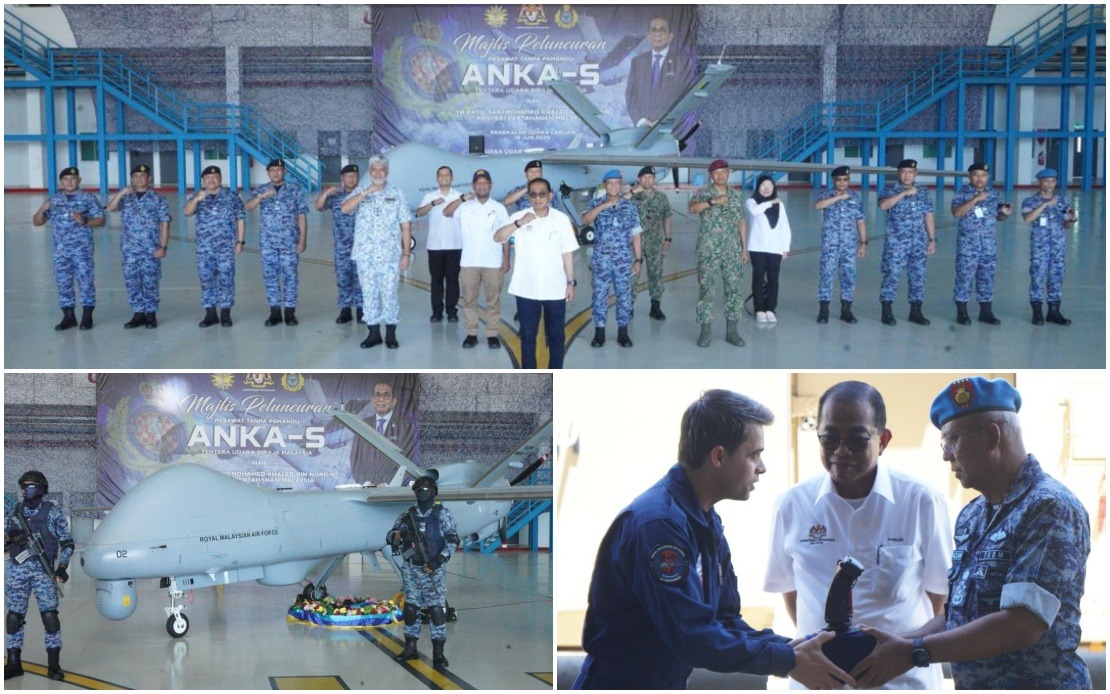
The Royal Malaysian Air Force has formally launched operational deployment of the ANKA-S Unmanned Aircraft System at its Labuan Air Base, marking a substantial upgrade to the nation's ability to monitor vast stretches of the South China Sea and surrounding maritime territory. Defence Minister Datuk Seri Mohamed Khaled Nordin characterised the development as a pivotal moment in Malaysia's defence architecture, providing surveillance coverage that previously did not exist in one of the world's most strategically important and contested waterways.
The three aircraft acquired at a total cost of RM423.8 million represent a significant investment in unmanned technology, with the package including sophisticated ground control stations and two years of specialised personnel training. These medium-altitude long-endurance systems can remain airborne for more than 24 hours and operate at altitudes reaching 30,000 feet, capabilities that translate into extended operational ranges and persistent surveillance across Malaysia's maritime jurisdiction. The positioning of the aircraft at Labuan, strategically located in the centre of Malaysian waters, allows for efficient coverage of critical areas while minimising response times to potential incursions.
The strategic implications of this capability extend beyond simple surveillance. The ANKA-S systems possess sophisticated sensor packages enabling accurate identification and tracking of vessel profiles, a capacity that allows the Royal Malaysian Air Force to move away from inefficient, unfocused patrol patterns toward targeted, intelligence-driven deployment of maritime assets. This represents a maturation of Malaysia's operational approach to maritime security, transforming the nature of surveillance from reactive patrolling to proactive intelligence gathering. The ability to distinguish vessel types and monitor movements in real time provides Malaysian authorities with the granular situational awareness necessary for effective maritime domain management.
Operational efficiency constitutes another significant advantage driving this acquisition. Traditional maritime surveillance relies upon expensive manned fighter aircraft and large patrol vessels, each representing substantial ongoing costs. The ANKA-S drones accomplish comparable surveillance missions at a fraction of the operational expense, reducing fuel consumption and extending the periods between maintenance cycles. This efficiency gain proves particularly valuable given Malaysia's expansive maritime territory and the resource constraints typical of regional defence establishments. The financial savings allow reallocation of defence resources toward other strategic priorities while maintaining or enhancing surveillance effectiveness.
The weather-agnostic operational capacity of these systems ensures consistent maritime monitoring regardless of atmospheric conditions, a critical attribute in Southeast Asia's tropical climate characterised by frequent rain and atmospheric disturbance. This all-weather capability ensures that Malaysia maintains persistent surveillance throughout the year, eliminating gaps that might otherwise occur during monsoon seasons or adverse weather patterns. Such continuous monitoring proves essential in contested waters where understanding adversarial movements demands uninterrupted observation.
Defence Minister Mohamed Khaled deliberately emphasised that Malaysia has chosen not to arm these aircraft, characterising this restraint as a deliberate signal of defensive intent. This decision carries diplomatic significance, distinguishing Malaysia's posture from more aggressive regional actors while underscoring the government's commitment to international law and peaceful resolution of maritime disputes. The unarmed configuration allows Malaysia to conduct intensive surveillance and intelligence gathering without the escalatory implications of weaponised unmanned systems, a nuance that matters considerably in an environment where regional tensions periodically flare. This measured approach demonstrates strategic sophistication beyond mere technological acquisition.
The implications for maritime law enforcement and resource management extend into civilian domains. Enhanced surveillance capabilities support coast guard operations against smuggling, illegal fishing, and human trafficking within Malaysian waters. The detailed vessel identification enables authorities to distinguish legitimate commercial traffic from illicit maritime activity, allowing more targeted interdiction efforts. For a nation with significant maritime commerce passing through its waters, this intelligence advantage translates into enhanced security for vital shipping lanes and improved protection against transnational criminal networks.
The government has signalled intention to acquire three additional ANKA-S aircraft under a second phase, subject to approval through the national development planning framework. This expansion would roughly double Malaysia's unmanned surveillance capacity, extending coverage to previously difficult-to-monitor regions and providing redundancy for maintenance and operational scheduling. Such planned expansion indicates sustained commitment to modernising maritime surveillance infrastructure rather than treating the current deployment as a one-time acquisition.
The launch ceremony, attended by senior military leadership including the Chief of Navy and Chief of Air Force, underscored the institutional significance of this capability. The positioning of unmanned systems alongside traditional naval and air force structures represents an evolution in how Malaysia conceptualises maritime defence. Rather than viewing these systems as replacements for conventional assets, the defence establishment integrates them as complementary capabilities enhancing overall situational awareness. This layered approach to maritime security—combining unmanned surveillance with traditional platforms—creates a more resilient and comprehensive defensive posture.
Regionally, Malaysia's deployment of advanced surveillance systems reflects broader trends among Southeast Asian nations seeking to enhance maritime awareness in contested waters. While other regional actors have pursued similar capabilities, Malaysia's explicit emphasis on defensive positioning and non-weaponised configuration distinguishes its approach. This stance carries implications for regional stability, potentially influencing how neighbouring countries perceive Malaysia's strategic intentions and defence modernisation trajectory. In an environment where misperception and miscalculation pose genuine risks, transparent communication about military capabilities and intentions assumes heightened importance.
The Data Exploitation Centre, visited by Defence Minister Mohamed Khaled during the launch ceremony, represents the analytical dimension of this surveillance enterprise. Raw sensor data proves valueless without interpretation; the centre provides the human expertise and technical infrastructure necessary to convert continuous video and sensor feeds into actionable intelligence. This integration of collection and analysis capabilities ensures that enhanced surveillance translates into improved decision-making and operational effectiveness rather than merely accumulating unprocessed information.
For Malaysia's defence establishment, these systems represent a generational shift toward technology-enabled maritime management. The transition from resource-intensive manned patrols toward persistent unmanned surveillance reflects both technological maturation and strategic necessity. As maritime challenges evolve—encompassing traditional security concerns, transnational crime, and environmental monitoring—surveillance systems capable of sustained operations across vast areas become increasingly central to national security strategy. The ANKA-S deployment positions Malaysia to address these multifaceted maritime challenges more effectively than previously possible.

%22%2F%3E%3C%2Fpattern%3E%3C%2Fdefs%3E%3Crect%20width%3D%22100%25%22%20height%3D%22100%25%22%20fill%3D%22url(%23ph21o2sg)%22%2F%3E%3Crect%20width%3D%22100%25%22%20height%3D%22100%25%22%20fill%3D%22url(%23ph21o2sp)%22%2F%3E%3Ctext%20x%3D%2250%25%22%20y%3D%2250%25%22%20text-anchor%3D%22middle%22%20dominant-baseline%3D%22central%22%20fill%3D%22rgba(255%2C255%2C255%2C0.95)%22%20font-family%3D%22Georgia%2C%20'Times%20New%20Roman'%2C%20serif%22%20font-weight%3D%22700%22%20font-size%3D%22170%22%20letter-spacing%3D%22-0.02em%22%3EGabungan%3C%2Ftext%3E%3C%2Fsvg%3E)