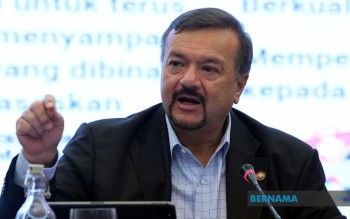
Malaysia's economic performance continues to defy global volatility, with the country maintaining steady expansion even as trade tensions and regional conflicts create turbulence across Asia-Pacific markets. Finance Minister II Datuk Seri Amir Hamzah Azizan highlighted the nation's trajectory during a press conference in Putrajaya, underscoring that Malaysia has preserved its growth momentum through careful policy implementation and strategic investment initiatives. The consistently solid figures suggest that Malaysia's diversified economic base and proactive government measures are insulating the nation from sharper downturns that have affected some neighbouring economies.
The statistical picture painted by the Finance Ministry reveals an accelerating trend. The country achieved 5.2 per cent gross domestic product growth in both 2024 and 2025, before moving into this year with an initial quarterly reading of 5.4 per cent. The second quarter advance estimate climbed to 5.8 per cent, bringing the year-to-date average to 5.6 per cent. This upward trajectory carries particular significance given the external environment. When contrasted with the trade frictions that dominated 2024 and the ongoing West Asian tensions affecting regional commerce, Malaysia's ability to sustain—and even accelerate—expansion demonstrates the effectiveness of policy buffers and structural reforms undertaken in preceding years.
Amir Hamzah attributed much of this resilience to the implementation of the MADANI Economy Framework, a long-term developmental blueprint that has begun delivering measurable results across multiple sectors. The framework's emphasis on inclusive prosperity and sustainable growth appears to be translating into real economic activity, suggesting that the government's strategic direction resonates with market conditions and investor confidence. By tying macroeconomic performance directly to this broader economic philosophy, the Finance Minister provided assurance that Malaysia's growth trajectory reflects not temporary cyclical factors but deep structural improvements in productive capacity.
A cornerstone initiative driving this expansion is the GEAR-uP programme, which the Ministry of Finance has spearheaded since 2024. This investment acceleration scheme mobilises RM120 billion in domestic direct investment across the 2024 to 2028 period, deliberately directing capital into priority sectors and regions. Rather than pursuing growth through external stimulus alone, the programme focuses on catalysing internal dynamism. This approach has particular relevance for Southeast Asian policymakers concerned about capital flight and over-reliance on foreign direct investment. By channelling resources through domestic institutions, Malaysia is building resilience against sudden external shocks.
Government-linked investment companies and government-linked companies play an outsized role in executing this strategy. These entities function not merely as capital allocators but as anchors for entire industrial ecosystems. By providing access to talent networks, facilitating technology transfer, and attracting complementary private investment, GLICs and GLCs create multiplier effects that traditional subsidies cannot replicate. The Finance Minister's emphasis on this institutional architecture reflects a sophisticated understanding that development requires more than cash injections—it demands the coordinated deployment of human capital, technical expertise, and market linkages.
Amir Hamzah explicitly distinguished between simply attracting foreign funds and fostering genuine economic transformation. This distinction carries weight for Malaysian workers and entrepreneurs who have experienced past cycles of investment-led growth that failed to generate proportionate employment or skills advancement. The current approach ostensibly targets value creation throughout the investment chain, ensuring that capital inflows translate into higher wages, better working conditions, and improved living standards. This philosophy underpins the broader MADANI agenda, which emphasises distributional outcomes alongside aggregate expansion.
The geopolitical and trade backdrop makes Malaysia's resilience noteworthy. Trade wars that defined 2024 have not disappeared; if anything, supply chain tensions persist as multinational corporations reassess global sourcing arrangements. Simultaneously, the Middle Eastern conflicts create uncertainty for regional shipping, energy prices, and investor sentiment. Many analysts expected such conditions to dampen Southeast Asian growth significantly. Malaysia's relative outperformance suggests that effective domestic policymaking and strategic sectoral positioning can partially offset these global headwinds, offering a template worth examining by regional peers facing similar pressures.
For Malaysian businesses and workers, the expansion carries practical implications. Faster GDP growth typically translates into greater employment opportunities, higher business profitability, and improved fiscal space for government services. A growth rate approaching 5.6 per cent places Malaysia among the region's stronger performers, particularly given the advanced stage of its economy. Sustaining such expansion as the country develops requires continuous upgrading of skills, infrastructure, and innovation capacity—precisely the objectives embedded in the MADANI framework.
The confidence articulated by the Finance Minister reflects genuine data validation rather than mere optimism. The first quarter and second quarter estimates reveal upward momentum, not deceleration. This pattern suggests that policy interventions implemented earlier are gaining traction, and that businesses and consumers are responding positively to improved conditions. However, external risks remain substantial. Further escalation of trade conflicts, financial market stress elsewhere in the globe, or regional security developments could alter this trajectory swiftly.
Looking forward, Malaysia's positioning as a developed economy depends on translating growth into productivity gains and technological advancement. The GEAR-uP programme's emphasis on attracting know-how alongside capital represents acknowledgment of this requirement. By consciously drawing foreign expertise into the country's investment framework, Malaysia is building institutional capacity to compete in high-value sectors rather than remaining locked in lower-margin manufacturing.
The Finance Minister's expression of confidence regarding Malaysia's trajectory reflected both empirical support and a forward-looking vision. The nation has weathered significant external turbulence without fundamental economic disruption, suggesting institutional resilience. Whether this momentum can be sustained as global conditions evolve remains the central question, but the policy architecture now in place appears deliberately structured to provide flexibility and capacity for adjustment across multiple scenarios.

