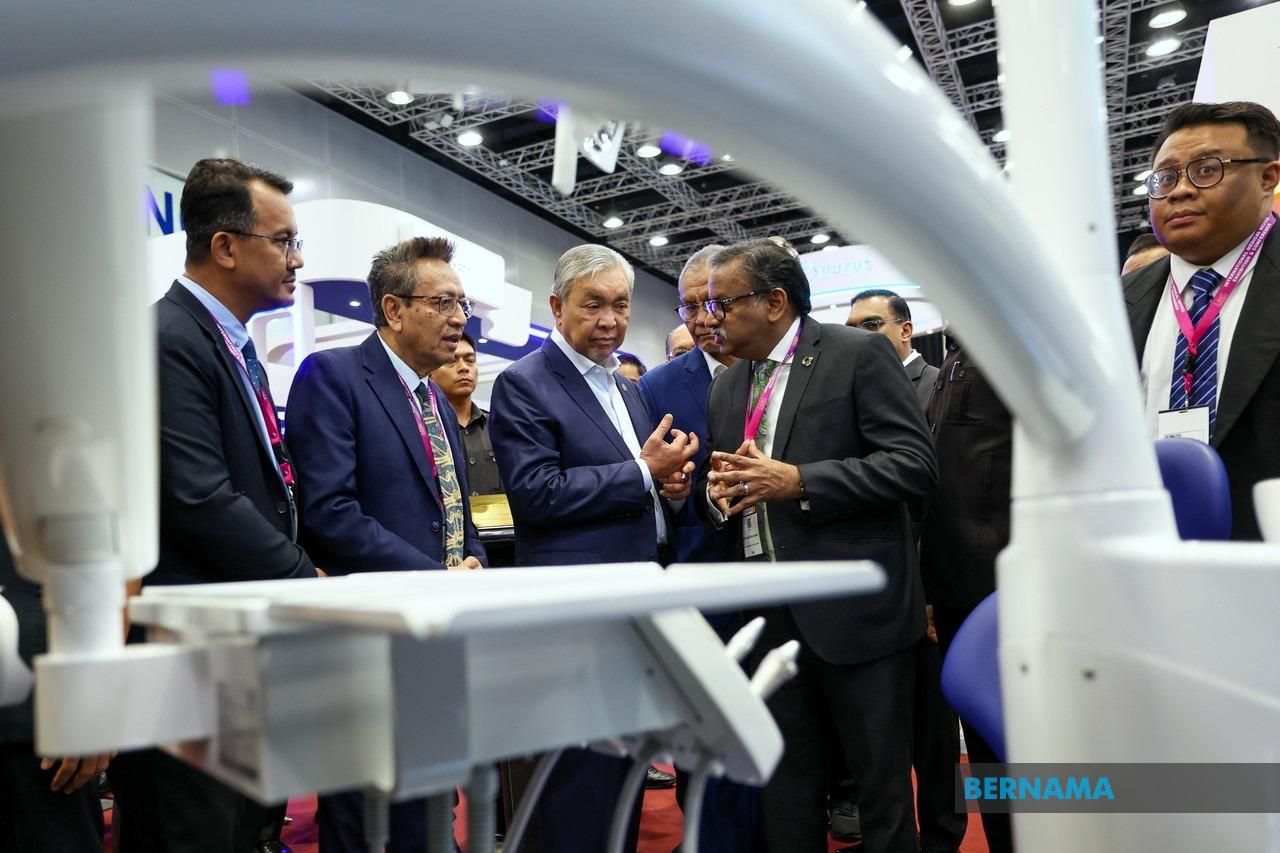
Malaysia has set its sights on nearly doubling medical device exports to exceed RM50 billion by 2030, a significant jump from the RM34.54 billion achieved in the previous year. Deputy Prime Minister Datuk Seri Dr Ahmad Zahid Hamidi articulated this ambitious growth target at the closing ceremony of the International Medical Device Exhibition and Conference (IMDEC) 2026 here, positioning it as part of a three-pronged national agenda to reshape how Malaysia competes in the increasingly lucrative global MedTech landscape.
The export expansion represents more than just numerical growth—it reflects a deliberate pivot toward higher-value manufacturing. Ahmad Zahid emphasized that Malaysia possesses the foundational strengths required for this transition: an established manufacturing ecosystem, preferential market access through regional trade agreements, and accumulated international credibility built over decades of medical device production. Yet he cautioned that the next wave of export acceleration must fundamentally differ from historical patterns by concentrating on sophisticated, premium-priced products rather than commodity-level manufacturing.
Beyond raw export figures, the government has outlined a vision to cultivate at least ten Malaysian MedTech companies with the scale, technological depth, and intellectual property ownership to compete effectively in regional and global markets. This second pillar distinguishes the strategy from mere contract manufacturing or foreign investment absorption. The approach seeks to transition Malaysia from being primarily a production location for multinational corporations to becoming a genuine innovation hub where Malaysian firms conceive, develop, and commercialize medical technologies independently. Such enterprises would retain profits and decision-making authority domestically rather than remitting returns to foreign headquarters.
The third strategic objective addresses a critical structural weakness in Malaysia's industrial development. Currently, only 33.1 per cent of employment in the medical device sector comprises managerial, technical, and supervisory positions—a proportion Ahmad Zahid deemed insufficient for a truly advanced economy. The government aims to ensure that at least half of all new jobs generated by MedTech investments after 2030 occupy these higher-echelon categories. This shift directly challenges the historical pattern where manufacturing facilities create primarily assembly-line and operative-level employment, trapping workers in lower-wage roles regardless of educational attainment.
Ahmad Zahid's comments on talent development strategy signal a philosophical reorientation in how Malaysia engages with foreign investors. Rather than passively accepting whatever workforce requirements companies bring, the government intends to cultivate skills and capabilities proactively through education and vocational training programs. In his capacity as chairman of the National Technical and Vocational Education and Training Council, Ahmad Zahid called on international MedTech corporations to collaborate during the planning and talent-building phases rather than arriving only when immediate labor shortages constrain operations. This approach seeks to embed Malaysian workers more deeply in value-creation processes from inception rather than as afterthought solutions to recruitment challenges.
The strategic importance of these objectives intensifies when contextualized within the global MedTech market's explosive trajectory. The worldwide medical device industry, valued at slightly more than USD572 billion in 2025, is projected to expand beyond USD1 trillion within a decade. This expansion reflects aging populations in developed economies, rising healthcare expenditure in middle-income countries, and accelerating technological innovation in diagnostics, therapeutics, and monitoring devices. Malaysia's positioning within this growth narrative remains crucial—without deliberate policy intervention, the country risks being relegated to low-margin assembly operations while innovation and premium manufacturing concentrate elsewhere.
Recent investment momentum provides a foundation for these ambitions. During 2025, Malaysia approved RM4 billion in fresh medical device sector investments spanning 46 distinct projects, collectively generating approximately 3,400 employment opportunities. While these figures demonstrate ongoing investor confidence, the quality and sustainability of this inflow depends on whether Malaysia can credibly deliver the skilled workforce and technological infrastructure that increasingly sophisticated manufacturers demand. The employment surge, if concentrated overwhelmingly in operative positions without corresponding advancement into technical and managerial roles, would represent hollow growth that enriches investors without proportionally benefiting Malaysian workers or the broader economy.
The IMDEC 2026 conference itself, held from August 26 to 28, assembled more than 160 exhibitors and over fifty regional and international speakers addressing regulation, innovation, and healthcare system transformation. Such forums facilitate knowledge transfer and networking essential for developing homegrown expertise. However, converting conference participation and foreign investment into sustainable competitive advantage requires deliberate institutional action—particularly in aligning educational curricula with industry requirements, establishing intellectual property protections that incentivize local innovation, and creating pathways for Malaysian entrepreneurs to access financing and technology partnerships.
For Malaysia's broader economic strategy, the MedTech sector expansion holds particular significance given regional dynamics. Neighboring economies including Singapore, Thailand, and Vietnam pursue similar objectives, creating intense competition for both investor attention and skilled talent pools. Malaysia's advantages—geographic proximity to Southeast Asian markets, established manufacturing infrastructure, and existing relationships with global supply chains—remain valuable but not immutable. Execution on Ahmad Zahid's three-pillar strategy will determine whether Malaysia can translate these inherent strengths into sustained competitive leadership or gradually loses market position to rivals with more aggressive capability development and innovation incentives.
The emphasis on domestically retained capability represents a notable departure from earlier phases of Malaysia's industrial development, when policymakers often prioritized foreign direct investment volume without commensurate attention to technology transfer or local value creation. This recalibration reflects accumulated learning about how peripheral economies can progress from assembly-based production toward genuinely innovative, high-value manufacturing. Whether Malaysian government agencies, educational institutions, and domestic companies can execute this transition at the required pace and scale remains the critical question determining whether RM50 billion in exports by 2030 becomes reality or remains aspirational rhetoric.

