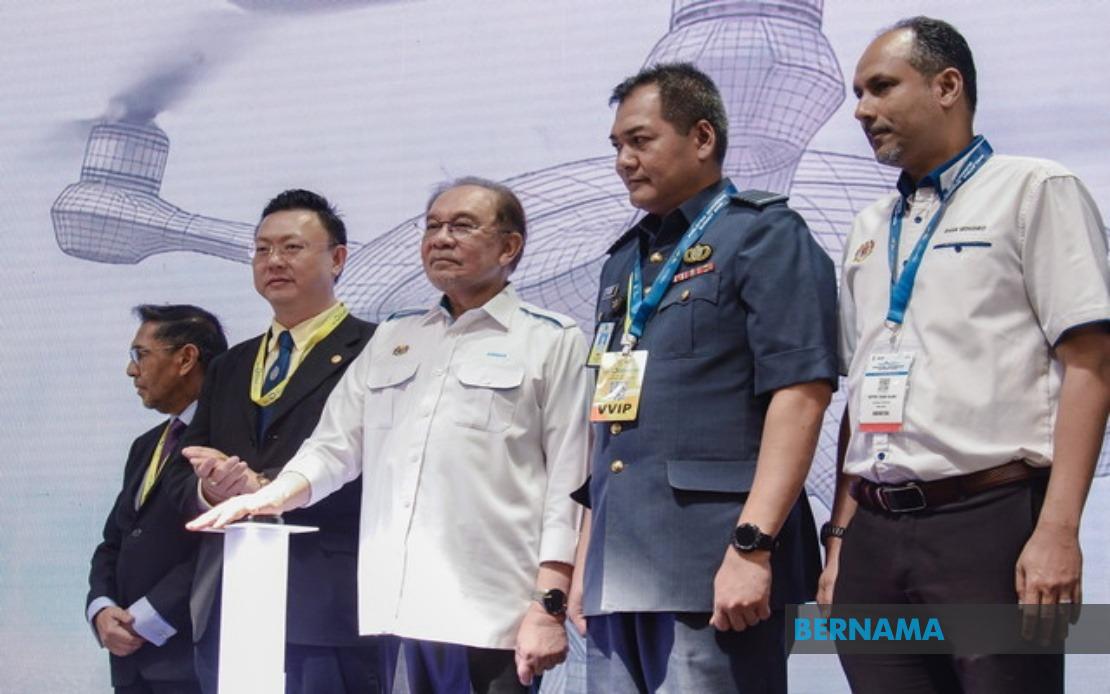
Prime Minister Datuk Seri Anwar Ibrahim has signalled the government's determination to position Malaysia as a regional leader in unmanned aerial vehicle technology, arguing that accelerated development of the drone sector is essential to enhancing the country's competitive standing in the global economy. Speaking at the closing ceremony of the MyDrone Expo 2026 in Sepang on June 27, he underscored the strategic importance of rapidly advancing capabilities across a range of emerging technologies, with particular emphasis on the unmanned systems industry and its interconnection with artificial intelligence and broader digital transformation initiatives.
The Prime Minister characterised the drone sector as more than a standalone industrial opportunity. Rather, he framed it as a convergence point where cutting-edge technologies meet practical application, creating a powerful multiplier effect across productivity gains, innovation cycles and sustained economic expansion. This framing reflects an understanding that Malaysia's future prosperity depends not on individual technological islands but on integrated ecosystems where complementary fields reinforce and accelerate one another. The emphasis on speed is deliberate; in competitive global markets, delayed action can mean permanent loss of market share and talent to faster-moving nations.
Anwar's remarks gain particular weight given the scale of the opportunity at stake. The global unmanned aerial vehicle market is expected to balloon to more than USD55 billion by 2030, representing a compound annual growth rate that dwarfs many traditional industrial sectors. Beyond raw market size, the low-altitude economy—encompassing everything from delivery systems to agricultural monitoring to infrastructure inspection—is increasingly recognised by institutional investors and venture capital as a fundamental driver of competitive advantage in the coming decade. For Malaysia, a country with significant agricultural and logistical sectors, the technology carries immediate practical applications beyond purely defensive economic positioning.
The MyDrone Expo 2026, which drew more than 100 exhibition booths and attracted thousands of participants and industry delegates from 46 countries, demonstrated both the current state of local interest and the scale of international engagement with Malaysia's emerging drone ecosystem. The three-day event exceeded organisational expectations, suggesting genuine momentum within both the local industry and among foreign observers assessing Southeast Asian technology hubs. The breadth of international participation—spanning nearly five dozen nations—indicates that Malaysia is already perceived as a meaningful player in global drone development conversations, even if current capabilities and market share remain modest relative to established players.
To translate opportunity into concrete economic outcomes, Anwar has directed Cabinet ministers, policymakers, research institutions and relevant government agencies to provide comprehensive regulatory and ecosystem support to private and public sector participants in the drone industry. This directive addresses a critical bottleneck that has historically constrained technology adoption in Malaysia: fragmented policy frameworks, inconsistent regulatory implementation and insufficient coordination across government entities. By consolidating support signals and streamlining approval processes, the government aims to reduce friction costs that disproportionately affect smaller firms and startups, which often lack the resources to navigate complex bureaucratic environments.
The government's policy stance extends beyond defensive or military applications of drone technology, emphasising instead civilian and commercial use cases as primary drivers of economic value creation. Agriculture represents a particularly significant opportunity; precision farming enabled by drone-based monitoring and data collection can substantially improve yields and reduce input costs across Malaysia's plantation sector, which remains a cornerstone of rural employment and export earnings. By explicitly endorsing agricultural deployment alongside defence applications, the government signals recognition that economic transformation requires broad-based technological diffusion rather than concentration in security-adjacent sectors.
Critical to realising this vision is systematic improvement across three interconnected dimensions: the regulatory framework governing drone operations, investment in research and development funding, and capacity for independent testing and certification. Each element poses distinct challenges. Regulatory frameworks must balance legitimate safety and security concerns with industry flexibility and international harmonisation, allowing Malaysian operators to compete on equal footing with counterparts in technologically advanced nations. Research funding requires sustained commitment beyond cyclical political priorities, with allocation levels comparable to advanced economies' investment in foundational technologies. Certification capabilities must be developed domestically rather than relying on foreign validation, creating domestic expertise and reducing compliance costs for local firms.
Anwar has also emphasised the necessity of closer collaboration between private sector firms, government research establishments and universities to build a capable talent pipeline. This tripartite model reflects international best practice in technology sector development, particularly in smaller economies lacking the scale to support large private research operations or maintain expensive government laboratories independently. By leveraging comparative advantages—universities' capacity for foundational research, government institutions' continuity and resources, and private firms' innovation speed and market discipline—Malaysia can construct a sustainable talent development system. The reference to existing artificial intelligence and quantum computing faculties suggests these could serve as models for drone technology programmes, indicating that the necessary institutional infrastructure for rapid skill development already exists in nascent form.
The implications of this push extend well beyond the drone industry itself. Malaysia's performance in the unmanned systems sector will serve as a test case for the broader government strategy of technology-led economic transformation. Success would generate momentum and confidence for advancement in other strategic technology domains, while failure could reinforce narratives of Malaysian technological capability limitations. The visibility of the MyDrone Expo and the Prime Minister's personal engagement signals that the government recognises the reputational and competitive stakes involved. Regional competitors, particularly Singapore and increasingly Vietnam and Indonesia, are pursuing parallel strategies in drone development, creating a genuine race for regional technological leadership.
For Malaysian businesses, the policy directive creates both opportunity and urgency. Entrepreneurs and established firms with relevant capabilities face a window in which government support and regulatory clarity are unusually aligned, a confluence that is historically brief and rare in Malaysian policy cycles. However, the same urgency creates pressure to move quickly, invest substantially and accept some downside risk in exchange for first-mover advantages. For investors and talent, the sector is suddenly positioned as a strategic priority rather than a niche opportunity, potentially unlocking capital flows and recruitment possibilities that were previously constrained by uncertainty about government commitment.
The role of international collaboration also warrants attention. The MyDrone Expo's international character and the participation of the World UAV Federation Malaysia Chapter suggest that Malaysia's drone development will be embedded within global networks rather than pursued in isolation. This is advantageous for technology transfer and market access but also means that Malaysian players must compete with well-resourced international firms and must align with international standards and practices. The challenge for policymakers lies in leveraging global expertise and investment while building genuine local capabilities that create lasting competitive advantage rather than merely becoming an assembly or testing location for foreign technology.
Ultimately, Anwar's pronouncements reflect a strategic calculation that unmanned systems represent a unique moment of opportunity for Malaysia. The technology is young enough that no single nation has achieved insurmountable dominance; the applications are diverse enough that multiple business models can succeed simultaneously; and the regulatory environment is still forming, creating space for early movers to shape standards and practices. Whether Malaysia can capitalise effectively on this window depends on whether policy directives translate into sustained funding, regulatory implementation and institutional coordination—a track record that offers reason for cautious optimism but hardly guarantees success.

