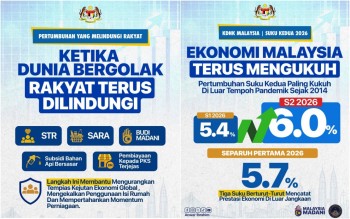
Malaysia's economy delivered a robust performance in the second quarter of 2026, expanding at a six per cent rate that has caught the attention of economists watching the region. The expansion marks the country's most impressive second-quarter outing in over a decade when bracketing out the extraordinary pandemic years, signalling that despite turbulent global conditions, Southeast Asia's third-largest economy remains on a resilient growth trajectory.
Prime Minister Datuk Seri Anwar Ibrahim highlighted the achievement as particularly noteworthy given the headwinds battering the broader international economy. The global landscape has darkened considerably, with supply chain disruptions continuing to ripple through trade corridors and geopolitical tensions in West Asia weighing on sentiment and logistics costs worldwide. That Malaysia could accelerate growth to six per cent under these circumstances underscores the Government's success in insulating domestic demand from external shocks.
The Government's intervention through a suite of welfare programmes has evidently cushioned households from inflationary waves unleashed by regional instability. The BUDI MADANI initiative, complemented by cash transfers under the Sumbangan Tunai Rahmah (STR) scheme and the Sumbangan Asas Rahmah (SARA) framework, has placed money in the pockets of lower-income Malaysians at a crucial moment. These targeted measures have sustained consumer spending, which typically accounts for roughly half of Malaysia's economic activity, preventing the sharp contraction that might otherwise accompany imported price pressures.
Beyond the visible relief programmes announced to fanfare, the MADANI Government has pursued less publicised interventions to stabilise prices and maintain supply availability. Price controls, regulatory oversight of key commodities, and coordination with importers and retailers have worked in tandem with monetary policy to prevent runaway inflation from eroding purchasing power. The cumulative effect is an economy where ordinary Malaysians have retained enough discretionary income to continue driving growth, even as neighbours grapple with stagflation anxieties.
The significance of this performance extends beyond domestic pride. As a small open economy heavily dependent on trade, Malaysia's ability to grow faster than the global average during a slowdown demonstrates the potency of well-calibrated counter-cyclical policy. The result offers a measured counterpoint to pessimism that developing economies must suffer when advanced economies falter. For investors and policymakers across Southeast Asia, the Malaysian example suggests that active, targeted government support—neither laissez-faire nor heavy-handed—can maintain growth momentum when external conditions deteriorate.
Yet Anwar's measured tone in announcing the figures suggests awareness that one quarter of strong growth does not guarantee sustained momentum. The Government has explicitly flagged that maintaining this pace requires continued vigilance and deeper reforms than revenue transfers alone can achieve. The Prime Minister acknowledged that truly shared prosperity demands more than cyclical support; it demands structural improvements in the quality of employment opportunities and earning potential for ordinary Malaysians.
The growth acceleration comes at a time when Malaysia faces mounting pressure to transition its economy toward higher-value sectors and productivity-led expansion. Simply sustaining six per cent growth through transfer payments is neither fiscally sustainable nor sufficient to achieve the country's ambitions of elevated living standards. The Government recognises that building on this quarter's achievement requires attracting investment into manufacturing, green technology, and digital services sectors that can offer well-remunerated positions and career progression for younger workers entering the labour market.
The challenge ahead involves threading a needle between immediate relief and long-term competitiveness. While household welfare measures have proven effective in maintaining demand during a global downturn, they cannot substitute for an economy that generates more high-skilled, high-wage employment at scale. The MADANI administration has committed itself rhetorically to this path of deeper reform, though the specifics of how the Government plans to accelerate productive investment and skill development remain to be fully detailed.
Regional observers will be tracking whether Malaysia can sustain six per cent growth into subsequent quarters or whether this performance proves cyclical, dependent on temporary advantages that erode as global conditions shift. Other Southeast Asian economies, particularly Thailand and Vietnam, will scrutinise whether Malaysia's policy mix offers lessons applicable to their own circumstances. The region's growth trajectory remains crucial to global economic rebalancing, especially as advanced economies navigate their own slowdowns and policy uncertainty.
The Prime Minister's invocation of reform and continued commitment to improving foundations suggests the Government views this quarter as confirmation of strategy rather than destination. By Anwar's articulation, the task now is scaling welfare state effectiveness while simultaneously engineering the structural shifts that can support rising incomes beyond what transfers alone accomplish. Whether the MADANI Government's vision translates into sustained prosperity will become clearer as economic data accumulates through the remainder of 2026.

