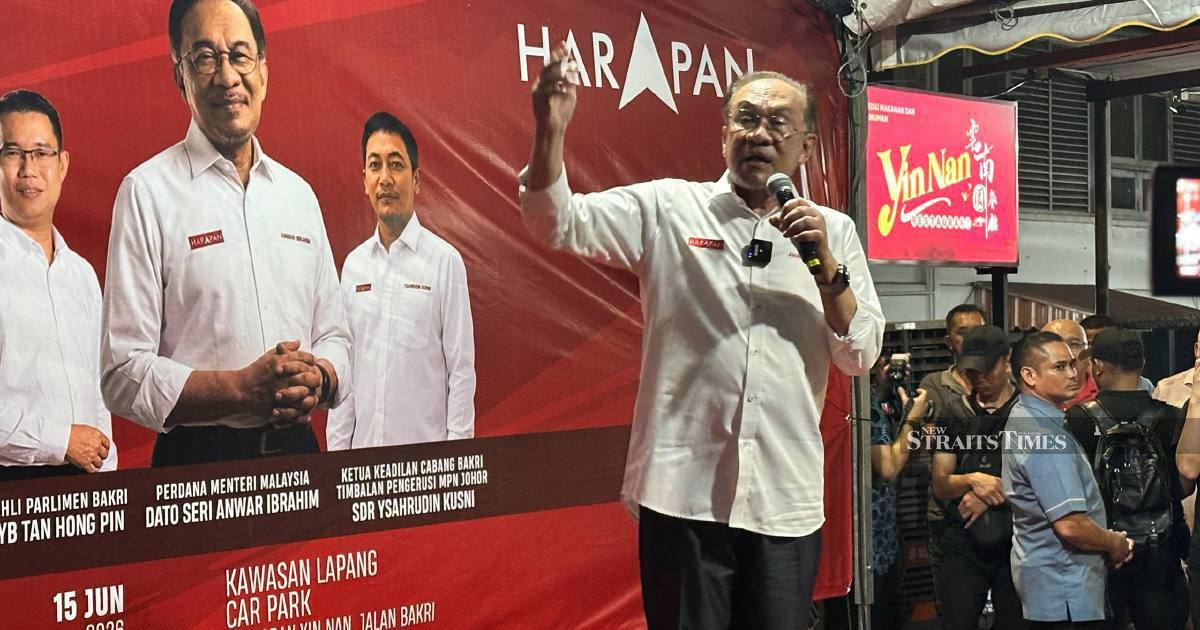
Prime Minister Datuk Seri Anwar Ibrahim has firmly dismissed concerns that Malaysia's pursuit of robust diplomatic relations with leading global powers—particularly China and the United States—inevitably leads to a dilution of the country's national values and principles. Speaking in Muar, Anwar stressed that engaging with major economic and political actors on the world stage does not automatically translate into compromising Malaysia's independent foreign policy or its commitment to international norms.
The Prime Minister's remarks address a recurring debate in Malaysian foreign policy circles regarding the balance between pragmatic engagement with superpowers and the preservation of national autonomy. This tension has become increasingly relevant as Malaysia navigates a multipolar regional environment where both Beijing and Washington maintain significant economic and strategic interests. Anwar's statement suggests the government believes these relationships can be mutually beneficial without requiring Malaysia to abandon its foundational commitments to national interests.
Malaysia's geopolitical position in Southeast Asia has historically depended on its ability to maintain equidistant relationships with competing powers while avoiding alignment that might compromise sovereignty. The country's membership in regional organisations, its role as a voice for developing nations, and its participation in international forums all reflect a carefully calibrated approach to global engagement. Anwar's comments indicate the government views this balancing act not as a contradiction but as a sophisticated expression of national diplomacy.
The question of maintaining principled foreign policy whilst strengthening ties with major powers carries particular weight for Malaysia given its diverse population, its role as a bridge between civilisations, and its commitment to causes such as Palestinian rights and advocacy for developing nations. These positions have sometimes appeared at tension with economic interests or relationships with key partners, creating expectations among certain segments of Malaysian society that engagement must carry moral and political costs.
Anwar's position suggests the government believes it is possible to expand commercial partnerships, deepen security cooperation, and increase people-to-people exchanges with both China and the United States without these relationships dictating Malaysia's votes in international bodies, its humanitarian stances, or its regional leadership role. This perspective reflects a view of modern statecraft where nations can maintain multiple partnerships that may occasionally conflict without necessarily being forced to choose absolute allegiance.
The timing of Anwar's statement comes as Malaysia continues to navigate complex trade relationships, regional security concerns, and development partnerships with both Eastern and Western powers. China represents Malaysia's largest trading partner and a major source of foreign direct investment, whilst the United States remains strategically important through defence agreements and technological partnerships. Managing these relationships whilst maintaining positions on issues like Myanmar, the Middle East, and climate change requires considerable diplomatic finesse.
Malaysia's experience reflects broader Southeast Asian challenges in maintaining strategic autonomy amidst great power competition. The region has emerged as crucial to both American and Chinese strategic interests, creating pressures on individual nations to align more firmly with one camp or the other. Anwar's articulation of Malaysia's position—that engagement need not mean subordination—addresses concerns that smaller nations face an inevitable binary choice in a divided world.
The principle that strong relationships with major powers can coexist with independent foreign policy rests on several practical foundations. Economic interdependence creates mutual incentives for stability and cooperation rather than coercion; neither China nor the United States can force Malaysia to abandon core interests without risking their own significant investments and relationships. Additionally, Malaysia's regional importance and its role as a moderate Muslim-majority nation give it leverage in international negotiations that extends beyond its raw economic or military power.
Implementing this balance requires consistent messaging, transparent diplomacy, and the credibility to demonstrate that Malaysia will not be pressured into positions it has not independently chosen. Anwar's articulation serves to reassure both domestic audiences concerned about foreign influence and international partners that Malaysia remains a reliable, principled actor even as it deepens partnerships with multiple powers. This approach distinguishes between transactional relationships—where one party demands allegiance—and strategic partnerships based on mutual respect and shared interests.
For Malaysian policymakers, the challenge lies not merely in maintaining rhetorical consistency but in ensuring that actions across various international forums, trade negotiations, and diplomatic initiatives align with stated principles. Public positions on issues ranging from human rights to regional disputes must reflect genuine commitments rather than being shaped solely by pressure from larger partners. Anwar's comments effectively frame this ongoing negotiation as both achievable and essential to Malaysia's role in the international system.
The implications of Malaysia's approach extend throughout Southeast Asia, where other nations similarly navigate relationships with multiple power centres. If Malaysia can demonstrate that maintaining principled foreign policy is compatible with deepening ties with both China and the United States, it provides a model for regional peers facing similar pressures. Conversely, any perception that Malaysian positions are being dictated by external powers would undermine both the country's regional credibility and its ability to advance shared Southeast Asian interests.

%22%2F%3E%3C%2Fpattern%3E%3C%2Fdefs%3E%3Crect%20width%3D%22100%25%22%20height%3D%22100%25%22%20fill%3D%22url(%23ph21o2sg)%22%2F%3E%3Crect%20width%3D%22100%25%22%20height%3D%22100%25%22%20fill%3D%22url(%23ph21o2sp)%22%2F%3E%3Ctext%20x%3D%2250%25%22%20y%3D%2250%25%22%20text-anchor%3D%22middle%22%20dominant-baseline%3D%22central%22%20fill%3D%22rgba(255%2C255%2C255%2C0.95)%22%20font-family%3D%22Georgia%2C%20'Times%20New%20Roman'%2C%20serif%22%20font-weight%3D%22700%22%20font-size%3D%22170%22%20letter-spacing%3D%22-0.02em%22%3EGabungan%3C%2Ftext%3E%3C%2Fsvg%3E)