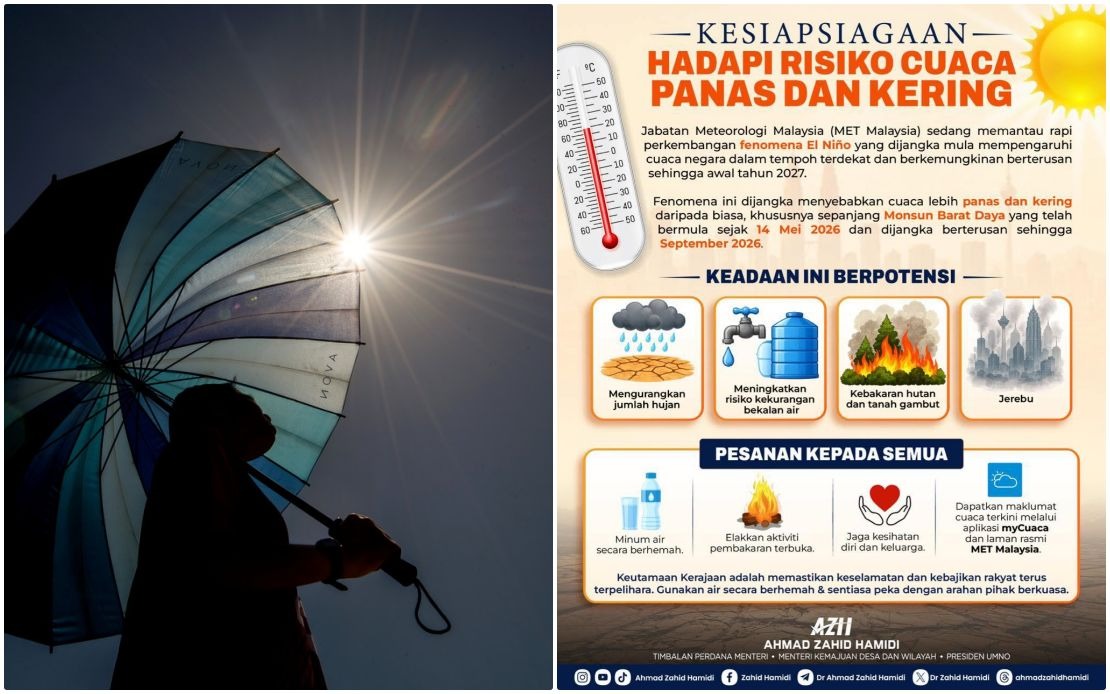
The Malaysian government has sounded an alarm about intensifying weather patterns linked to the El Niño phenomenon, with Deputy Prime Minister Datuk Seri Dr Ahmad Zahid Hamidi cautioning the nation to brace for significantly warmer and drier conditions that could extend well into 2027. In his capacity as chairman of the Central Disaster Management Committee, Ahmad Zahid outlined the potential cascade of challenges that El Niño-driven weather could unleash across the archipelago during the coming months and years.
The onset of El Niño is expected to coincide with and potentially amplify the effects of the Southwest Monsoon, which commenced on May 14 and will continue through September. This convergence of natural weather patterns creates a compounded risk scenario that authorities say requires heightened public awareness and proactive household measures. The phenomenon's signature characteristics—suppressed rainfall and elevated temperatures—could aggravate existing vulnerabilities in water supply systems, agricultural productivity, and natural fire management across the country.
Ahmad Zahid articulated a multifaceted threat landscape stemming from prolonged dry conditions. Beyond the obvious discomfort of sustained heat, the more pressing concerns centre on potential water scarcity affecting both urban and rural populations, as well as the heightened combustibility of forests and peatlands. Such conditions historically precede episodes of transboundary haze that afflict not only Malaysia but neighbouring countries across Southeast Asia, disrupting air quality, commerce, and public health.
In his public advisory, the Deputy Prime Minister issued a series of practical recommendations calibrated for ordinary Malaysians. He called for judicious water consumption patterns, deliberate avoidance of open burning practices, and heightened attention to the health requirements of vulnerable demographic groups—the elderly, children, and those with pre-existing respiratory or cardiovascular conditions. These directives represent an effort to distribute responsibility for risk mitigation across government and civil society rather than positioning the challenge as solely a state problem.
The myCuaca application and the Malaysian Meteorological Department (MetMalaysia) have been designated as authoritative information sources for real-time weather intelligence. Ahmad Zahid's promotion of these digital and institutional channels reflects the government's expectation that informed citizens—equipped with timely forecasts and guidance—can make better decisions about daily activities, travel, and resource management. This information-centric approach assumes that public behaviour will adapt appropriately once citizens understand the severity and duration of anticipated conditions.
Dr Mohd Hisham Mohd Anip, MetMalaysia's director-general, corroborated the warning in a formal statement, affirming that temperature and moisture patterns will diverge measurably from seasonal norms during the Southwest Monsoon phase. The meteorological establishment's assessment carries scientific weight, having conducted atmospheric monitoring and climate modelling to forecast the trajectory of oceanic and atmospheric interactions driving El Niño dynamics.
The declared time horizon—extending to early 2027—signals an expectation of sustained climatic stress over an unusually prolonged interval. Such extended dry spells have historically tested Malaysia's water infrastructure, particularly in states where population density strains existing reservoirs and treatment facilities. The prospect of back-to-back dry seasons without significant relief periods could necessitate emergency water rationing, industrial curtailment, and agricultural adaptations that carry economic ramifications extending beyond immediate household inconvenience.
For Malaysia, an equatorial nation accustomed to abundant precipitation, El Niño episodes represent a significant departure from climatological norms. The country's ecosystems and engineered systems—dams, irrigation networks, coastal aquifers—have evolved under regimes of consistent moisture availability. A multi-year phase of relative aridity could stress these systems and reveal infrastructural vulnerabilities that planning authorities and utilities must urgently address through demand management and supply augmentation strategies.
The emphasis on "early preparations and responsible action by all parties" in Ahmad Zahid's statement acknowledges that climate resilience requires coordination across government agencies, private enterprises, and households. Water utilities must optimize distribution networks and consider alternative sources; agricultural authorities must facilitate crop selection adjustments; disaster management agencies must stockpile firefighting resources; and ordinary citizens must internalize conservation disciplines that may feel counterintuitive in a nation where water scarcity is not a frequent lived experience.
The timing of this advisory—issued during the early stages of the anticipated phenomenon—creates a window for preventive measures before acute scarcity or crisis scenarios materialise. Governments in Southeast Asia have observed that early, transparent communication about climate hazards can mobilise public cooperation more effectively than crisis declarations issued when conditions have already deteriorated. Malaysia's articulation of the El Niño threat represents an attempt to convert meteorological forecasts into behavioural and policy shifts before acute problems demand reactive and costly interventions.
The broader regional context merits consideration as well. El Niño effects are pan-regional phenomena, affecting Thailand, Indonesia, the Philippines, and Vietnam with varying intensity. Malaysia's proactive posture on the issue positions it among more forward-leaning governments in Southeast Asia regarding climate communication, though implementation of water conservation and fire prevention measures will ultimately determine whether the advisory translates into meaningful risk reduction or remains primarily symbolic.
Looking ahead, the coming months will test whether Malaysian households, industries, and agricultural sectors can operationalise the guidance provided by Ahmad Zahid and MetMalaysia. The success of climate adaptation hinges not merely on technical forecasting or policy pronouncements, but on the cultural and behavioural shifts that allow societies to live more sustainably within the hydrological constraints imposed by natural climate variability. Malaysia's El Niño experience through 2027 may ultimately serve as a catalyst for more systemic approaches to water security and environmental resilience across the nation.

%22%2F%3E%3C%2Fpattern%3E%3C%2Fdefs%3E%3Crect%20width%3D%22100%25%22%20height%3D%22100%25%22%20fill%3D%22url(%23ph21o2sg)%22%2F%3E%3Crect%20width%3D%22100%25%22%20height%3D%22100%25%22%20fill%3D%22url(%23ph21o2sp)%22%2F%3E%3Ctext%20x%3D%2250%25%22%20y%3D%2250%25%22%20text-anchor%3D%22middle%22%20dominant-baseline%3D%22central%22%20fill%3D%22rgba(255%2C255%2C255%2C0.95)%22%20font-family%3D%22Georgia%2C%20'Times%20New%20Roman'%2C%20serif%22%20font-weight%3D%22700%22%20font-size%3D%22170%22%20letter-spacing%3D%22-0.02em%22%3EGabungan%3C%2Ftext%3E%3C%2Fsvg%3E)