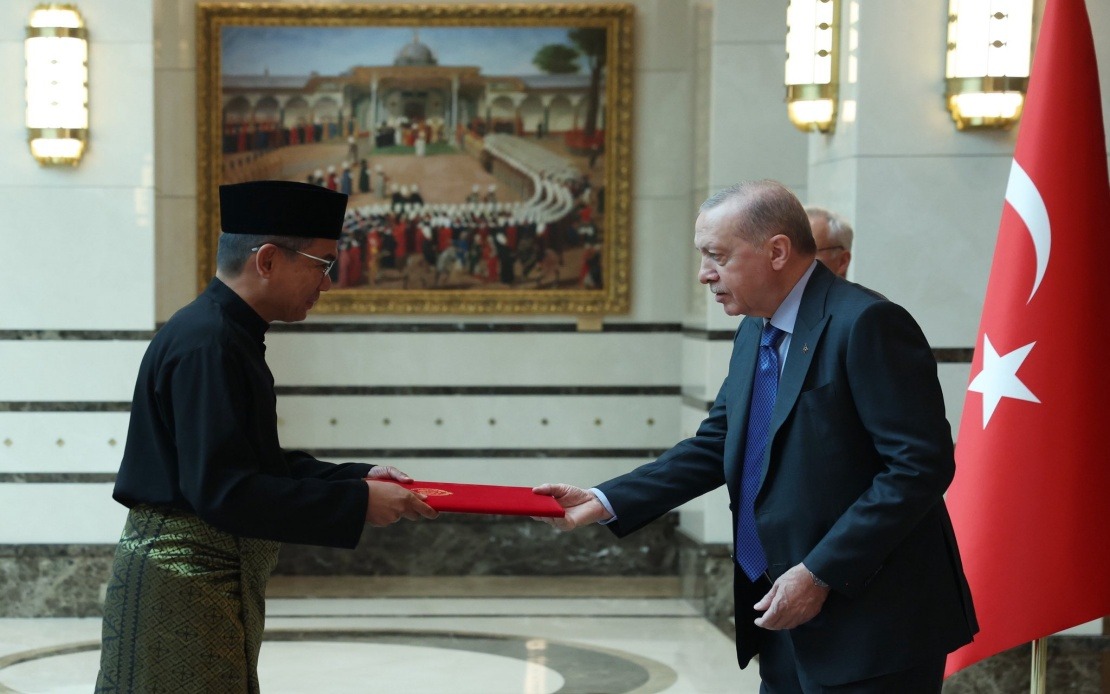
Malaysia has formally endorsed Türkiye's ambition to secure ASEAN Dialogue Partner status, signalling Kuala Lumpur's confidence in deepening ties with the transcontinental power. The endorsement came during credentials ceremonies at the Presidential Complex in Ankara on June 17, when newly appointed Malaysian Ambassador Adlan Mohd Shaffieq presented his letter of credence to Turkish President Recep Tayyip Erdoğan.
In articulating Malaysia's position, Ambassador Shaffieq underscored that Türkiye has evolved into a significant stakeholder for the Southeast Asian region. Beyond traditional diplomatic courtesies, his remarks reflected a substantive assessment of Turkish engagement patterns across ASEAN capitals. The ambassador specifically highlighted three dimensions of this partnership: accelerating commercial activity, a coherent strategic vision aligned with regional interests, and expanding grassroots connections among ASEAN populations and Turkish society.
The timing of Malaysia's explicit support carries particular weight within ASEAN's consensus-driven institutional framework. As one of the bloc's founding members and a consistent voice for regional integration, Malaysia's endorsement carries influence over other member states' positions on dialogue partnership applications. Dialogue Partner status, while not conferring decision-making authority, provides frameworks for structured engagement on transnational challenges and facilitates participation in various ASEAN-led mechanisms and forums.
Ambassador Shaffieq conveyed warm sentiments from Malaysia's highest offices, delivering personal greetings and best wishes from His Majesty Sultan Ibrahim and Prime Minister Datuk Seri Anwar Ibrahim to President Erdoğan. This ceremonial dimension underscores the political importance both nations attach to their bilateral relationship. The personal rapport between Anwar and Erdoğan has emerged as a cornerstone of Malaysia-Türkiye relations, creating momentum for institutional deepening across multiple domains.
The ambassador outlined concrete areas where Malaysia and Türkiye have established cooperative foundations. Education represents a significant pillar, with growing numbers of Malaysian students pursuing tertiary studies in Turkish institutions and vice versa. Defence and security cooperation has expanded through military exchanges, joint training initiatives, and procurement discussions. Notably, the halal industry has become an increasingly important nexus of bilateral commerce, with Türkiye positioning itself as a major supplier of halal-certified products to Malaysian and regional markets, reflecting broader positioning in the global Islamic economy.
Malaysia's characterisation of the relationship as built upon "mutual trust, respect, and a common aspiration for peace, prosperity, and development" reflects broader strategic alignment. Both nations share concerns about regional stability, maritime security, and equitable economic development. Additionally, as Muslim-majority countries with secular constitutional frameworks, Malaysia and Türkiye navigate comparable domestic political complexities and share interests in moderate interpretations of Islam within governance structures.
The ambassador emphasised that deepening collaboration should leverage the personal understanding between Anwar and Erdoğan. This explicit reference to leader-level chemistry suggests Malaysia intends to capitalise on executive-level goodwill to unlock accelerated progress on pending initiatives. Such leadership-driven approaches often circumvent bureaucratic obstacles and signal higher-order political commitment to institutional stakeholders.
President Erdoğan's response during the ceremony demonstrated reciprocal enthusiasm for bilateral advancement. His expression of confidence regarding trade expansion, coupled with articulation of a US$10 billion bilateral trade target, indicates ambitious growth projections. Current trade volumes remain substantially below this threshold, suggesting both nations view the target as an aspirational but achievable benchmark that would require coordinated investment promotion and supply-chain integration efforts.
For Malaysia specifically, supporting Türkiye's dialogue partnership application serves multiple strategic interests. It positions Kuala Lumpur as a trusted facilitator of ASEAN engagement with emerging powers, enhances Malaysia's diplomatic influence within ASEAN councils, and reinforces its credentials as a bridge between the Muslim world and Southeast Asian regionalism. Dialogue partnership status would create institutional channels through which Malaysia and other ASEAN members could engage Türkiye on issues ranging from trade rule harmonisation to security cooperation in contested maritime zones.
Türkiye's broader engagement with Southeast Asia reflects its strategic reorientation toward the Indo-Pacific region. Turkish policymakers increasingly view ASEAN as a critical partner in a multipolar international order, and dialogue partnership status would formalise this relationship within ASEAN's institutional architecture. The status would grant Türkiye participation rights in various ASEAN forums, from the ASEAN Regional Forum to the East Asia Summit dialogue partner sessions, multiplying avenues for Turkish representation in regional deliberations.
The implicit multilateral dimensions of this bilateral endorsement merit consideration. Malaysia's public support may influence other ASEAN member states' positions, potentially expediting consensus around Türkiye's application within ASEAN mechanisms. Indonesia, as ASEAN's largest economy and current or recent chair, holds particular sway, and Malaysia's backing could catalyse broader acceptance among smaller economies that often follow larger members' leads on dialogue partnership questions.
Looking forward, bilateral relations appear poised for intensification across economic, security, and people-to-people dimensions. The US$10 billion trade target, if achieved, would position Türkiye among Malaysia's top trading partners and would necessitate substantial increases in bilateral investment, particularly in manufacturing, processing, and technology sectors. Defence cooperation initiatives may expand to include more sophisticated platforms and knowledge transfer arrangements, while educational exchanges could institutionalise through twinning programmes between Malaysian and Turkish universities.

%22%2F%3E%3C%2Fpattern%3E%3C%2Fdefs%3E%3Crect%20width%3D%22100%25%22%20height%3D%22100%25%22%20fill%3D%22url(%23ph21o2sg)%22%2F%3E%3Crect%20width%3D%22100%25%22%20height%3D%22100%25%22%20fill%3D%22url(%23ph21o2sp)%22%2F%3E%3Ctext%20x%3D%2250%25%22%20y%3D%2250%25%22%20text-anchor%3D%22middle%22%20dominant-baseline%3D%22central%22%20fill%3D%22rgba(255%2C255%2C255%2C0.95)%22%20font-family%3D%22Georgia%2C%20'Times%20New%20Roman'%2C%20serif%22%20font-weight%3D%22700%22%20font-size%3D%22170%22%20letter-spacing%3D%22-0.02em%22%3EGabungan%3C%2Ftext%3E%3C%2Fsvg%3E)