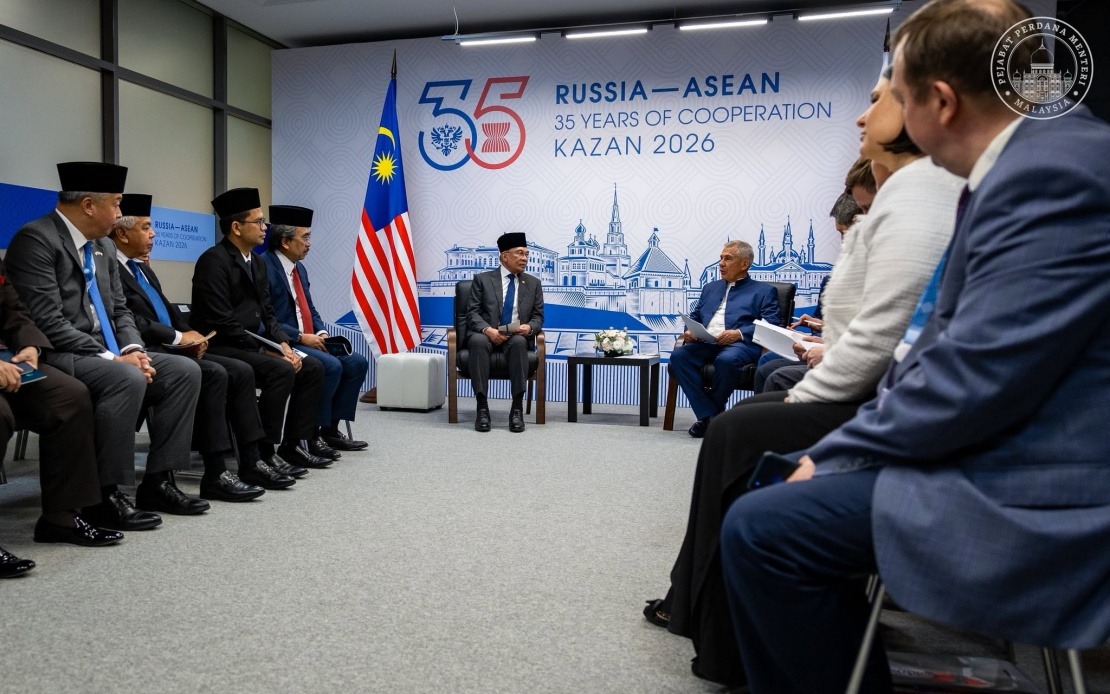
Prime Minister Datuk Seri Anwar Ibrahim has signalled Malaysia's readiness to substantially broaden its partnership with the Republic of Tatarstan, identifying multiple sectors where both sides stand to gain mutual benefit. The announcement came after Anwar held formal discussions with Rais Rustam Minnikhanov, the head of Russia's oil-rich republic, following his arrival in Kazan on Tuesday evening for a two-day working visit that includes participation in the ASEAN-Russia Commemorative Summit.
The bilateral encounter yielded a comprehensive agenda spanning traditional economic areas alongside emerging technological and cultural domains. Trade and investment featured prominently in discussions, alongside education, tourism development, and the halal industry—sectors where Malaysia has developed considerable expertise that could prove valuable to the Tatarstan region. The inclusion of technology and human resource development reflects both governments' recognition that regional partnerships must extend beyond conventional commerce to encompass innovation ecosystems and knowledge transfer initiatives. These conversations underscore a broader strategic intent to position Malaysia as a bridge between Southeast Asian dynamism and Russian economic interests.
The energy sector commanded particular attention during the meeting, a natural focus given Tatarstan's significance as one of Russia's premier oil-producing territories. Anwar and Minnikhanov specifically explored opportunities within the oil and gas complex, including downstream activities, refining operations, and petrochemical manufacturing. For Malaysia, which maintains substantial refineries and petrochemical facilities, this discussion holds tangible commercial potential. Regional energy security considerations in Southeast Asia have elevated the strategic importance of diversified energy partnerships beyond traditional suppliers, making Russian engagement strategically relevant despite geographical distance.
Beyond resource sectors, the leaders discussed the prospective role of the Kazan Forum in cultivating business linkages between their respective economies. This venue was positioned as instrumental for identifying opportunities within innovation clusters, digital economy development, and strategic investment partnerships. Such forums serve as crucial networking platforms where enterprises can identify complementary capabilities and establish frameworks for collaboration. For Malaysian companies seeking to access Russian and Central Asian markets, such institutionalised dialogue mechanisms reduce transaction costs and information asymmetries that traditionally impede cross-border business formation.
Anwar emphasised the cultural and religious dimensions of the bilateral relationship, extending congratulations to Kazan on its designation as Islamic World Cultural Capital 2026 by the Islamic World Educational, Scientific and Cultural Organisation. This recognition reflects Kazan's historical and contemporary significance as a centre of Islamic scholarly pursuit, cultural preservation, and innovative thinking within the Islamic world. For Malaysia, which positions itself as a global Islamic hub spanning commerce, finance, and culture, such parallels create natural platforms for intellectual and cultural exchange that can complement conventional economic cooperation. The city's multi-ethnic composition and historical role as a cradle of Islamic-Russian cultural synthesis offers distinctive opportunities for Malaysian cultural and educational institutions.
Anwar also acknowledged President Vladimir Putin's establishment of the Strategic Vision Group, characterising this institutional framework as a vital conduit for strengthening Russia's dialogue with the Islamic world. This assessment reflects Malaysia's broader diplomatic strategy of engaging major powers through structured mechanisms that institutionalise dialogue and reduce the likelihood of miscommunication. The existence of such formal institutional architecture facilitates sustained engagement regardless of short-term political fluctuations, creating stable foundations for long-term cooperation.
The Prime Minister's delegation included substantial ministerial representation, with Investment, Trade and Industry Minister Datuk Seri Johari Abdul Ghani and Economy Minister Akmal Nasrullah Mohd Nasir accompanying him to Kazan. This composition signals serious government commitment to advancing concrete commercial initiatives rather than merely ceremonial engagement. The presence of senior trade and investment officials alongside diplomatic staff indicates that discussions translated directly into actionable policy frameworks capable of generating tangible outcomes for Malaysian enterprises seeking Russian market access.
The ASEAN-Russia Commemorative Summit represents the highest-level engagement forum between the regional organisation and Moscow, embodying a relationship trajectory that has strengthened considerably since initial dialogue began in 1991. Russia's elevation from dialogue partner status in 1996 to full Strategic Partnership in 2018 reflects mutual recognition of expanding common interests across political-security, economic, and socio-cultural dimensions. For Malaysia, participating in such summits reinforces ASEAN's collective positioning as a strategic region whose alignment multiple major powers actively pursue, enhancing the bloc's diplomatic leverage.
Kazan itself provides symbolic resonance for Malaysia's engagement strategy with Russia. Situated approximately 800 kilometres east of Moscow at the confluence of the Volga and Kazanka rivers, the city commands a population of roughly 1.3 million and occupies a distinctive position as Russia's cultural third capital following Moscow and Saint Petersburg. Its millennium-spanning history and recognised status as an invaluable centre of Islamic cultural heritage and practice creates natural affinity with Malaysia's self-conception. The city's Tatar Muslim population and institutional infrastructure supporting Islamic studies and cultural work provide authentic counterparts for Malaysian organisations seeking to develop academic and cultural programming within Russian contexts.
The timing and substance of these discussions merit consideration within broader geopolitical contexts affecting Southeast Asian trade and security calculations. Malaysia's historical non-aligned positioning has evolved to encompass sophisticated multi-vector engagement with major powers, including Russia, despite Western sanctions regimes affecting Moscow. Developing substantive economic partnerships with Tatarstan and Russia more broadly diversifies Malaysian trade exposure and reduces dependence on traditional Western and Chinese markets, contributing to broader regional resilience. The emphasis on energy sector cooperation particularly reflects Malaysia's strategic interest in maintaining multiple energy supply relationships and supporting Malaysian downstream industries' access to diverse feedstock sources.
Looking forward, the bilateral discussions initiated during this Kazan visit are unlikely to yield immediate transformative outcomes but rather establish frameworks within which Malaysian and Tatarstan enterprises can develop specific commercial initiatives. The formal designation of broad cooperation areas provides policy legitimacy for government bodies to support private sector engagement and removes diplomatic obstacles to business formation. For Malaysian investors with experience in petrochemical processing, refining, and value-added energy services, Tatarstan represents an accessible entry point into the Russian economy offering natural resource wealth combined with developed industrial capacity.
The incorporation of halal industry considerations within bilateral discussions reflects Malaysia's distinctive advantage in certifying and marketing Islamic-compliant products and services globally. Tatarstan's substantial Muslim population and cultural identity as an Islamic centre within Russia creates natural demand for Malaysian halal expertise, from food processing standards to financial services compliant with Islamic principles. This sector represents potentially high-margin cooperation requiring relatively modest capital investment while generating significant employment and knowledge transfer opportunities for both jurisdictions.
Ultimately, Anwar's Kazan visit and the substantive bilateral discussions undertaken there demonstrate Malaysia's sophisticated approach to great power engagement, balancing traditional alignment patterns with strategic pragmatism regarding expanding cooperation with rising and established powers alike. The emphasis on institutional frameworks, sectoral specificity, and long-term relationship building rather than transactional short-term gains reflects evolved Malaysian statecraft recognising that sustained prosperity requires diversified international partnerships cultivated through consistent, high-level diplomatic investment and genuine attention to partners' distinct interests and capabilities.

%22%2F%3E%3C%2Fpattern%3E%3C%2Fdefs%3E%3Crect%20width%3D%22100%25%22%20height%3D%22100%25%22%20fill%3D%22url(%23ph21o2sg)%22%2F%3E%3Crect%20width%3D%22100%25%22%20height%3D%22100%25%22%20fill%3D%22url(%23ph21o2sp)%22%2F%3E%3Ctext%20x%3D%2250%25%22%20y%3D%2250%25%22%20text-anchor%3D%22middle%22%20dominant-baseline%3D%22central%22%20fill%3D%22rgba(255%2C255%2C255%2C0.95)%22%20font-family%3D%22Georgia%2C%20'Times%20New%20Roman'%2C%20serif%22%20font-weight%3D%22700%22%20font-size%3D%22170%22%20letter-spacing%3D%22-0.02em%22%3EGabungan%3C%2Ftext%3E%3C%2Fsvg%3E)