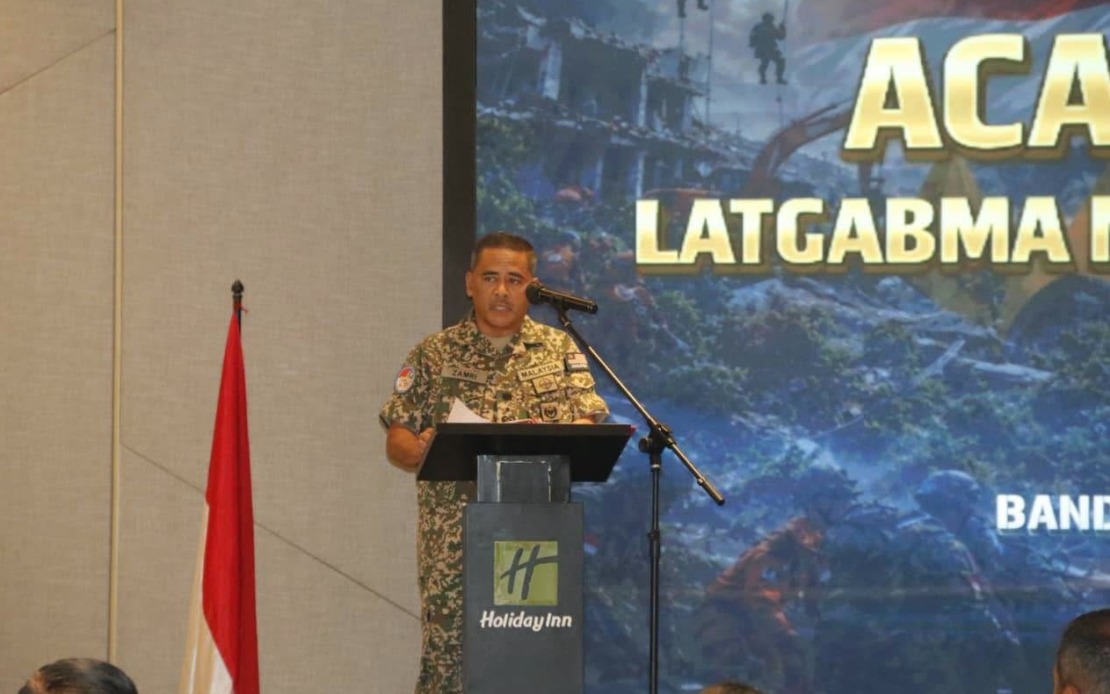
Malaysia and Indonesia are reinforcing their strategic defence relationship through an extensive joint military exercise designed to test shared operational capabilities across land, sea and air domains while addressing the region's most pressing security challenges. The 12AB/2026 Malaysia-Indonesia Joint Combined Exercise, known as LATGABMA MALINDO DARSASA, is currently underway in Lampung, Sumatra, bringing together 719 military and civilian personnel from both countries in a 13-day deployment that extends beyond traditional combat training to encompass humanitarian operations and technological threats.
The exercise represents a significant evolution in how Malaysia and Indonesia approach their bilateral defence partnership. Rather than focusing narrowly on conventional military scenarios, organisers have structured the event to reflect the complex security environment both nations face in the 21st century. Brigadier General Datuk Zamri Othman, commander of the 1st Infantry Brigade and chief of the MAF Exercise Planning Group, characterised the operation as far more than a routine drill, describing it instead as a tangible demonstration of the deep fraternal bonds and mutual strategic confidence that underpin the relationship between Kuala Lumpur and Jakarta.
The selection of Lampung as the primary exercise location is strategically deliberate and rooted in geographical reality. The province sits at the intersection of three active tectonic plate belts, positioning it as an ideal natural laboratory for training personnel in disaster response scenarios grounded in actual Indonesian experience. This choice ensures that participating forces are preparing for contingencies based on genuine historical events rather than theoretical abstractions. The scenario architecture draws explicitly from the devastating earthquakes and tsunamis that have repeatedly struck southern Sumatra, creating a training environment that mirrors real-world conditions Malaysian and Indonesian servicemen and women might genuinely encounter.
Beyond traditional military cooperation, the exercise reflects mounting awareness in both capitals that contemporary security threats extend far beyond territorial disputes or conventional military challenges. Rising incidents of maritime crime, human trafficking, drug smuggling, and terrorism throughout the Strait of Malacca and surrounding waters necessitate coordinated responses that only bilateral cooperation can effectively deliver. The decision to incorporate cyber defence components into the 12AB/2026 exercise underscores recognition that digital infrastructure has become as critical to national security as physical borders or naval assets.
The exercise curriculum is divided into interconnected phases designed to build knowledge progressively from classroom-based instruction to practical field application. The Staff Exercise segment concentrates on ten critical scenarios ranging from initial disaster response and mass casualty management through to cyber attacks, information warfare and the stabilisation phases that follow major crises. This structured progression ensures personnel understand not only the immediate response requirements but also the broader context of how military and civilian agencies must coordinate during extended emergency operations.
The Field Training Exercise component represents the practical culmination of theoretical preparation, involving force integration training that brings together MAF soldiers, TNI counterparts, and crucial civilian agencies including Indonesia's National Search and Rescue Agency (BASARNAS), the Indonesian Red Cross, and regional disaster management authorities. This multi-agency dimension is particularly important for Malaysia, where the nature of transboundary disasters—especially flooding and maritime emergencies—requires seamless coordination between military and civilian responders. Joint training activities encompass rope rescue techniques, rappelling operations, emergency medical response and the rapid establishment of field hospitals, all competencies essential for effective humanitarian aid and disaster relief operations.
Concurrently, the exercise incorporates what organisers call civic action programmes that generate tangible benefits for local Indonesian communities. Engineers from both nations are undertaking reconstruction work on two uninhabitable houses in Kampung Sukamaju and building concrete road infrastructure in Kampung Keteguhan, transforming the exercise from a purely military activity into an opportunity for both countries' armed forces to demonstrate their commitment to regional development. Medical teams are conducting health screening operations, distributing spectacles and organising blood donation programmes through community health centres, activities that strengthen people-to-people connections alongside institutional military relationships.
The cybersecurity training component addresses an often-overlooked dimension of modern defence cooperation. The CyberEx segment covers technical attack vectors including reconnaissance, enumeration, credential attacks, man-in-the-middle interception, spoofing and feed manipulation—the precise techniques that non-state actors and hostile governments increasingly employ against Southeast Asian nations. By training Malaysian and Indonesian personnel together on these threats, both countries develop shared understanding of cyber vulnerabilities and coordinated response protocols that will prove invaluable as digitalisation accelerates across the region's critical infrastructure.
This current exercise represents the continuation of a partnership framework stretching back four decades. The LATGABMA MALINDO DARSASA series commenced in 1984 and has been conducted triennially on a rotating basis through formal mechanisms including the General Border Committee and the Malaysia-Indonesia Joint Training Committee. The previous iteration, held in Pekan, Pahang in 2023, focused specifically on counter-terrorism operations, demonstrating how the exercise adapts its emphasis to address evolving security priorities. This institutional continuity provides confidence that bilateral defence cooperation will persist regardless of short-term political fluctuations.
For Malaysia, participation in this exercise carries particular significance given the nation's extensive coastlines and vulnerability to maritime emergencies spanning the Strait of Malacca, the South China Sea and the Sulu-Celebes Seas. The knowledge and relationships built through joint training with Indonesia directly enhance Malaysia's capacity to respond to natural disasters, maritime accidents and security incidents affecting shipping lanes critical to the global economy. Similarly, Indonesian participation benefits from Malaysian expertise in naval operations, urban search and rescue, and cyber defence capabilities that have been developed through Malaysia's own experience managing complex maritime environments and transnational security challenges.
The 463 TNI personnel, 150 MAF personnel and representatives from Indonesia's National Disaster Management Agency, National Police and various civilian emergency response organisations collectively represent approximately 719 participants working across integrated command structures. This diversity of participants ensures that lessons learned flow throughout both defence establishments and into civilian government agencies responsible for emergency management. The exercise thus becomes an opportunity for institutional learning that extends well beyond the immediate participants, shaping doctrine and procedures that will guide both countries' responses to future crises.
The exercise reinforces that Southeast Asian nations are increasingly moving toward more sophisticated, comprehensive approaches to security challenges that recognise the interconnected nature of modern threats. Neither Malaysia nor Indonesia can address maritime security, disaster response or cyber threats in isolation. By conducting joint exercises that test combined capabilities across multiple domains simultaneously, both nations signal to their populations and the international community that they take their mutual security obligations seriously whilst building the practical operational relationships that transform strategic declarations into effective real-world coordination.

%22%2F%3E%3C%2Fpattern%3E%3C%2Fdefs%3E%3Crect%20width%3D%22100%25%22%20height%3D%22100%25%22%20fill%3D%22url(%23ph21o2sg)%22%2F%3E%3Crect%20width%3D%22100%25%22%20height%3D%22100%25%22%20fill%3D%22url(%23ph21o2sp)%22%2F%3E%3Ctext%20x%3D%2250%25%22%20y%3D%2250%25%22%20text-anchor%3D%22middle%22%20dominant-baseline%3D%22central%22%20fill%3D%22rgba(255%2C255%2C255%2C0.95)%22%20font-family%3D%22Georgia%2C%20'Times%20New%20Roman'%2C%20serif%22%20font-weight%3D%22700%22%20font-size%3D%22170%22%20letter-spacing%3D%22-0.02em%22%3EGabungan%3C%2Ftext%3E%3C%2Fsvg%3E)