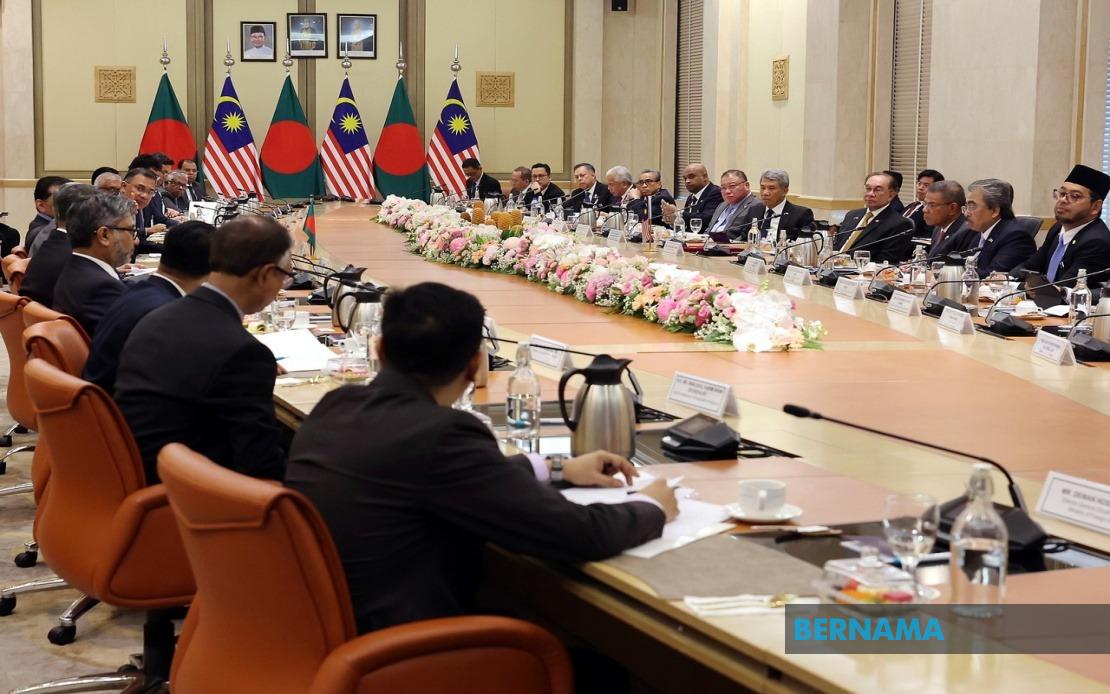
Prime Minister Datuk Seri Anwar Ibrahim has signalled a significant shift in Malaysia-Bangladesh relations, calling for both nations to channel their collaborative efforts into cutting-edge sectors that will shape the region's economic future. Speaking at a joint press conference in Putrajaya on June 22, Anwar emphasised that while investment flows between the two countries remain essential, the partnership must transcend conventional boundaries to encompass emerging technologies and modern industries that address global challenges ahead.
The statement came during an official visit by Bangladesh Prime Minister Tarique Rahman, who spent two days in the Malaysian capital for high-level talks. The timing reflects a strategic recalibration of Southeast Asian partnerships, as nations increasingly recognise that sustained growth depends on leapfrogging into innovation-driven sectors rather than remaining anchored to legacy industries. For Malaysia, which has long positioned itself as a technology hub in the region, the invitation to Bangladesh signals confidence in sharing expertise and creating collaborative pathways in advanced fields.
Anwar outlined a comprehensive vision for expanded cooperation that spans multiple domains. Beyond semiconductors, digital economy initiatives, and renewable energy projects, the Prime Minister specifically highlighted artificial intelligence as a critical frontier. He acknowledged that AI development presents both significant opportunities and formidable challenges for developing economies, requiring joint research efforts and knowledge exchange. The emphasis on AI is particularly relevant given Malaysia's aspirations to become a global artificial intelligence centre and Bangladesh's substantial young workforce that could benefit from technology skills development.
The semiconductor sector represents perhaps the most strategically sensitive area of proposed collaboration. Both countries have recognised the geopolitical importance of semiconductor self-sufficiency following global supply chain disruptions in recent years. Malaysia already hosts significant semiconductor manufacturing and design capabilities, making it a natural knowledge partner for Bangladesh's emerging electronics industry. This cooperation could help Bangladesh reduce its reliance on external semiconductor imports while providing Malaysian firms with expanded markets and manufacturing alternatives across the border.
Energy cooperation assumes heightened importance given the region's growing electricity demands and the global transition toward renewable sources. Bangladesh faces substantial energy challenges as its population and industrial base expand, while Malaysia possesses experience in both conventional and renewable energy management. Joint ventures in solar technology, grid modernisation, and energy storage systems could benefit both economies while contributing to regional energy security and environmental sustainability targets aligned with Southeast Asian climate commitments.
The bilateral engagement was formalised through multiple agreements signed during the visit. A Memorandum of Understanding on Cultural Cooperation acknowledges the deep historical and people-to-people connections between Malaysia and Bangladesh, particularly given the significant Bangladeshi diaspora residing in Malaysia. Beyond cultural dimensions, two Exchanges of Notes were executed covering Counter-Terrorism Research and Investment Promotion and Facilitation. The counter-terrorism research collaboration reflects shared security concerns across South and Southeast Asia, while the investment facilitation mechanism aims to reduce bureaucratic barriers and encourage business expansion between the two nations.
The investment facilitation agreement carries particular weight for Malaysian enterprises seeking to expand southwestward into Bangladesh's substantial market of over 170 million people. As Myanmar's instability continues to complicate regional business operations, Bangladesh increasingly attracts manufacturing investment from firms looking to diversify away from established supply chain hubs. Malaysian companies in textiles, food processing, and light manufacturing could leverage improved bilateral frameworks to establish operations in Bangladesh, while Bangladeshi investors might equally find Malaysia's regulatory infrastructure and technology ecosystem attractive for their own expansion ambitions.
For Malaysia specifically, the Bangladesh partnership represents a strategic counterweight to existing regional relationships while expanding the nation's soft power influence across South Asia. The emphasis on technology and research cooperation positions Malaysia as an innovation partner rather than merely a trading counterpart, elevating the relationship's intellectual capital. This approach aligns with Malaysia's broader National AI Strategy and its efforts to establish itself as a regional technology leader capable of exporting expertise and technical know-how across Asia.
The timing of this deepened cooperation also reflects broader geopolitical recalibration in the region. As major powers compete for influence across South and Southeast Asia, Malaysia's proactive engagement with Bangladesh—a nation of enormous strategic and demographic significance—demonstrates Kuala Lumpur's commitment to strengthening ASEAN's periphery and building stronger bridges with neighbouring regions. Bangladesh's position as a crucial player in both ASEAN+3 frameworks and South Asian geopolitics makes it a natural partner for Malaysian strategic ambitions.
For Malaysian businesses and research institutions, the partnership opens concrete opportunities. Universities can establish joint research programmes in AI and semiconductors, leveraging Malaysian expertise in these domains. Technology companies can explore partnerships with Bangladeshi firms seeking to upgrade their capabilities, while Malaysian investors can identify opportunities in Bangladesh's rapidly developing digital economy. The bilateral agreements essentially create institutional frameworks that make such cooperation less friction-dependent and more systematic.
The challenge ahead lies in translating these agreements into tangible collaboration and measurable outcomes. Previous cooperation initiatives between Southeast and South Asian nations have sometimes foundered due to implementation gaps, bureaucratic delays, or misaligned priorities. Success will depend on both governments establishing dedicated mechanisms to monitor progress, address bottlenecks, and ensure that the enthusiasm expressed at diplomatic summits translates into sustained engagement at the business and research levels.

%22%2F%3E%3C%2Fpattern%3E%3C%2Fdefs%3E%3Crect%20width%3D%22100%25%22%20height%3D%22100%25%22%20fill%3D%22url(%23ph1riqwg)%22%2F%3E%3Crect%20width%3D%22100%25%22%20height%3D%22100%25%22%20fill%3D%22url(%23ph1riqwp)%22%2F%3E%3Ctext%20x%3D%2250%25%22%20y%3D%2250%25%22%20text-anchor%3D%22middle%22%20dominant-baseline%3D%22central%22%20fill%3D%22rgba(255%2C255%2C255%2C0.95)%22%20font-family%3D%22Georgia%2C%20'Times%20New%20Roman'%2C%20serif%22%20font-weight%3D%22700%22%20font-size%3D%22320%22%20letter-spacing%3D%22-0.02em%22%3EMACC%3C%2Ftext%3E%3C%2Fsvg%3E)
%22%2F%3E%3C%2Fpattern%3E%3C%2Fdefs%3E%3Crect%20width%3D%22100%25%22%20height%3D%22100%25%22%20fill%3D%22url(%23ph3s8o3g)%22%2F%3E%3Crect%20width%3D%22100%25%22%20height%3D%22100%25%22%20fill%3D%22url(%23ph3s8o3p)%22%2F%3E%3Ctext%20x%3D%2250%25%22%20y%3D%2250%25%22%20text-anchor%3D%22middle%22%20dominant-baseline%3D%22central%22%20fill%3D%22rgba(255%2C255%2C255%2C0.95)%22%20font-family%3D%22Georgia%2C%20'Times%20New%20Roman'%2C%20serif%22%20font-weight%3D%22700%22%20font-size%3D%22170%22%20letter-spacing%3D%22-0.02em%22%3EMalaysia%3C%2Ftext%3E%3C%2Fsvg%3E)