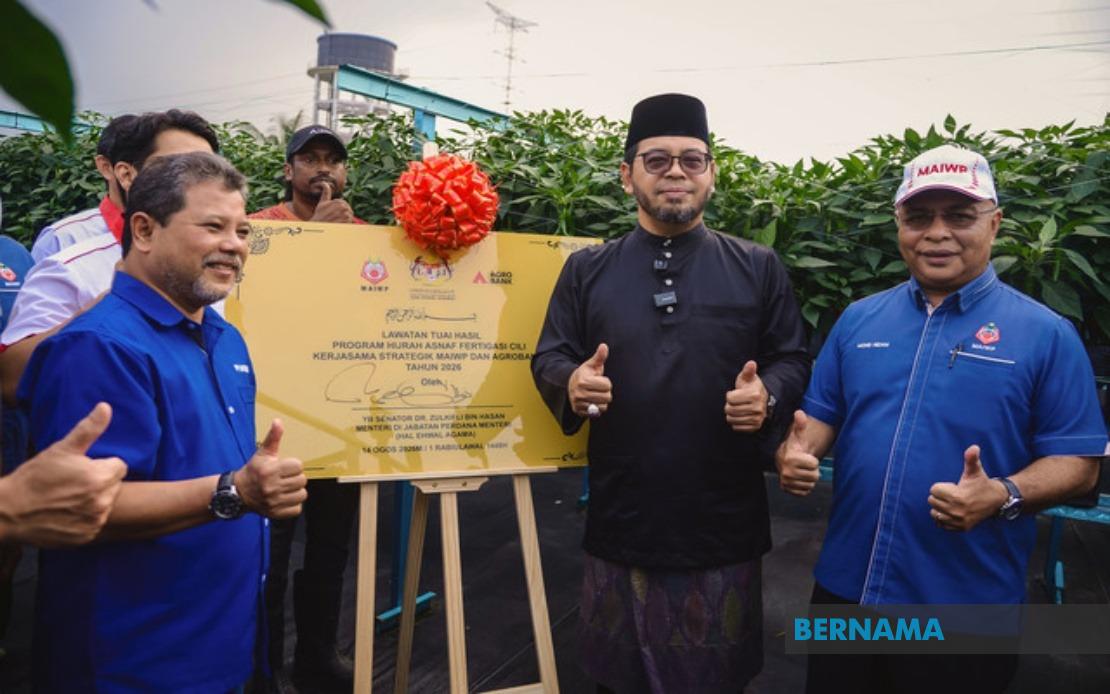
The Islamic Welfare and Zakat Council (MAIWP) has demonstrated remarkable success in scaling its asnaf chilli production programme, announcing plans to expand operations across five acres following an exceptionally productive initial phase. The initiative, overseen by Dr Zulkifli Hasan, Minister in the Prime Minister's Department (Religious Affairs), represents a strategic investment in sustainable livelihood development for economically vulnerable segments of Malaysia's Muslim community, combining traditional farming knowledge with modern irrigation technology.
The programme's inaugural harvest delivered compelling results that underscore its viability as an economic empowerment tool. The first crop yielded more than 16.7 tonnes of chillies, translating into revenue exceeding RM207,000 for participating asnaf members. This outcome validates the approach of equipping disadvantaged individuals with practical agricultural expertise and market-ready produce, enabling them to transition from welfare dependency to productive economic participation. The returns demonstrate that chilli cultivation, particularly using precision fertigation systems that optimise water and nutrient delivery, can generate meaningful income within relatively compact growing spaces.
Dr Zulkifli emphasised that the project's significance extends beyond immediate agricultural output. He highlighted how the initiative catalyses broader economic activity by encouraging participants to develop downstream value-added operations. By transforming raw chillies into processed products—whether dried varieties, chilli pastes, sauces, or other prepared goods—beneficiaries can tap into higher-margin markets and establish small-scale food enterprises. This vertical integration approach transforms the programme from simple crop production into a more comprehensive economic ecosystem, positioning participants as entrepreneurs rather than subsistence farmers.
The human dimension of the programme comes into sharp focus through participant testimonies. Alinda Rosely, a 49-year-old single mother, exemplifies the transformative potential of structured agricultural training combined with market access. She credits the fertigation knowledge acquired through the initiative with enabling her financial rehabilitation. During a period of favourable chilli prices, she generated RM40,000 within six months, demonstrating that sustained income sufficient to support a household and achieve genuine economic dignity remains achievable through focused agricultural effort. Her experience illustrates how technical skills, when paired with supportive institutional frameworks and market conditions, can rapidly shift trajectories for vulnerable populations.
The expansion to five acres signals MAIWP's confidence in replicating and scaling this model across a broader beneficiary base. Fertigation technology, which delivers water and nutrients through drip systems calibrated to crop requirements, offers particular advantages in the Malaysian context. The approach maximises yields per unit of land, reduces water consumption compared to traditional flooding methods, and minimises the physical labour required—a critical consideration when serving participants of varying ages and physical capacities. As water scarcity becomes an increasingly pressing regional concern, demonstrating efficient irrigation techniques also positions such programmes as environmentally responsible development initiatives.
This agricultural expansion aligns with MAIWP's broader institutional mission to cultivate self-reliant and economically competitive asnaf communities. Rather than perpetuating one-directional welfare provision, the organisation has repositioned zakat—the Islamic obligatory alms—as an investment instrument in human capital development and productive assets. This philosophical shift reflects contemporary Islamic finance thinking, which increasingly emphasises that zakat can serve catalytic functions in generating sustainable livelihoods rather than merely providing temporary relief.
The scale of MAIWP's overall charitable operations contextualises this chilli initiative within a substantial institutional apparatus. As of mid-August 2026, the council had distributed RM699.57 million in zakat funds across 38 distinct welfare assistance schemes, alongside complementary funding mechanisms. The chilli fertigation project represents a carefully targeted subset of this portfolio, suggesting that MAIWP allocates resources strategically based on programme outcomes and scalability potential. That this particular agricultural initiative merits expansion indicates strong organisational assessment of its effectiveness relative to alternative deployment options.
From a regional development perspective, the programme carries implications for broader Southeast Asian approaches to poverty alleviation and rural economic development. Malaysia's Muslim-majority demographic means that Islamic-anchored development mechanisms enjoy particular institutional coherence and community legitimacy. The MAIWP model demonstrates how religious obligation frameworks can be mobilised to underwrite practical skill acquisition, technology transfer, and market integration—addressing structural barriers that purely financial assistance fails to remedy. Other nations confronting similar challenges of agricultural modernisation and inclusive economic development might observe valuable lessons in Malaysia's integration of Islamic institutional systems with contemporary agricultural science.
The chilli sector itself holds strategic significance within Malaysia's agricultural landscape and rural economies. Domestic demand remains consistent across peninsular, Sarawak, and Sabah markets, with chillies serving as essential ingredients across Malaysian, Indian, and Southeast Asian cuisines. By developing local productive capacity among asnaf participants, MAIWP simultaneously addresses food security considerations and reduces reliance on imports whilst creating dignified employment. This multiplicity of benefits—individual livelihood improvement, institutional capacity-building, sectoral development, and food system resilience—explains why policymakers regard agricultural development programmes as particularly valuable instruments for inclusive growth.
Looking forward, the MAIWP expansion raises considerations about sustainability, market dynamics, and programme replicability. The initial harvest occurred under conditions of strong chilli pricing; future cohorts will inevitably encounter more volatile market conditions. Successful scaling requires attention to collective marketing mechanisms, price stabilisation strategies, and potentially value-addition infrastructure that individual farmers cannot provide independently. Whether MAIWP develops cooperative structures or other institutional mechanisms to stabilise beneficiary incomes through commodity price fluctuations will significantly influence the programme's long-term success and its capacity to deliver consistent livelihood improvements across economic cycles.
The programme also highlights the increasingly sophisticated approaches taken by Malaysia's Islamic institutional sector toward economic development. Rather than viewing zakat administration narrowly as charity distribution, contemporary leaders like Dr Zulkifli position it as strategic investment in community assets and individual capabilities. This conceptual evolution, grounded in Islamic jurisprudential traditions that emphasise sustainable poverty elimination over indefinite welfare provision, shapes how Malaysia approaches development challenges. As the nation pursues inclusive growth objectives whilst managing fiscal pressures, the effectiveness of such Islamic-anchored mechanisms in delivering measurable livelihood improvements becomes increasingly significant for national development strategy.
The five-acre expansion represents both immediate economic activity and a longer-term institutional commitment to demonstrating viable pathways from vulnerability toward self-sufficiency. Success will ultimately be measured not merely in tonnes of chillies harvested or ringgit generated, but in the number of households like Alinda Rosely's that achieve genuine economic transition and the broader ecosystem of agricultural skills, entrepreneurial confidence, and market participation that such programmes cultivate across Malaysia's asnaf communities.

