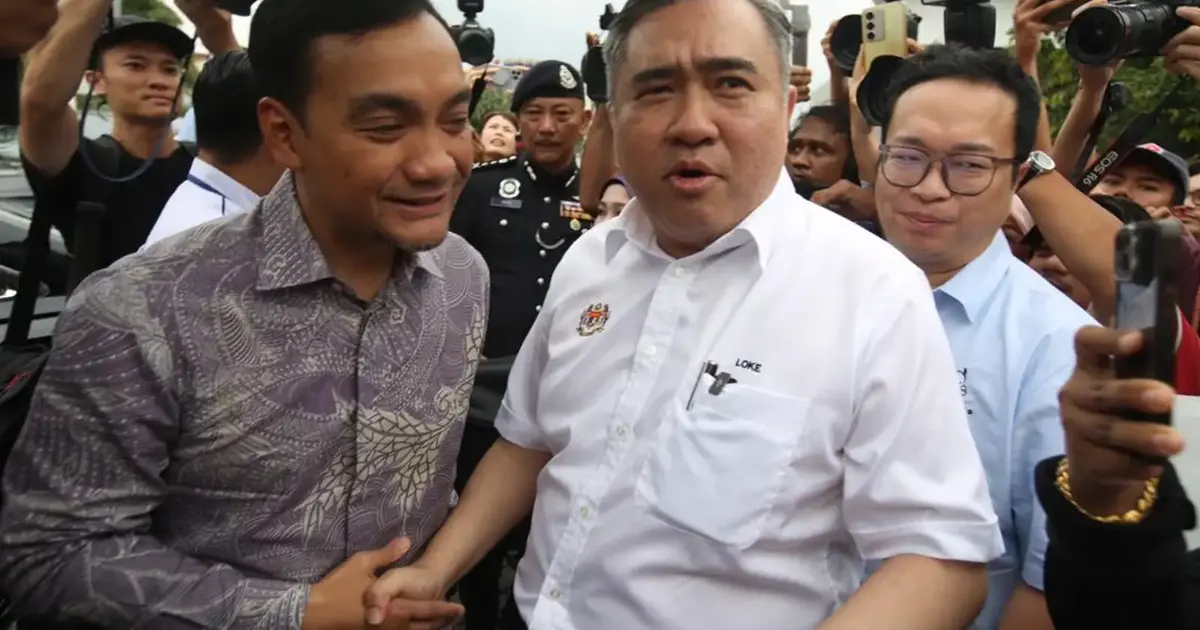
Transport Minister Anthony Loke and Johor Menteri Besar Onn Hafiz Soppian demonstrated political composure when they met for the first time following a public spat conducted across social media platforms, maintaining a respectful veneer despite the recent friction between Malaysia's federal and state leadership in the country's southern region.
The encounter took place at a ministry-organised event focused on transportation matters, a sector that regularly intersects both federal and state-level governance responsibilities. Such coordination mechanisms are essential in Malaysia's federal system, where critical infrastructure projects often require seamless cooperation between Putrajaya and state capitals. The meeting underscored how personal disagreements, however public they may become, frequently must be set aside when officials are compelled to work within the machinery of government.
Onn Hafiz, who governs Johor as the state's chief executive, chose to acknowledge the scheduling circumstances during his remarks at the gathering, noting that he had been required to reorganise his calendar following a last-minute invitation to the transport ministry programme. This observation, delivered within the formal setting of an official function, functioned as both a gentle critique and an indirect reference to the tensions that had recently played out online. The statement reflected the careful balancing act that contemporary politicians must perform when managing interpersonal disputes while maintaining the appearance of institutional decorum.
The broader context of the disagreement remains significant for understanding Malaysian political dynamics. Social media has increasingly become a platform where political figures engage in public disputes, particularly when issues of federal-state authority and resource allocation come into question. These online exchanges, while often pointed, have become normalised features of contemporary Malaysian politics, reflecting deeper structural tensions within the federation's governance framework.
For Malaysia's transport sector specifically, maintaining workable relationships between federal and state administrations remains critical. Johor, as the nation's second-largest state by population and a crucial economic hub, hosts major transportation infrastructure including ports, railways, and highway networks that connect to federal projects. Any significant breakdown in cooperation between the transport ministry and the Johor administration could create bottlenecks affecting national logistics and economic competitiveness across Southeast Asia's most developed corridor.
The decision by both leaders to keep the meeting professional reflects a pragmatic understanding that governance continuity depends upon separating personality conflicts from institutional responsibilities. Loke's position as transport minister places him at the centre of major infrastructure initiatives, some of which necessarily involve Johor's cooperation and resources. Similarly, Onn Hafiz's administration benefits from federal allocations and ministerial coordination on projects ranging from rail connectivity to port development.
This incident illustrates a broader pattern in Malaysian politics where public disagreements often get compartmentalised away from official business. While online platforms have democratised political speech and allowed leaders to communicate more directly with constituencies, they have simultaneously created permanent records of disputes that might previously have remained within closed-door negotiations. The challenge for contemporary Malaysian politicians lies in managing these dual spheres—the informal, sometimes combative space of social media and the formal, protocol-bound environment of official functions.
The cordiality maintained during their meeting also sends signals to other government officials and state governments about expectations for professional behaviour. In a federal system managing competing interests between Kuala Lumpur and thirteen state governments, clarity about the distinction between legitimate policy disagreement and personal animosity proves important for institutional stability. When senior officials demonstrate capacity to disagree publicly yet cooperate effectively in formal settings, it establishes precedent that politics can proceed through proper channels without devolving into dysfunction.
Onn Hafiz's comments about schedule adjustment, while seemingly routine, carried symbolic weight in the context of their recent disagreement. It operated simultaneously as acknowledgment of the meeting's importance and subtle commentary on the circumstances surrounding the invitation. Such rhetorical moves are characteristic of senior Malaysian politicians navigating the complex demands of maintaining political credibility among supporters while preserving working relationships essential to governance.
Looking forward, the success of this meeting may influence how federal-state relations develop during Loke's tenure in the transport portfolio. Transport infrastructure projects increasingly define state-level economic development and directly affect Johor's competitiveness as a regional economic centre. The ability of Loke and Onn Hafiz to work constructively together, irrespective of online disagreements, will likely determine the pace and scope of major initiatives affecting the state's connectivity and development trajectory.
The incident ultimately reflects the reality of Malaysian governance in the digital age: that public disputes on social media remain constrained by institutional imperatives that require cooperation. Whether such compartmentalisation proves sustainable as social media becomes ever more dominant in political communication remains an open question for Malaysian political observers watching how the federation's leadership manages the intersection of populist digital platforms and traditional governance hierarchies.

%22%2F%3E%3C%2Fpattern%3E%3C%2Fdefs%3E%3Crect%20width%3D%22100%25%22%20height%3D%22100%25%22%20fill%3D%22url(%23ph21o2sg)%22%2F%3E%3Crect%20width%3D%22100%25%22%20height%3D%22100%25%22%20fill%3D%22url(%23ph21o2sp)%22%2F%3E%3Ctext%20x%3D%2250%25%22%20y%3D%2250%25%22%20text-anchor%3D%22middle%22%20dominant-baseline%3D%22central%22%20fill%3D%22rgba(255%2C255%2C255%2C0.95)%22%20font-family%3D%22Georgia%2C%20'Times%20New%20Roman'%2C%20serif%22%20font-weight%3D%22700%22%20font-size%3D%22170%22%20letter-spacing%3D%22-0.02em%22%3EGabungan%3C%2Ftext%3E%3C%2Fsvg%3E)