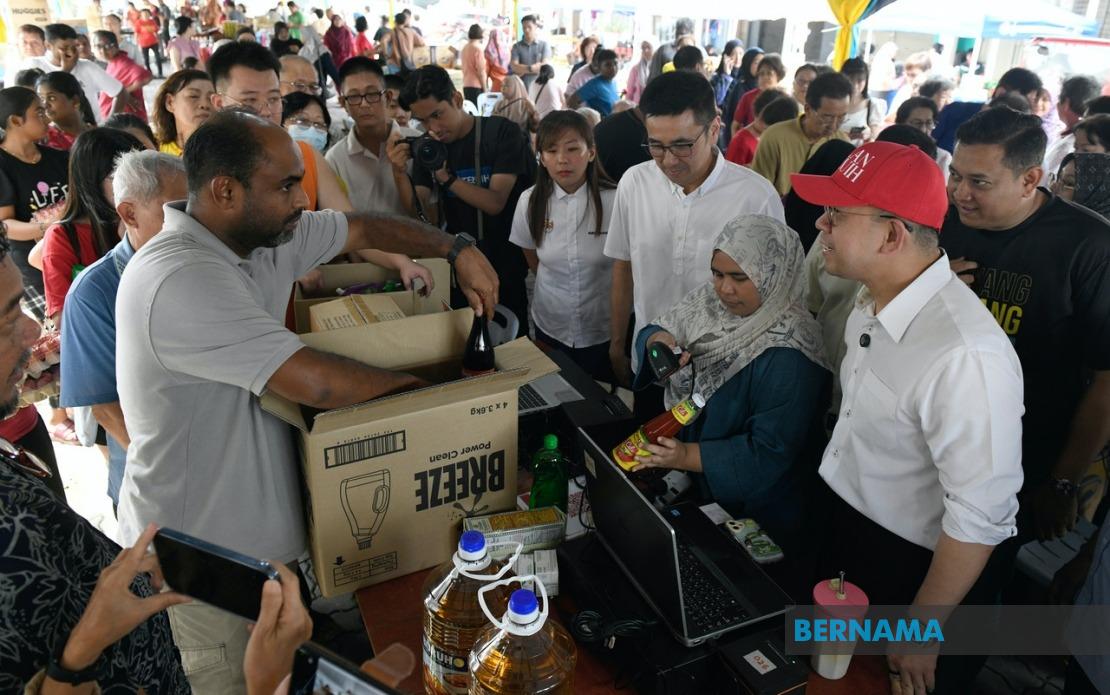
The Malaysian government is doubling down on its commitment to nurture small and medium-sized enterprises through targeted initiatives under the Ministry of Entrepreneur and Cooperatives Development, commonly known as KUSKOP. The strategy reflects a recognition that local entrepreneurs remain vital to sustaining the nation's economic momentum, particularly as the wholesale and retail sector continues to demonstrate impressive resilience and growth. Minister Steven Sim Chee Keong outlined this vision while launching the Jualan MADANI KUSKOP programme in the Jawi state constituency, signalling renewed determination to ensure grassroots businesses benefit from expanding market opportunities.
The timing of this push is particularly significant given recent economic performance. Latest data from Malaysia's Department of Statistics reveals that the wholesale and retail trade sector generated nearly RM175 billion in sales during April 2026, representing a robust 15.3 per cent increase compared to the corresponding period the previous year. Such figures underscore the sector's fundamental strength and its capacity to absorb new entrants and support business expansion. Rather than allowing this growth to concentrate among larger players, KUSKOP's approach seeks to distribute opportunities more widely across the MSME ecosystem, where most of Malaysia's employment and entrepreneurial activity is concentrated.
Sim attributed this sector expansion to coordinated efforts spanning government policy, private sector engagement, and community participation. The minister specifically highlighted three anchoring factors: ongoing work to reduce living costs for consumers, price stabilisation initiatives that have prevented inflation from eroding margins, and improvements in worker incomes that have maintained purchasing power. These elements create a favourable operating environment for retailers and wholesalers, as demand remains supported by confident consumers with disposable income. Understanding these conditions matters for Malaysian businesses considering entry or expansion in the sector, as they reflect structural rather than temporary improvements.
What distinguishes KUSKOP's current approach is its explicit acknowledgment of global headwinds. While acknowledging tariff tensions, trade conflicts, and geopolitical volatility affecting international commerce, the minister stressed Malaysia's particular vulnerability given its reliance on open trade. However, rather than viewing this as a limiting constraint, KUSKOP positions domestic economic growth as a buffer against external shocks. The implication for regional observers is clear: as supply chains potentially reorganise and international trade becomes more fragmented, vibrant domestic markets become increasingly valuable to businesses seeking stable revenue streams and growth outlets.
The wholesale and retail sector's expansion also reflects underlying shifts in consumer behaviour and shopping patterns. The period covered by the statistics coincides with post-pandemic normalisation of physical retail, alongside growing integration of e-commerce and hybrid shopping models. MSMEs that successfully navigate both channels can capture a broader customer base. KUSKOP's programmes appear calibrated to help smaller operators develop these capabilities, whether through training, access to technology platforms, or network support that facilitates market linkages.
Cooperatives occupy a strategic position within this growth narrative. Unlike individual entrepreneurs operating in isolation, cooperatives pool resources and leverage collective bargaining power, enabling members to negotiate better terms with suppliers and reach economies of scale previously available only to larger retailers. KUSKOP's emphasis on strengthening cooperatives recognises this multiplicative effect, where support directed to cooperative structures benefits dozens or hundreds of member businesses simultaneously. For Malaysia's estimated 12,000-plus cooperatives, renewed government focus could catalyse modernisation and market adaptation.
The geographical focus on constituencies like Jawi reflects KUSKOP's commitment to bringing support to all regions, not merely urban centres where commercial infrastructure is already well-developed. Rural and semi-urban areas frequently struggle with market access, supplier relationships, and operational capacity—precisely the challenges KUSKOP's programmes target. By decentralising programme delivery and tailoring initiatives to local circumstances, the ministry acknowledges that wholesale and retail opportunities exist everywhere consumers gather, regardless of population density.
Accessibility to the sector's growth also depends on practical enablers beyond policy encouragement. MSMEs typically face financing constraints, skills gaps, and information asymmetries that hinder expansion even when market conditions are favourable. KUSKOP's programmes likely encompass credit facilitation, business training, market intelligence sharing, and mentorship—the scaffolding small businesses require to scale operations. As competition intensifies within Malaysia's retail landscape, particularly as large format retailers expand and e-commerce platforms proliferate, differentiation through service, specialisation, and community connection becomes essential for MSME survival and prosperity.
The minister's comments reflect broader Southeast Asian trends where governments increasingly prioritise inclusive growth. Thailand, Vietnam, and Indonesia have implemented comparable MSME support programmes, recognising that distributed economic power strengthens social stability and regional competitiveness. Malaysia's approach positions the nation within this regional movement, potentially strengthening supply chain partnerships across ASEAN as MSMEs gain capacity to engage in cross-border wholesale trade and regional retail networks.
Looking ahead, KUSKOP's agenda confronts both structural opportunities and persistent challenges. The sector's continued expansion appears sustainable given steady domestic demand, but MSMEs must simultaneously contend with rising operational costs, labour scarcity in certain regions, and the competitive pressure of organised retail. Success for government initiatives depends on translating policy support into tangible business improvements—whether through improved profit margins, expanded market reach, or reduced operational friction. Malaysian entrepreneurs monitoring these developments should view KUSKOP's initiatives as a signal to explore retail and wholesale opportunities, particularly those willing to engage with cooperative structures and adopt modern business practices that enhance efficiency and market responsiveness.

