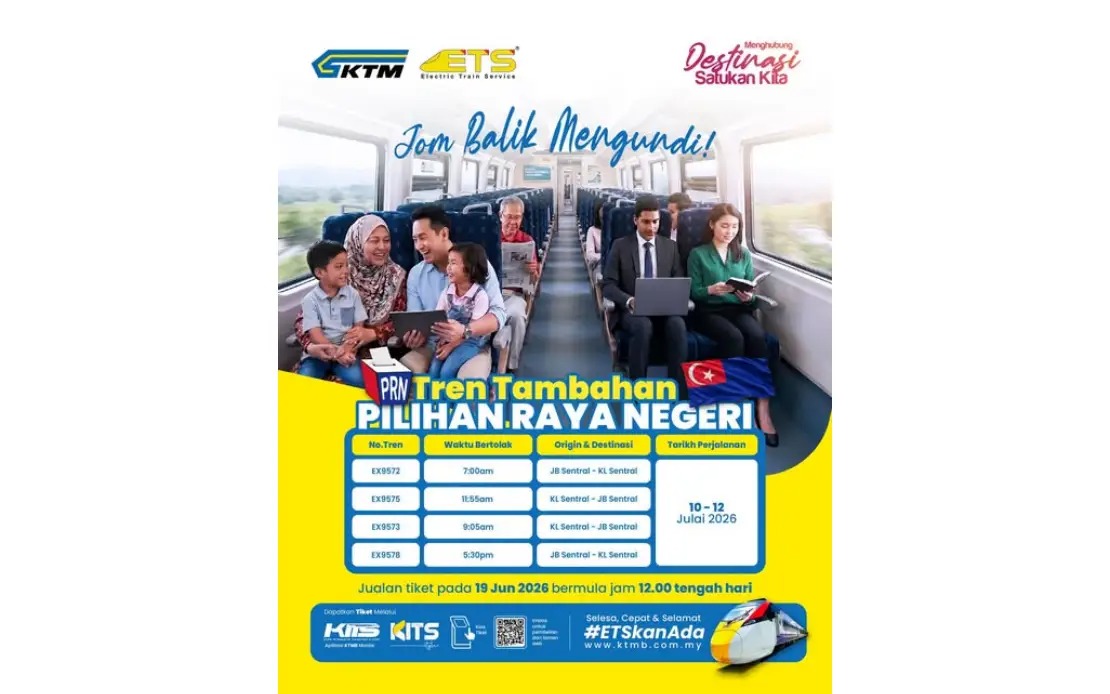
Keretapi Tanah Melayu Berhad has rolled out a series of enhanced train services on the Electric Train Service network running southbound ahead of the Johor state election, tackling the anticipated surge in passenger demand as eligible voters make their way back to their home constituencies for polling day.
The railway company's announcement, published via Facebook on June 19, signals recognition of a familiar pattern in Malaysian electoral cycles: the substantial movement of voters from urban centres to their home states when elections are called. For Johor, where the state assembly was dissolved on June 1, this phenomenon is expected to be particularly pronounced given the state's substantial migrant workforce in Kuala Lumpur and other developed regions.
According to the timeline established by the Election Commission, voters will have a three-day window—from July 10 to July 12—to utilise the additional services, with the official polling day set for July 11. This scheduling provides those travelling long distances the flexibility to depart before the actual voting date and return afterwards without rushing, addressing a consistent pain point during election cycles when regular services become congested.
KTMB has streamlined the booking process by opening ticket sales from noon on June 19 through multiple channels, reflecting the operator's investment in digital accessibility. The Malaysian railway company allows passengers to secure seats via the KTMB Mobile app, the KITS Style platform, its online portal at online.ktmb.com.my, or through traditional ticket kiosks at stations. This multi-channel approach is particularly significant for Malaysia's diverse traveller base, accommodating both tech-savvy younger voters and older citizens who may prefer in-person transactions.
The decision to augment services demonstrates how Malaysian institutions adapt operational capacity around electoral events. Unlike some democracies where election day is declared a public holiday, Malaysia's approach implicitly accepts that significant portions of the workforce will need to traverse the country. By pre-emptively scheduling extra trains, KTMB helps manage the logistics of this democratic exercise, reducing the stress on families attempting to coordinate travel during what is typically a hectic period.
For southern Malaysia specifically, the Johor election carries particular weight. The state represents one of Malaysia's economic powerhouses and remains a critical political battleground where federal ruling coalitions have invested substantial resources. The concentration of voters whose primary residence is in Johor but who work in Klang Valley or Penang means that any state election here generates pronounced population flows that extend beyond local commuting patterns.
The timing of KTMB's announcement also reflects standard practice in Malaysian election management. With the polling date confirmed weeks in advance, relevant agencies have opportunity to prepare infrastructure. This contrasts sharply with snap elections or those called with minimal notice, where such accommodations become impossible to arrange. The interval between the June 1 dissolution and the July 11 polling date gave KTMB adequate lead time to assess demand patterns, arrange additional rolling stock allocation, and coordinate scheduling with other rail operations.
From a passenger experience standpoint, the availability of dedicated extra services typically proves more reliable than hoping regular capacity will somehow absorb election-driven demand. It reduces platform congestion, minimises delays that cascade through the network, and ensures voters aren't stranded at stations trying to board overcrowded trains. For rail operators across Southeast Asia grappling with similar periodic surges, KTMB's proactive approach offers a workable model.
The move also reflects broader infrastructure challenges facing Malaysian transport as the nation becomes increasingly urbanised yet maintains electoral constituencies based on historical settlement patterns. Millions of Malaysians maintain official residences in home states for voting purposes while conducting their professional lives hundreds of kilometres away. Without coordination between election management bodies and transport operators, this creates recurring logistical flashpoints.
Prior to polling day, KTMB's messaging emphasises the patriotic dimension: "Let's head home to vote." This framing acknowledges that electoral participation, while sometimes burdensome operationally, remains fundamental to Malaysia's democratic system. The railway company is positioning itself not merely as a commercial carrier but as an enabler of civic participation, a framing that carries weight in Malaysian public discourse.
For passengers planning to utilise these services, early booking is advisable given the predictable demand surge. The June 19 ticket sale opening means those working in northern states have roughly three weeks to secure their reservations, though historical patterns suggest the most convenient time slots will fill quickly. The multi-channel booking system should accommodate most users, though reliability varies across platforms, and station ticket counters remain the fallback option for those encountering digital difficulties.
Beyond the immediate operational matter, KTMB's announcement underscores how elections ripple through Malaysia's economic and infrastructure systems. Universities, offices, and businesses throughout the nation will experience staffing fluctuations as employees return to vote. Shopping malls along the southern corridor will see predictable busy periods. This cascading effect makes the transport operator's proactive approach not merely convenient but substantively important for managing broader economic activity during the electoral period.