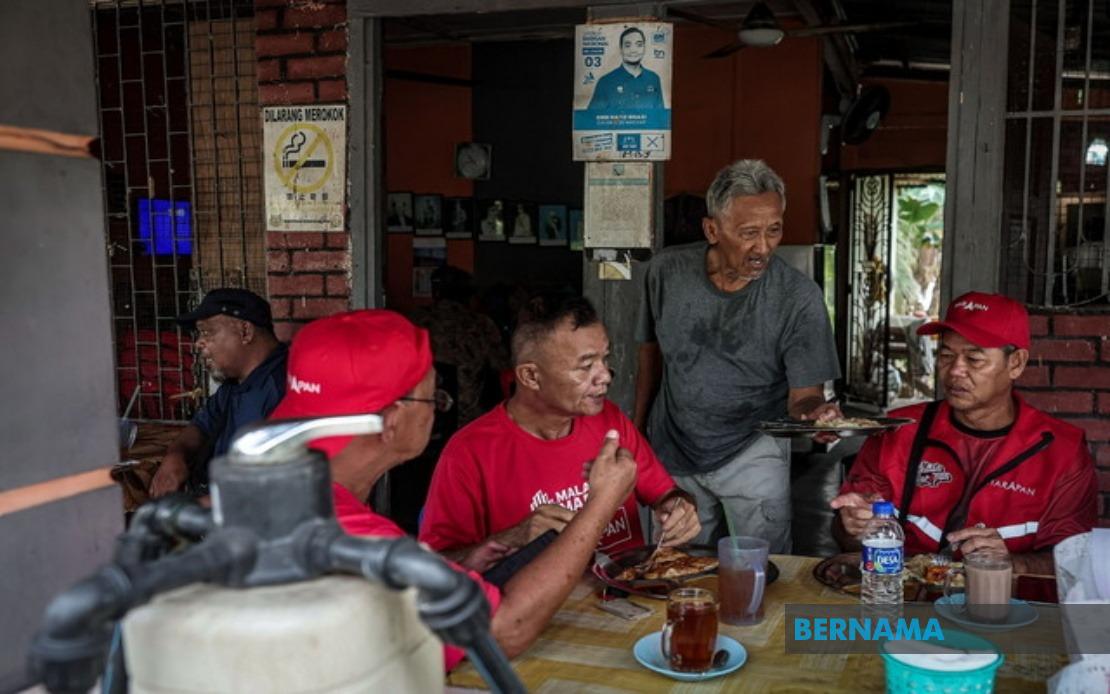
The Johor state election, scheduled for July 11, has emerged as an unlikely catalyst for economic activity among small-scale food traders and hawkers, transforming what might otherwise be an ordinary campaign season into a period of genuine commercial prosperity for workers in settlements and roadside stalls across the state.
In the Felda Layang-Layang settlement near Kluang, the visible impact has been particularly pronounced for established operators who have served the community for decades. Noorma Zafmeeden, a 70-year-old stall operator, has witnessed a striking transformation in her morning revenues since the election campaign commenced. Her warung, which typically generates less than RM400 during ordinary morning hours, has experienced what she describes as a substantial uplift in customer transactions and average transaction values. For Noorma and her husband Bahari Madiran, both long-term residents of the Felda settlement since 1987, this seasonal surge represents a meaningful augmentation to their established routine of preparing roti canai and nasi lemak before dawn and transitioning to fried dishes in the evening hours.
The economic significance of the campaign period extends beyond mere numerical increases in customer count. Bahari, who is 76 years old and has operated the warung alongside his wife for many years, observes that their establishment has transcended its commercial function to become a gathering space reflecting the multicultural character of Malaysia itself. The father of five emphasises that the diverse clientele—drawn from various ethnic and religious backgrounds—creates an environment of genuine harmony and social cohesion. He views the influx of campaign workers and visitors from across the country not merely as an opportunity to increase earnings, but as a chance to engage with fellow Malaysians from different regions and backgrounds, enriching his personal experience beyond financial considerations.
Similar patterns are evident in the Simpang Renggam area, where Ahmad Ridzuan Awang operates a nasi campur stall. The 45-year-old trader has reported that his sales volume has effectively doubled during the election campaign period. Where his prepared dishes would ordinarily deplete only by late afternoon, the heightened demand driven by campaign activity has resulted in his entire inventory clearing by 1:30 in the afternoon. This acceleration reflects both individual consumer purchases and bulk orders from political parties and campaign organisations, demonstrating how election activity stimulates demand across multiple customer segments.
The economic ramifications of this campaign-driven surge extend beyond individual food traders to encompass the broader local business ecosystem. Ahmad Ridzuan has observed that what he characterises as an influx of "political tourists"—individuals drawn to the area specifically for campaign activities—generates positive spillover effects for suppliers, logistics providers, and complementary businesses operating in the surrounding locality. This multiplier effect suggests that election campaigns can function as genuine economic stimulus for rural and semi-rural areas that might otherwise experience modest commercial activity during non-election periods.
The 2024 Johor state election represents a significant democratic exercise, with 172 candidates competing for 56 state assembly seats. The electoral schedule includes early voting scheduled for July 7, with the main polling day set for July 11. This timeline has created an extended campaign period during which traders like Noorma and Ahmad Ridzuan have benefited from sustained visitor presence and campaign-related activity throughout the state.
For small traders operating in rural Felda settlements and roadside stalls, election seasons function as irregular but predictable economic events that interrupt otherwise monotonous revenue patterns. The phenomenon reflects how democratic processes, while primarily political in nature, generate tangible economic consequences for ordinary Malaysians engaged in subsistence and modest-income commercial activities. The visibility of campaign operations, movement of political operatives between constituencies, and concentration of public attention during electoral periods all conspire to drive foot traffic and consumer spending in locations that might otherwise remain relatively quiet.
The observations from Layang-Layang and Simpang Renggam illuminate a broader dynamic within Malaysian electoral politics: the ways in which electoral contests simultaneously serve democratic functions and generate material economic activity at grassroots levels. For vendors who lack access to formal employment or substantial capital reserves, these periodic commercial surges represent meaningful additions to annual household income and provide welcome diversification from the thin margins that characterise small-scale food trading in ordinary circumstances.
Moreover, this phenomenon carries implications for how election campaigns are perceived within rural Malaysian communities. Rather than viewing electoral periods purely as disruptions to normal commercial life, traders and their families increasingly recognise such seasons as opportunities for enhanced earnings and expanded social interaction. The satisfaction expressed by both Bahari and Ahmad Ridzuan suggests that election campaigns can be experienced positively by those who benefit commercially, potentially contributing to higher engagement and participation rates among business-owning segments of the population.
The experience across Johor's petty trading sector during this election cycle demonstrates that electoral activity, while focused on political competition and citizen choice, inevitably generates economic consequences that ripple through local supply chains and informal trading networks. For traders like Noorma Zafmeeden and Ahmad Ridzuan Awang, whose margins depend on consistent customer traffic and volume sales, the campaign period represents an intersection of democratic participation and economic livelihood—a reminder that politics and commerce remain intimately connected within Malaysia's local economies.

