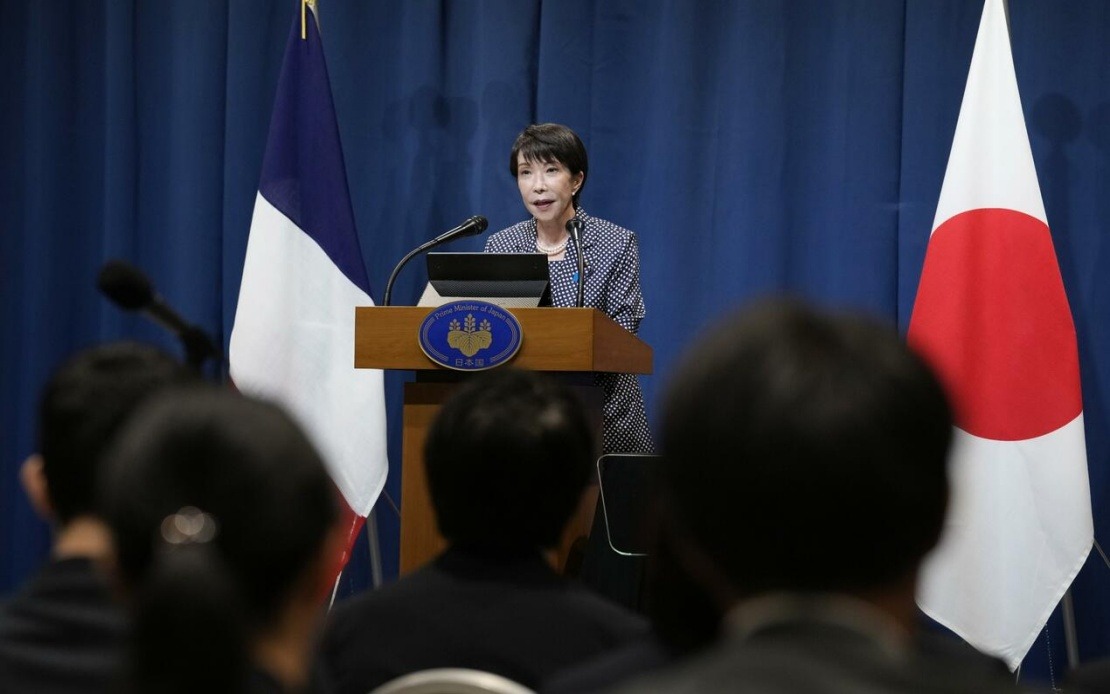
Prime Minister Sanae Takaichi's administration faces its steepest approval decline since taking office last October, with cabinet support slipping to 55.8 per cent according to a Kyodo News survey conducted over the weekend. The dip signals growing public discontent at a critical moment for Japan's economic recovery, as citizens contend with cost-of-living pressures that have become a defining domestic challenge.
The timing of the survey reveals the interconnection between Japan's vulnerable resource-based economy and global geopolitical volatility. Japan, which depends heavily on imported energy and raw materials, remains acutely sensitive to regional instability in critical shipping lanes. The polling occurred in the aftermath of a preliminary peace agreement between the United States and Iran, which included Tehran's agreement to reopen the Strait of Hormuz—a waterway through which roughly a third of global seaborne traded oil passes annually. For Japan, which imports nearly all its petroleum, the resolution offered temporary relief from concerns about supply disruptions and potential price spikes.
Yet the stabilisation of this geopolitical flashpoint has not translated into improved public confidence in Takaichi's government. The apparent disconnect suggests deeper anxieties about Japan's economic trajectory, particularly regarding inflation's persistent grip on household finances. Food and energy costs remain stubbornly elevated relative to pre-pandemic levels, forcing families to reassess budgets and curtail discretionary spending. For a nation accustomed to decades of deflationary pressures, this inflationary environment feels novel and destabilising to many consumers.
The survey also probed Japanese attitudes toward potential Self-Defence Forces deployment to the Strait of Hormuz, a contentious issue reflecting Japan's delicate balance between its alliance with the United States and its historical pacifism enshrined in its post-war constitution. A substantial majority of 54.7 per cent of respondents opposed sending Japanese naval vessels to the waterway to protect commercial shipping, viewing such involvement as unnecessarily risky and beyond Japan's appropriate role. Conversely, 36.6 per cent supported a maritime security mission, likely reflecting concerns about the direct economic impact of disrupted energy flows. The five-to-three ratio against deployment underscores public wariness about military adventurism, even in defence of national economic interests.
The government's proposed consumption tax adjustments emerge as a focal point of public debate and potential policy response to household distress. The current eight per cent rate on food and beverages, introduced several years ago, continues to rankle consumers already stretched financially. The poll indicates that 43.9 per cent of respondents find acceptable the proposal to reduce this levy to one per cent, conditional on expedited implementation. This conditional acceptance suggests pragmatic public support for targeted relief, provided the government demonstrates commitment to swift action rather than prolonged deliberation.
A notable subset of respondents, representing 22.6 per cent of the survey pool, advocates for complete elimination of consumption tax on food and beverages, in line with pledges made by Japan's ruling coalition parties during recent campaigning. This demand for zero taxation reflects the intensity of public frustration with food affordability. For Malaysia and other Southeast Asian nations watching Japan's policy trajectory, the political pressure building around consumption tax policy offers instructive lessons about the electoral salience of basic commodity costs, particularly food prices affecting working and middle-class households.
The erosion of cabinet support to 55.8 per cent, while still technically representing majority approval, marks a threshold where governments typically face intensified scrutiny from opposition parties and media. The decline represents approximately 4-5 percentage points from Takaichi's honeymoon period upon her appointment, suggesting that initial goodwill has been exhausted by the realities of governing during an economically challenging period. Japanese premiers historically face steeper approval volatility than their counterparts in some neighbouring democracies, making sustained majority support essential for policy continuity.
For the broader Southeast Asian region, Japan's domestic economic struggles carry indirect implications. As the world's third-largest economy and a major investor and trading partner throughout Asia, any Japanese recession or policy retrenchment reverberates across regional supply chains and demand patterns. Malaysia, with significant Japanese manufacturing presence and export relationships, remains sensitive to shifts in Japanese economic performance and consumer confidence. Furthermore, Japan's approach to managing inflation and household welfare provides a comparative reference point for policymakers across the region deliberating similar cost-of-living challenges.
The intersection of geopolitical risk, inflation, and domestic political stability evident in Japan's current environment illustrates the multifaceted pressures confronting contemporary Asian governments. Takaichi's administration must simultaneously address household economic anxiety, navigate delicate regional security questions, and maintain stable energy imports without sacrificing fiscal discipline or alienating allies. The public's measured scepticism toward both military deployments and rapid policy reversals suggests voters demand cautious, evidence-based governance rather than reactive populism, even during periods of economic stress.