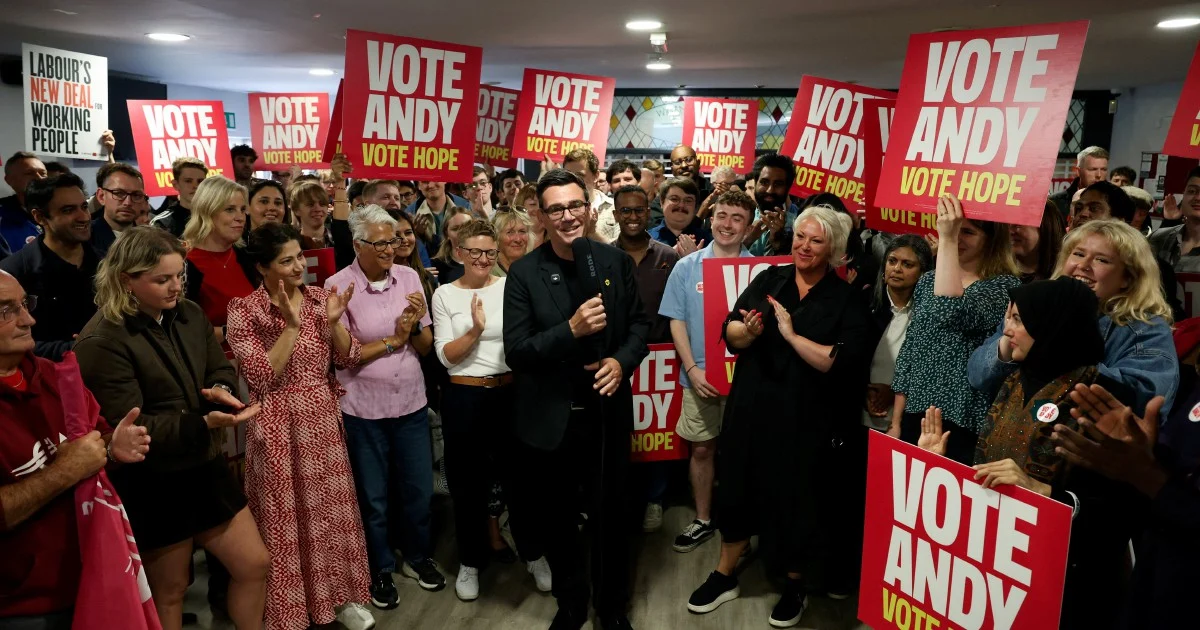
Andy Burnham's pathway to challenging Prime Minister Keir Starmer for leadership of Britain may be significantly eased not by his own political strengths but by the deepening rupture between rival right-wing populist movements competing for voters. The Labour figure faces a critical test in Thursday's Makerfield election, a contest that could reshape the political dynamics around his future ambitions. Should he prevail, the result may owe more to fractured opposition than to a compelling mandate from constituents.
The fragmentation now visible on Britain's right represents a fundamental challenge to electoral coherence among parties that once counted on consolidated support. Where voters might previously have coalesced around a single populist standard-bearer, the multiplication of competing movements offering similar ideological messaging has created dangerous divisions in their ranks. This splintering effect is particularly acute in constituencies like Makerfield, where the dispersal of right-wing votes across multiple parties weakens the ability of any single competitor to mount an effective counter-challenge to Labour candidates.
For Burnham, whose ambitions to lead the party have become increasingly public, the Makerfield contest represents essential validation. A victory would demonstrate that he retains grassroots appeal and can hold a seat against the political currents that have reshaped British politics in recent years. Yet the circumstances of such a win would be telling. Rather than reflecting personal political capital or a convincing articulation of Labour values, it would instead highlight the organizational disarray and mutual antagonism afflicting Britain's right-wing political landscape.
The two populist movements now competing for working-class and conservative-minded voters have developed a bitter rivalry that extends beyond normal inter-party competition. Their leaders and activists frequently train attacks on one another with an intensity that sometimes exceeds their criticism of Labour itself. This internal preoccupation leaves both movements weakened and divided, unable to present a unified alternative to Starmer's government.
Makerfield presents a microcosm of these broader national dynamics. The seat has traditionally been Labour territory, but recent years have witnessed significant shifts in working-class voting patterns across similar constituencies. The right-wing parties hoped to capitalize on these realignments, but their mutual hostility undermines that objective. Where they might have combined to mount a serious challenge, they instead stand fractured.
For Malaysian observers and Southeast Asian readers, this British political moment offers instructive parallels about coalition-building and voter fragmentation. In multiparty democracies across the region, the phenomenon of opposition splitting—whether intentional or accidental—frequently determines electoral outcomes. When competing political movements share similar ideological territory but lack sufficient organizational discipline or personal reconciliation among leaders, the result is typically a weakening of their collective influence. Britain's experience demonstrates that such fragmentation transcends geography and political culture.
The implications for Starmer's government extend beyond a single by-election result. If Burnham's victory in Makerfield comes about primarily because his opponents cancel each other out rather than because Labour has articulated a compelling vision, it suggests deeper vulnerabilities in the government's long-term political position. A prime minister whose majority rests on the incompetence or disarray of opposition parties rather than on genuine public confidence enjoys a precarious mandate. This distinction matters significantly as Starmer seeks to establish his government as a stable force following years of Conservative turbulence.
Burnham's own political trajectory has been noteworthy. As Greater Manchester mayor, he built a reputation for regional advocacy and occasionally combative engagement with Westminster. His profile has grown considerably, and speculation about his future leadership ambitions has intensified. The Makerfield election represents an opportunity to transition from regional prominence to a seat in the Commons, traditionally essential for anyone seeking to lead a major party. However, the manner of victory would shape perceptions of his political viability.
The right-wing parties show no signs of reconciliation despite their electoral weakness. Their leaders have constructed separate brands and constituencies that, while overlapping significantly, remain distinct in political rhetoric and organizational structure. Neither appears willing to subordinate its identity or interests to create a unified opposition force. This intransigence virtually guarantees continued division in constituencies across Britain, benefiting Labour candidates in the process.
Thursday's result in Makerfield will therefore tell a specific story about contemporary British politics: that parties capable of challenging an incumbent government are instead focused on undermining one another. For Burnham, victory achieved through such circumstances would be bittersweet—a win that advances his personal ambitions while simultaneously highlighting the shallow foundations upon which the government's electoral strength rests. As British politics continues to fracture and realign, the question of whether any force can genuinely unite opposition voters remains unresolved.

%22%2F%3E%3C%2Fpattern%3E%3C%2Fdefs%3E%3Crect%20width%3D%22100%25%22%20height%3D%22100%25%22%20fill%3D%22url(%23ph21o2sg)%22%2F%3E%3Crect%20width%3D%22100%25%22%20height%3D%22100%25%22%20fill%3D%22url(%23ph21o2sp)%22%2F%3E%3Ctext%20x%3D%2250%25%22%20y%3D%2250%25%22%20text-anchor%3D%22middle%22%20dominant-baseline%3D%22central%22%20fill%3D%22rgba(255%2C255%2C255%2C0.95)%22%20font-family%3D%22Georgia%2C%20'Times%20New%20Roman'%2C%20serif%22%20font-weight%3D%22700%22%20font-size%3D%22170%22%20letter-spacing%3D%22-0.02em%22%3EGabungan%3C%2Ftext%3E%3C%2Fsvg%3E)