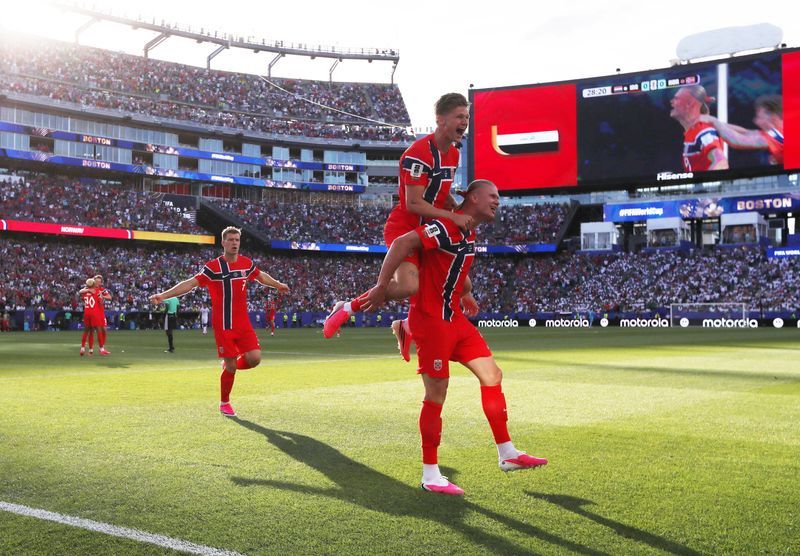
Erling Haaland has announced himself on football's grandest stage with characteristic ruthlessness, firing Norway to a commanding 4-1 victory over Iraq in their World Cup match on Tuesday. The Norwegian striker's devastating first-half brace showcased precisely why he carries the weight of his nation's expectations, producing a masterclass in clinical finishing that overshadowed his team's otherwise inconsistent performance across the 90 minutes.
Haaland's two-goal contribution extends a remarkable career trajectory that few modern footballers can match. The 23-year-old striker has now found the net on his competitive debut in virtually every major arena: the German Bundesliga, English Premier League, Champions League, and now the World Cup finals. His ability to perform at the highest level of international football validates the considerable optimism that surrounds his candidacy to become one of the tournament's standout performers, though observers caution against complacency given the challenges that lie ahead.
What made Haaland's display particularly noteworthy was how it salvaged a performance that saw Norway struggle to impose a coherent tactical identity for long stretches. The team committed numerous passing errors and failed to control proceedings for sustained periods, yet the quality of Haaland's finishing proved decisive. His opening goal arrived through textbook predatory instinct when David Moller Wolfe delivered a precise ball across the box, requiring only a composed finish that Haaland duly provided. The second exemplified his work ethic and anticipation: aggressive pressing on the Iraqi defence forced a loose backpass, and when the goalkeeper attempted to clear the error, Haaland's positioning allowed him to block the ball into the net.
The contrast between Haaland's commanding presence and his team's overall midfield performance was stark. Captain Martin Odegaard, Norway's creative fulcrum and primary playmaker, operated unusually subdued throughout the encounter, failing to orchestrate the rhythm and tempo that the team required. Norwegian Prime Minister Jonas Gahr Stoere had emphasised on the eve of the match that while individuals score goals, teams secure victories through collective effort. Haaland's intervention meant that philosophical point went largely untested, though manager Stale Solbakken's tactical approach—essentially to position Haaland and unleash him whenever opportunity presented—proved sufficient for this stage of the tournament.
Norway's defensive organisation also deserved scrutiny despite the convincing scoreline. When Iraq equalised through Aymen Hussein's goal, it resulted from inexplicable ball-watching by the Norwegian back line, a lapse that suggested complacency rather than Iraqi tactical superiority. The ease with which Iraq breached the defensive line served as a warning that more disciplined opponents would punish such lapses. For a team making its first World Cup appearance in 28 years, such defensive vulnerabilities could prove costly in upcoming fixtures against more formidable attacking units.
The victory positions Norway at the summit of their group with three points, though that advantage is precarious. France's 3-1 demolition of Senegal earlier on the same day means the standings could shift dramatically following subsequent matches. Haaland himself struck a note of caution following the match, suggesting his team must elevate their standards considerably in upcoming contests. The striker's measured assessment reflects awareness that controlling matches and performing consistently under pressure differ fundamentally from defeating opponents who lack world-class technical standards.
Norway's return to the World Cup after a 28-year hiatus resonates particularly throughout Scandinavian football. The nation's absence from successive tournaments had become a source of frustration for football enthusiasts across the region, making Tuesday's victory a genuine cause for celebration despite the performance limitations evident throughout. For Malaysian and Southeast Asian observers, Norway's journey offers instructive parallels: smaller nations can still compete at the highest level through strategic recruitment, tactical discipline, and the cultivation of genuinely elite individual talents like Haaland.
Haaland's demeanour following the match reflected justified confidence mixed with appropriate humility. When asked about the result, he expressed satisfaction that his team had avoided an upset defeat, indicating the pressure placed upon Norway as favourites within their group. Though he acknowledged uncertainty about the time back home, he expressed hope that Norwegian fans were celebrating appropriately—a modest touch that contrasted with the explosive nature of his play on the pitch. His reticence to dominate media commentary, preferring instead to let his performances speak louder than words, represents a refreshing approach in an era of constant player interviews and social media engagement.
For Norway, the challenge now intensifies considerably. Remaining group opponents will arrive with superior tactical organisation and individual quality compared to Iraq, meaning Haaland cannot carry matches single-handedly. The team must demonstrate improvement in midfield control, defensive organisation, and general cohesion to progress from the group stage. Yet with Haaland providing regular goals and performing under the tournament's intense pressure, Norway possesses genuine potential to surprise sceptics. The striker's World Cup announcement has been made; now his team must ensure they can deliver a sustained campaign rather than merely a memorable opening performance.

%22%2F%3E%3C%2Fpattern%3E%3C%2Fdefs%3E%3Crect%20width%3D%22100%25%22%20height%3D%22100%25%22%20fill%3D%22url(%23ph21o2sg)%22%2F%3E%3Crect%20width%3D%22100%25%22%20height%3D%22100%25%22%20fill%3D%22url(%23ph21o2sp)%22%2F%3E%3Ctext%20x%3D%2250%25%22%20y%3D%2250%25%22%20text-anchor%3D%22middle%22%20dominant-baseline%3D%22central%22%20fill%3D%22rgba(255%2C255%2C255%2C0.95)%22%20font-family%3D%22Georgia%2C%20'Times%20New%20Roman'%2C%20serif%22%20font-weight%3D%22700%22%20font-size%3D%22170%22%20letter-spacing%3D%22-0.02em%22%3EGabungan%3C%2Ftext%3E%3C%2Fsvg%3E)