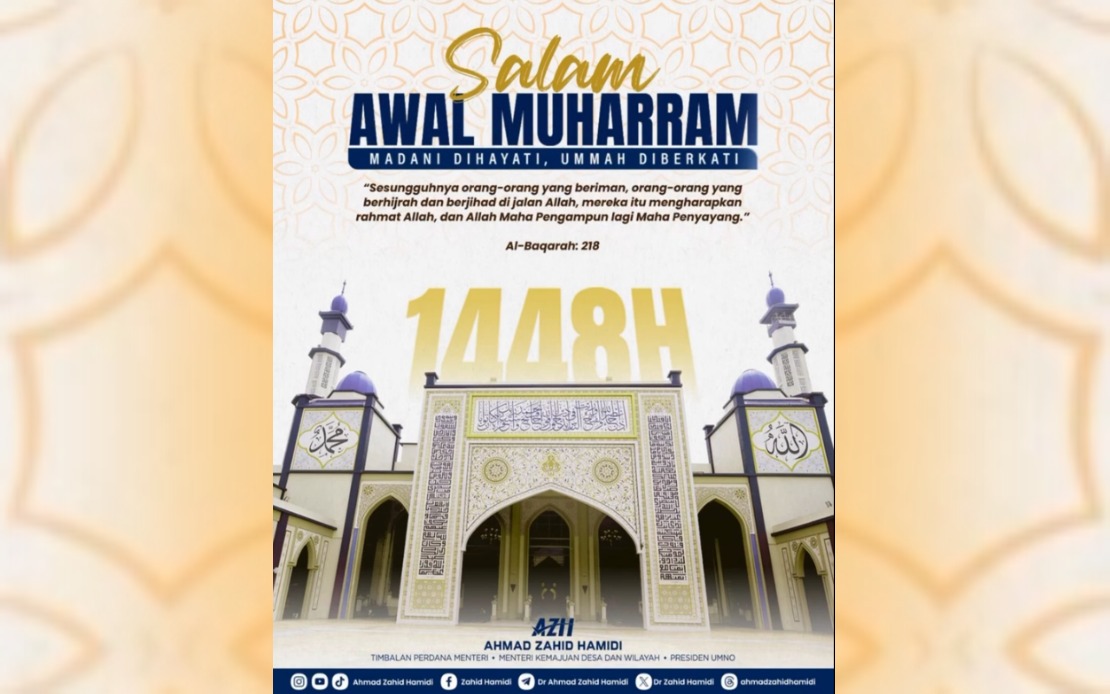
Malaysia's senior political leadership has seized the occasion of Awal Muharram 1448H to call for a nationwide embrace of the Hijrah spirit, framing the Islamic New Year not merely as a calendar milestone but as a moment for meaningful personal and collective transformation. Deputy Prime Minister Datuk Seri Dr Ahmad Zahid Hamidi emphasized that the Maal Hijrah observance serves as a critical reminder that genuine change demands far more than rhetoric—it requires concerted effort, discipline and unwavering commitment to self-improvement and progress. Speaking through a Facebook post, he positioned the new Hijrah year as an opportunity for Malaysians to fortify their determination to serve their communities and nation with sincerity and greater intentionality.
The Deputy Prime Minister drew directly on the historical significance of the Hijrah, the Prophet Muhammad's migration from Mecca to Medina, to extract contemporary lessons applicable to Malaysia's present circumstances. He highlighted how the ancient journey exemplifies the values of sacrifice and perseverance that remain essential for navigating modern life's obstacles. In his view, these foundational Islamic principles should continue to guide the nation's leadership, workforce and broader citizenry as they engage in their respective roles and responsibilities. Zahid Hamidi further characterized the current global environment as one demanding courage—specifically the courage to initiate substantive reforms, acknowledge systemic weaknesses and persistently pursue improvement for collective advancement.
Deputy Prime Minister Datuk Seri Fadillah Yusof approached the Hijrah message from a more pragmatic angle, explicitly connecting it to Malaysia's economic vulnerabilities and resource constraints. He stressed that the observance transcends mere ceremonial significance; instead, it represents a summons to strengthen interpersonal bonds and deepen commitment to familial and national welfare. Fadillah articulated a vision of Hijrah as a call to enhanced responsibility and moral accountability across Malaysian society. He specifically referenced the turbulent international economic landscape—characterized by supply disruptions, logistical bottlenecks and persistent uncertainty—as circumstances that demand Malaysians extract and apply the Hijrah spirit's core lessons of prudence, adaptability and fortitude.
The Deputy Prime Minister elaborated on Islamic teachings regarding moderation and resource stewardship, positioning these concepts as practical responses to contemporary pressures. He advocated for cultivating disciplined spending habits, conscientious energy consumption and deliberate avoidance of wastefulness in food and water usage. Rather than treating these recommendations as burdensome restrictions, Fadillah framed them as opportunities for collective impact—suggesting that cumulative small choices by individuals and families can substantially improve national wellbeing and stability. This messaging implicitly acknowledges Malaysia's vulnerability to external economic shocks while empowering ordinary citizens to contribute meaningfully through daily decisions.
Fadillah further grounded his Hijrah commentary in Malaysia's foundational strength: national unity rooted in diverse communities coexisting peacefully. He cautioned against allowing societal differences to become divisive forces, instead promoting mutual respect, cooperative spirit and shared dedication to maintaining the nation's peace and prosperity. This emphasis on unity carries particular resonance in the Malaysian context, where religious and ethnic plurality necessitates ongoing commitment to social cohesion. By tethering the Hijrah spirit to Malaysia's pluralistic identity, Fadillah positioned the Islamic New Year observance as a moment for all citizens—regardless of religious affiliation—to recommit to collective harmony and progressive advancement.
Communications Minister Datuk Fahmi Fadzil contributed a more introspective framing, characterizing the arrival of 1 Muharram as providing space for reflection, recalibrated resolve and deepened spiritual conviction. His commentary emphasized Hijrah as teaching courageous transformation, patient perseverance through adversity and sincere dedication to meaningful endeavors. This formulation presents the Islamic New Year as psychologically and spiritually significant beyond its religious dimensions, offering all Malaysians—particularly those engaged in public communication and information work—a framework for renewed purpose and authenticity in their professional contributions.
Minister in the Prime Minister's Department (Religious Affairs) Zulkifli Hasan approached the occasion with particular attention to spiritual practice and personal introspection. He reframed the public holiday dimension of 1 Muharam, stressing its primary importance as an occasion for Muslims to engage in deep self-examination and moral improvement (Islah). Zulkifli provided specific religious guidance regarding prayer observances, encouraging Muslims to recite end-of-year prayers for 1447H before Maghrib and beginning-of-year prayers for 1448H after Maghrib, ideally performed alongside family members. This detailed instruction demonstrates how spiritual leaders within government are facilitating meaningful religious practice during the transition between Islamic calendar years, connecting official messaging to lived religious experience.
The breadth of Cabinet participation in the Hijrah messaging underscores the Malaysian government's desire to project coherence and unified national purpose across diverse ministerial portfolios. Agriculture and Food Security Minister Datuk Seri Mohamad Sabu, Science, Technology and Innovation Minister Chang Lih Kang, Women, Family and Community Development Minister Datuk Seri Nancy Shukri, Education Minister Fadhlina Sidek, and National Unity Minister Datuk Aaron Ago Dagang all extended formal Hijrah greetings, alongside Investment, Trade and Industry Minister Datuk Seri Johari Abdul Ghani, Health Minister Datuk Seri Dzulkefly Ahmad, and Digital Minister Gobind Singh Deo. This comprehensive ministerial engagement suggests deliberate strategic coordination to ensure the Hijrah message penetrates multiple policy domains and governmental levels.
The sustained emphasis on unity, reform and resilience across these official messages reflects broader governance anxieties regarding Malaysia's current trajectory. The repeated invocation of prudence, adaptability and internal strength suggests administration recognition that external circumstances—global economic instability, supply chain vulnerabilities, geopolitical uncertainties—require enhanced national cohesion and collective discipline. By grounding these practical imperatives in Islamic theological principles accessible to Malaysia's Muslim majority, government leaders effectively deployed religious observance as a vehicle for promoting contemporary policy objectives.
For Malaysian readers navigating persistent economic pressures, rising living costs and social fragmentation, the government's Hijrah messaging offers both spiritual sustenance and practical framework for action. The emphasis on modest consumption, resource conservation and mutual support provides dignity to necessary belt-tightening while framing participation in national resilience as spiritually significant rather than merely sacrificial. Simultaneously, the insistent focus on unity and interfaith respect positions the Islamic New Year as a moment when religious practice reinforces rather than threatens the national social contract, a particularly important reassurance in contemporary Southeast Asia.
The Maal Hijrah 1448H observance thus transcends ceremonial significance in Malaysia's governance context, functioning as a coordinated effort by the nation's political leadership to reorient citizens toward values of disciplined self-improvement, collective responsibility and steadfast unity. Whether this messaging translates into sustained behavioral change and strengthened national cohesion remains uncertain, but the comprehensiveness of official participation and the deliberate theological grounding of policy imperatives suggest the government recognizes Hijrah's potential to mobilize national sentiment during a period demanding sacrifice and renewed commitment.

%22%2F%3E%3C%2Fpattern%3E%3C%2Fdefs%3E%3Crect%20width%3D%22100%25%22%20height%3D%22100%25%22%20fill%3D%22url(%23ph21o2sg)%22%2F%3E%3Crect%20width%3D%22100%25%22%20height%3D%22100%25%22%20fill%3D%22url(%23ph21o2sp)%22%2F%3E%3Ctext%20x%3D%2250%25%22%20y%3D%2250%25%22%20text-anchor%3D%22middle%22%20dominant-baseline%3D%22central%22%20fill%3D%22rgba(255%2C255%2C255%2C0.95)%22%20font-family%3D%22Georgia%2C%20'Times%20New%20Roman'%2C%20serif%22%20font-weight%3D%22700%22%20font-size%3D%22170%22%20letter-spacing%3D%22-0.02em%22%3EGabungan%3C%2Ftext%3E%3C%2Fsvg%3E)