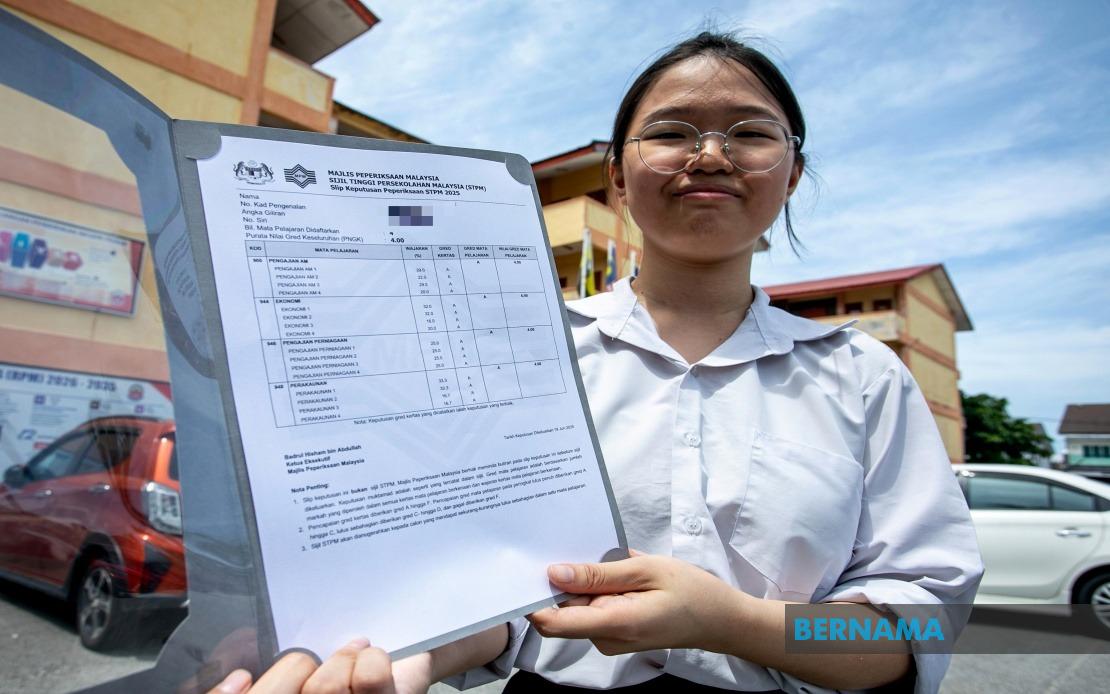
Yong Xin Yi, a 20-year-old student from Sekolah Menengah Kebangsaan Jalan Tasek in Ipoh, has emerged as one of the standout performers in this year's Sijil Tinggi Persekolahan Malaysia examination, securing an impressive four A grades with a perfect Cumulative Grade Point Average of 4.00. Her exceptional achievement in General Studies, Principles of Accounting, and Economics represents the culmination of a methodically structured approach to examination preparation that balanced classroom participation with consistent home revision. The examination results, released in June 2025, placed her among five elite students from her institution who attained the same four-A benchmark, underscoring the effectiveness of her disciplined learning methodology.
The foundation of Xin Yi's academic success rests upon a rigorously maintained revision schedule that she has maintained throughout her STPM studies. Beginning each day at 5:00 pm and continuing until 10:00 pm, she dedicated five consecutive hours to reinforcing concepts and working through examination-style questions. What distinguishes her approach from conventional study methods is the deliberate integration of classroom learning with home-based reinforcement. Rather than viewing these revision sessions as isolated study periods, Xin Yi conceptualised them as extensions of her in-class learning, allowing her to clarify ambiguities and deepen her understanding of material presented by her teachers. This synergistic relationship between classroom engagement and home revision created a comprehensive learning ecosystem that maximised knowledge retention.
Crucially, Xin Yi emphasised that her in-class focus represented a more valuable investment of her intellectual energy than extended revision sessions alone. By maintaining active concentration during lessons and absorbing explanations directly from her teachers, she substantially reduced the cognitive burden of independent study later. This approach reflects an understanding that quality of attention during instruction often yields greater returns than quantity of time spent reviewing material afterwards. The strategy proved particularly effective for subjects requiring conceptual understanding rather than pure memorisation, allowing her to grasp fundamental principles at their point of introduction rather than struggling to reconstruct understanding through notes later.
Completion of assigned homework formed an integral component of her study architecture. Rather than treating homework as an obligatory exercise to satisfy teacher requirements, Xin Yi recognised it as a practical mechanism for mastering course content. Each assignment provided an opportunity to apply recently learned concepts to concrete problems, identifying gaps in understanding before they could consolidate into persistent misconceptions. This proactive approach to homework transformed routine assignments into valuable diagnostic tools that guided her revision priorities and ensured comprehensive coverage of examination syllabuses.
Among her three examination subjects, General Studies presented the most formidable challenge, requiring not merely factual knowledge but sophisticated written expression and precise adherence to specific answer formats and assessment criteria. Recognising this particular vulnerability, Xin Yi strategically allocated additional attention to the subject, treating it as a priority area deserving concentrated effort. This targeted intervention demonstrates a mature approach to academic problem-solving—identifying weaknesses early and addressing them through enhanced focus rather than allowing deficiencies to accumulate. Her willingness to confront and overcome subject-specific challenges exemplifies the kind of adaptive learning that distinguishes exceptional students from merely competent ones.
Beyond the technical aspects of examination preparation, Xin Yi credited her parents with providing the emotional and motivational foundation necessary for sustained academic effort. As the only child in her family, she occupies a distinctive position within her household, and her parents—her mother working as a clerk and her father as a phone salesman—invested considerable faith in her educational aspirations. Their consistent encouragement throughout her studies created a supportive environment that allowed her to pursue her intellectual goals with confidence. This family dimension proves particularly significant in understanding academic achievement, as psychological support frequently proves as crucial as study techniques in determining examination outcomes.
Xin Yi's accomplishment carries particular resonance for students from modest socioeconomic backgrounds across Malaysia. Her parents' professional backgrounds, while respectable, represent ordinary working-class employment rather than affluent circumstances. The family's circumstances demonstrate that exceptional academic outcomes need not depend upon expensive tuition classes or privileged social positions. Instead, structured personal discipline, parental encouragement, and strategic classroom engagement can generate achievement outcomes equivalent to those obtained through more resource-intensive pathways. This case study offers genuine inspiration to Malaysian students whose families face financial constraints but possess strong commitment to educational advancement.
Looking beyond her STPM results, Xin Yi has articulated clear educational ambitions centred upon economic studies. She plans to pursue a degree in economics at Universiti Putra Malaysia, having carefully evaluated both her personal interests and the career trajectory available within this discipline. Her aspiration to become an economist reflects a thoughtful career selection process grounded in realistic assessment of both aptitude and professional opportunity. The economics field offers diverse career pathways across government, financial institutions, research organisations, and international agencies, providing genuine scope for professional advancement aligned with her academic strengths.
Xin Yi has articulated her intention to leverage her academic success toward improving her family's circumstances and rewarding her parents' sacrifices. This motivation—extending academic achievement beyond personal fulfilment toward broader family benefit—represents a value orientation common among Malaysian students but often overlooked in discussions of academic performance. Her determination to translate educational credentials into tangible family improvement reflects a perspective that education constitutes not merely individual advancement but an instrument for intergenerational social mobility. Such purpose-driven motivation frequently proves more sustaining than achievement-oriented ambition alone, providing psychological resources to overcome inevitable obstacles encountered during rigorous tertiary study.
The broader implications of Xin Yi's achievement merit consideration within Malaysia's educational context. Her five-hour daily revision schedule, while substantial, remains achievable for motivated students without requiring disruptive lifestyle modifications or expensive external resources. Her emphasis upon classroom focus as a primary study strategy offers a valuable counterpoint to the tutorial-centre culture prevalent among Malaysian families seeking examination success. Her achievement demonstrates that systematic discipline, strategic prioritisation of subject-specific challenges, and consistent execution of a thoughtfully designed study plan can generate results equivalent to, or surpassing, those obtained through more elaborate or expensive preparation methodologies. As more Malaysian students transition through upper secondary education toward tertiary studies, exemplars like Xin Yi illustrate that sustainable academic excellence emerges from disciplined personal habits rather than privileged circumstances.

%22%2F%3E%3C%2Fpattern%3E%3C%2Fdefs%3E%3Crect%20width%3D%22100%25%22%20height%3D%22100%25%22%20fill%3D%22url(%23ph340i1g)%22%2F%3E%3Crect%20width%3D%22100%25%22%20height%3D%22100%25%22%20fill%3D%22url(%23ph340i1p)%22%2F%3E%3Ctext%20x%3D%2250%25%22%20y%3D%2250%25%22%20text-anchor%3D%22middle%22%20dominant-baseline%3D%22central%22%20fill%3D%22rgba(255%2C255%2C255%2C0.95)%22%20font-family%3D%22Georgia%2C%20'Times%20New%20Roman'%2C%20serif%22%20font-weight%3D%22700%22%20font-size%3D%22170%22%20letter-spacing%3D%22-0.02em%22%3EMalaysia%3C%2Ftext%3E%3C%2Fsvg%3E)