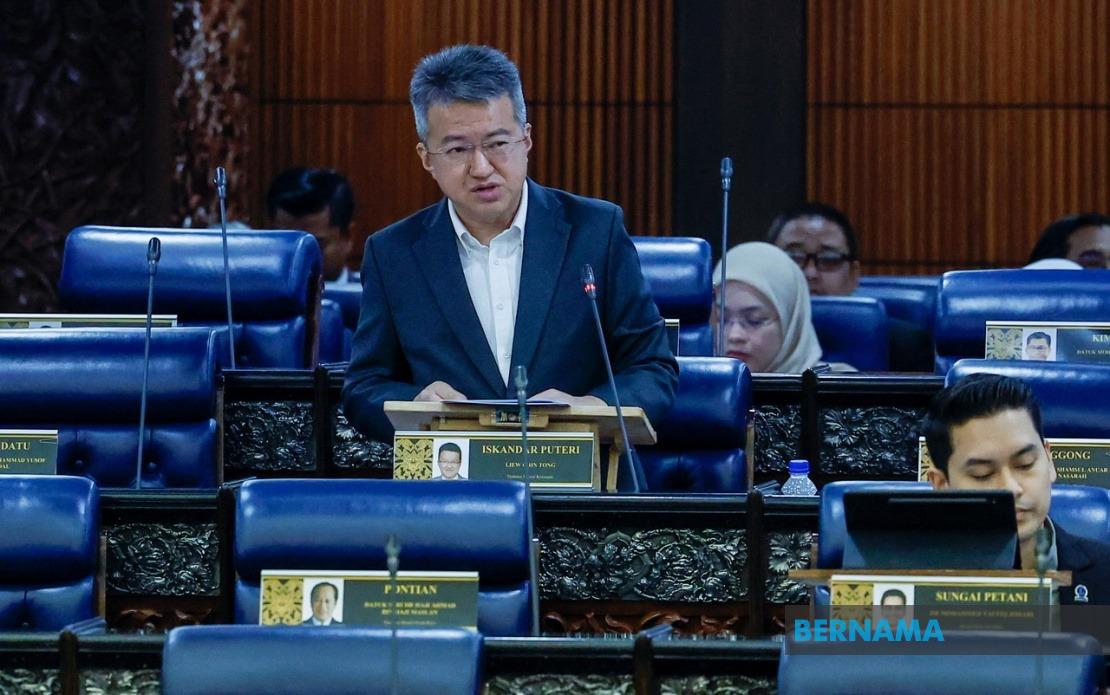
The federal government has moved to clarify its fiscal commitments to Sabah, asserting that a RM1.5 billion boost to the state's interim special grant will operate independently of existing development and operating budget allocations. Deputy Finance Minister Liew Chin Tong made the assurance during parliamentary proceedings on July 14, responding to parliamentary concerns about whether the increased special grant—first announced by Prime Minister Datuk Seri Anwar Ibrahim in May—might cannibalise other funding streams destined for Sabah's infrastructure and essential services.
The distinction matters significantly for Sabah's fiscal landscape. Under the current federal budget, the state's development allocation has expanded to RM6.9 billion from RM6.7 billion, representing a modest but tangible increase. Liew emphasised that this expansion would continue funding an extensive portfolio of capital projects, ranging from the strategically important Pan Borneo Highway to foundational infrastructure in rural communities. The government's development agenda encompasses rural road networks, electrification programmes serving remote areas, water supply systems, and facility upgrades spanning hospitals, primary health clinics, dilapidated school buildings, and police stations across the state.
For Malaysian observers tracking intergovernmental fiscal dynamics, the clarification addresses a fundamental tension in federal-state relations. The special grant mechanism, enshrined in Article 112C of the Federal Constitution, represents a constitutional obligation distinct from ordinary budget allocations. By ringfencing the RM1.5 billion increase and confirming that conventional development budgets remain untouched, the federal government is attempting to demonstrate simultaneous respect for constitutional arrangements and capacity for additional resource transfers. This matters because Southeast Asia's federal systems often struggle with coordinating multiple funding mechanisms without generating zero-sum fiscal competition between tiers of government.
Beyond capital infrastructure, the federal government has committed to sustained support for Sabah's operating costs, particularly in the electricity sector. Despite transferring regulatory authority over electricity supply to the Sabah state government in 2024, Kuala Lumpur will maintain subsidy provision to cushion consumers from market prices. The electricity subsidy allocation for 2026 is projected to reach RM880 million, representing ongoing federal financial commitment to keeping utility costs manageable in a state where higher transportation costs already elevate living expenses. This arrangement reflects pragmatic fiscal federalism: Sabah gains regulatory control while remaining shielded from the fiscal volatility of full cost-recovery pricing.
Water infrastructure has emerged as another focal point for increased investment. Rural water supply allocations have jumped substantially, climbing from RM103.5 million in 2025 to RM143 million in the current year. This 38 per cent increase addresses chronic service gaps in Sabah's interior communities, where pipeline infrastructure often remains inadequate or severely deteriorated. For Malaysian policymakers concerned with equitable development outcomes, such targeted investment seeks to narrow the urban-rural service divide that has historically characterised East Malaysian states.
Cost-of-living assistance programmes have also expanded significantly in Sabah, with combined allocations under the Sumbangan Tunai Rahmah (STR) and Sumbangan Asas Rahmah (SARA) schemes reaching approximately RM1.2 billion. These direct cash transfers represent the federal government's response to inflationary pressures affecting household budgets across the country. For Sabah specifically, where household incomes often lag Peninsular Malaysia and goods imported from the peninsula command premium prices, such assistance programmes provide meaningful economic relief to lower and middle-income families.
The procedural framework governing the special grant disbursement carries constitutional weight. Both the federal and Sabah state governments must observe processes stipulated under Article 112D of the Federal Constitution, replicating mechanisms successfully implemented during 2022, 2023, and 2025 payment cycles. This regularised approach reduces administrative friction and establishes predictability in intergovernmental transfers, elements particularly important for state-level financial planning in a system where unexpected fiscal shocks can disrupt subnational budgets.
Underlying these assurances sits a more complex constitutional narrative. The federal government has filed an appeal against certain aspects of the Kota Kinabalu High Court's ruling on special grant matters, yet simultaneously affirms respect for the constitutional principle itself. This apparent contradiction reflects the genuine tension between interpreting Article 112C and addressing fiscal sustainability concerns at federal level. Liew's parliamentary statement seeks to signal that constitutional compliance and federal fiscal interests are not irreconcilable, positioning the government as both constitutionally faithful and fiscally prudent.
Looking forward, federal and state authorities have committed to negotiating a permanent mechanism for determining future special grant levels, working within the framework established by Articles 112C and 112D. This forward-looking posture acknowledges that ad hoc arrangements, however well-intentioned, ultimately create uncertainty for state development planning. A durable formula tied to transparent principles would provide Sabah with greater confidence in medium-term fiscal projections, facilitating more ambitious infrastructure and social programmes.
For Southeast Asian federalism scholars, Sabah's fiscal arrangements illustrate both the opportunities and complexities of divided sovereignty. The state's constitutional entitlements to special grants reflect its historically distinct status within the Malaysian federation, negotiated during 1963 negotiations establishing Malaysia. Yet translating such constitutional guarantees into actual fiscal flows requires continuous political negotiation and administrative coordination. The assurances offered by the Deputy Finance Minister reflect this ongoing negotiation process, where constitutional text meets fiscal reality and competing priorities intersect.

