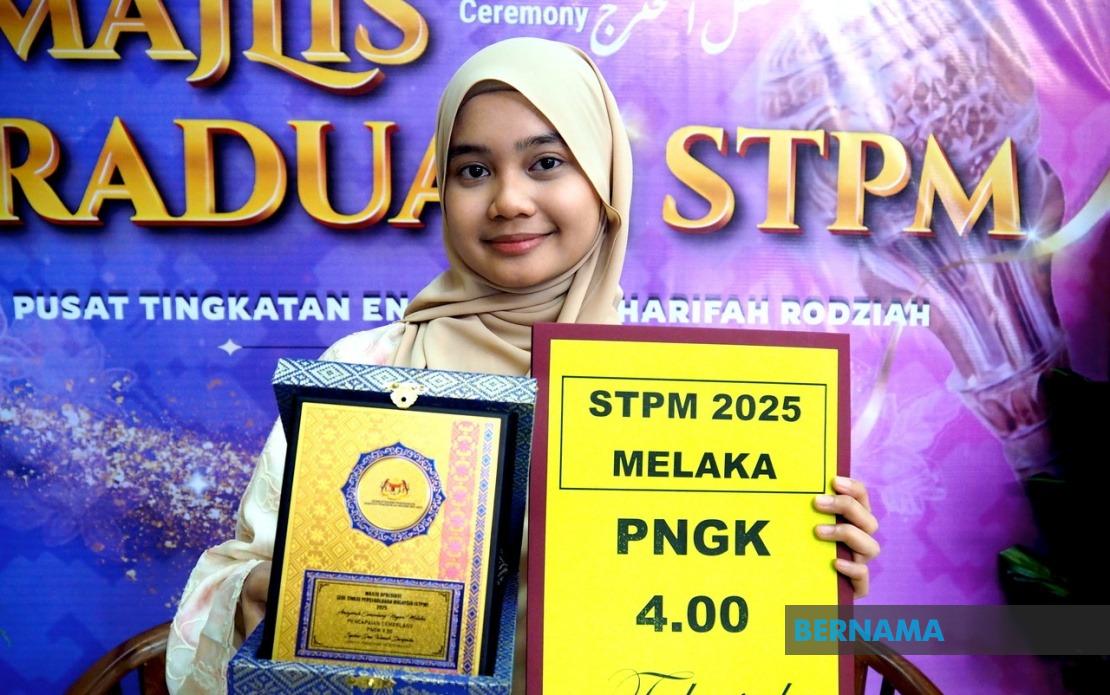
Nurfariesya Nasywa Hamedee has turned personal tragedy into academic triumph, securing a flawless Cumulative Grade Point Average of 4.00 in this year's Sijil Tinggi Persekolahan Malaysia examination. The 21-year-old student from Sekolah Menengah Kebangsaan Agama Sharifah Rodziah in Melaka credits a single piece of counsel from her father, delivered just before his unexpected death, as the cornerstone of her determination to excel despite overwhelming grief.
Hamedee Asri passed away from a heart attack one week before Nurfariesya was scheduled to sit for her Sijil Pelajaran Malaysia trial examination several years ago. The loss struck at a vulnerable moment in her academic journey, threatening to derail her studies entirely. The emotional toll was so severe that the teenager seriously contemplated abandoning her education altogether, preferring instead to enter the workforce to help support her family during a period of financial strain and emotional upheaval.
What ultimately saved her academic prospects was her father's parting message, passed through her mother Yusnita Ruslan, urging Nurfariesya not to squander her abilities and potential. This simple but profound instruction became the emotional anchor that pulled her back from the brink of quitting. Rather than allowing grief to define her trajectory, she channelled her loss into motivation, transforming her father's final words into a tangible goal she could pursue through academic achievement. Every examination revision session and every challenging assignment thereafter became an act of honouring his memory and respecting his faith in her capabilities.
The announcement of her STPM results yesterday at the Melaka State STPM Results ceremony, officiated by Datuk Rosli Abdullah (State Deputy Exco for Education, Higher Education, and Religious Affairs), represented vindication of her struggles. What makes her achievement particularly noteworthy is that she significantly exceeded her own expectations. Based on trial examination performance and her initial calculations, Nurfariesya had anticipated a CGPA of approximately 3.92, making the perfect 4.00 score an unexpected reward for her perseverance. She is among the elite cohort of students whose dedication produced flawless academic records.
Her path to this excellence was shaped by genuine intellectual curiosity rather than mere grade-chasing. Since her formative years in school, Nurfariesya developed a keen interest in Shariah law, a passion that sustained her through the most difficult periods of her studies. She pursued a challenging subject combination including General Studies, Arabic, Usuluddin (Islamic Theology), History, and Shariah, demonstrating depth of intellectual engagement across multiple disciplines. This genuine enthusiasm for her field of study proved far more effective than any rote memorisation technique, providing intrinsic motivation that external rewards cannot replicate.
The third of four siblings has already charted an ambitious career path that builds on this academic foundation. Her aspiration is to become a Shariah lawyer, combining her demonstrated mastery of Islamic jurisprudence with legal practice. She has already progressed through the interview process for a Bachelor's Degree program at Universiti Malaya, positioning herself for admission to one of Malaysia's most prestigious institutions. This trajectory represents the natural extension of her demonstrated capabilities and intellectual interests, suggesting that her STPM achievement is merely the beginning of a promising professional journey.
When asked to distil the secret to her success, Nurfariesya rejected the notion of hidden formulas or special techniques. Instead, she emphasised the fundamentals: consistent hard work, resilience in the face of setbacks, and unwavering spiritual faith. This measured response reflects a maturity often absent in high-achieving students who sometimes attribute success to luck or innate talent. Her emphasis on perseverance and religious conviction resonates particularly strongly within the Malaysian context, where these values carry deep cultural significance.
Her decision to pursue STPM rather than matriculation or other pre-university pathways was itself a strategic choice. She recognised that the STPM route offered a more direct pathway to undergraduate studies while simultaneously opening multiple channels into Malaysia's higher education institutions. This pragmatic approach to educational planning demonstrates that her academic success stems not merely from intelligence but from thoughtful decision-making and clear goal-setting throughout her secondary education.
Meanwhile, another exceptional student has brought further distinction to Melaka's educational achievements. Ng Zhen Hong, a 20-year-old from Kolej Tingkatan Enam Tun Fatimah, has been recognised as the recipient of the National-Level Best Student Award for the Science Stream in the 2025 STPM examination. His elevation to this national honour reflects the consistent calibre of Melaka's student cohort and the quality of teaching and support available within the state's educational institutions.
Ng's approach to academic excellence differs from Nurfariesya's in its disciplinary focus yet mirrors her achievements in terms of dedication and strategic effort. As the eldest of two siblings, he attributes his success substantially to parental support and guidance from his teachers, alongside a genuine passion for scientific disciplines. Rather than viewing science as a collection of formulae to memorise, he cultivates enthusiasm for problem-solving and mathematical reasoning, treating computational and analytical challenges as intellectual puzzles rather than burdensome obligations. This distinction in mindset frequently separates students who merely achieve high grades from those who develop genuine mastery of their subject matter.
Ng's daily commitment to revision—dedicating one to two hours each day to reinforcing his learning—demonstrates the consistency that underpins excellent academic outcomes. Notably, he achieved ten A grades in his SPM examination, establishing the foundation for his subsequent STPM excellence. His plan to pursue Chemical Engineering or Electrical Engineering at Universiti Malaya represents a natural progression from his demonstrated aptitudes and interests, with both disciplines demanding precisely the problem-solving orientation and mathematical facility he has cultivated throughout his secondary education.
The achievements of both Nurfariesya and Ng highlight a broader narrative about Malaysian secondary education: that excellence emerges not from systemic shortcuts or privileged access but from consistent application, institutional support, and genuine intellectual engagement. Their success stories provide important counterweights to narratives focusing on educational challenges or declining academic standards. Instead, they demonstrate that when students, teachers, and families align around shared educational goals, Malaysian schools continue to produce graduates capable of competing at the highest levels.
For Malaysian parents and students contemplating educational pathways and career trajectories, these examples offer practical wisdom beyond mere grade-point statistics. Both students succeeded by aligning their academic pursuits with their values and interests—Nurfariesya with Shariah law and Islamic studies, Ng with scientific problem-solving—rather than pursuing credentials disconnected from genuine passion. Their achievements suggest that the most sustainable path to educational excellence runs through authentic intellectual curiosity rather than external pressure or comparative ranking anxieties. In an increasingly competitive educational landscape across Southeast Asia, this insight carries particular significance for families investing heavily in their children's academic futures.