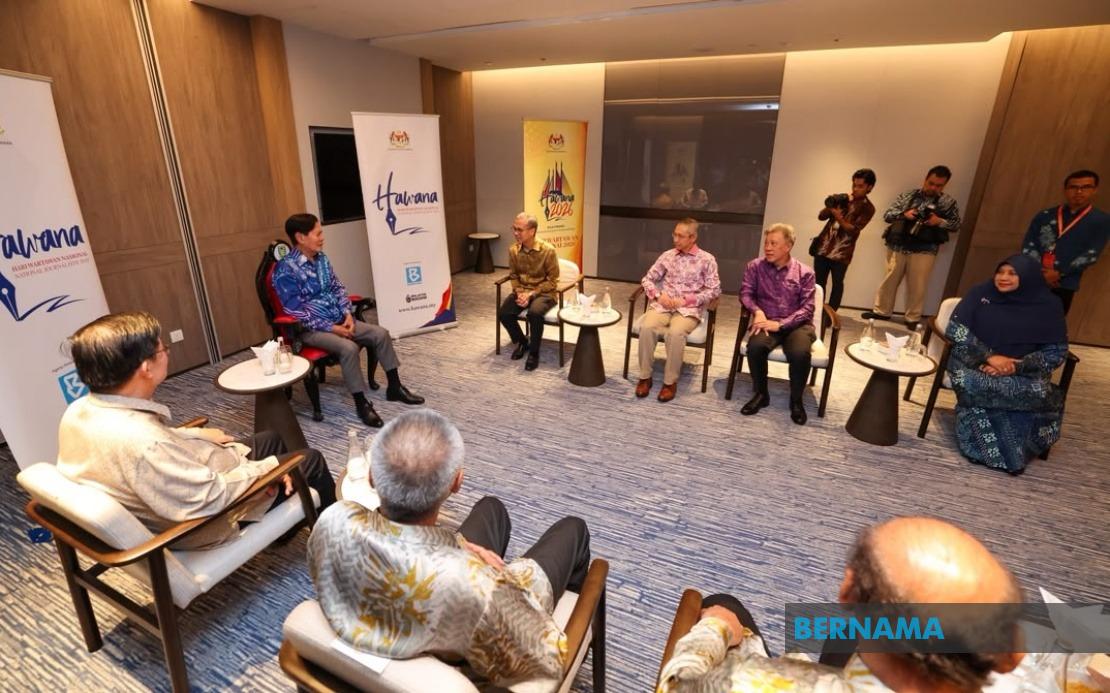
Datuk Fahmi Fadzil, Malaysia's Communications Minister, has made an impassioned appeal to journalists and media organisations across Southeast Asia to deepen their collaborative efforts in fighting misinformation and upholding the standards of truthful reporting. Speaking at the National Journalists' Day (HAWANA) 2026 celebration in Butterworth on June 19, Fahmi emphasised that the region's media fraternity must work in concert to address the mounting challenges posed by competing narratives and the accelerating pace at which information—both accurate and false—circulates through digital channels.
The minister articulated a vision in which journalism grounded in truth, integrity and responsibility serves as an essential institutional anchor in societies increasingly susceptible to false claims and deliberate misinformation campaigns. He framed the role of media not merely as a conduit for news, but as a foundational instrument that shapes public understanding of events, informs policy discussions, and sustains the connection between citizens and the realities they inhabit. In this context, Fahmi argued that strengthening cross-border partnerships and exchanging best practices among ASEAN newsrooms becomes not a luxury but a strategic necessity for regional stability.
The emphasis on regional cooperation reflects a growing recognition across Southeast Asia that misinformation poses transnational challenges requiring coordinated responses. When false narratives spread unchecked across borders, they can inflame communal tensions, undermine public health initiatives, and destabilise electoral processes. By fostering dialogue between Malaysian, Indonesian, Thai, Vietnamese and other ASEAN journalists, media organisations can develop shared standards for verification, fact-checking methodologies, and ethical frameworks tailored to the region's specific cultural and political contexts. Such collaboration also creates opportunities for knowledge transfer, allowing newsrooms in smaller markets to benefit from the sophisticated counter-misinformation strategies employed by larger, well-resourced outlets.
Fahmi's remarks gain particular significance given Malaysia's own struggles with false information, ranging from health-related hoaxes during public health emergencies to politically motivated disinformation campaigns around elections. The Communications Ministry has long positioned itself as a coordinator of fact-checking initiatives and digital literacy programmes, and the minister's call for ASEAN-wide action suggests an ambition to scale these efforts regionally. This approach acknowledges that individual nations cannot effectively combat misinformation operating within borderless digital ecosystems; only coordinated action across the region can create sufficient friction against false narratives.
The HAWANA 2026 event itself—held under the joint patronage of Penang Chief Minister Chow Kon Yeow and state officials—demonstrates the weight Malaysian authorities now attach to honouring and fortifying the journalism profession. By designating an annual celebration for journalists and hosting it at the state government level, Malaysia signals that media practitioners are regarded as strategic partners in national development rather than merely observers or critics. This framing is important for Southeast Asia, where media freedom and journalist safety remain contentious issues in several countries. When governments publicly celebrate the journalism profession and emphasise its indispensable role, they create political cover for journalists to operate with greater independence and emboldened voices.
The attendance of senior figures—including Bernama chairman Datuk Seri Wong Chun Wai, Communications Ministry secretary-general Datuk Abdul Halim Hamzah, and representatives from ASEAN Communications Ministers—reflects the multi-stakeholder approach now characterised Malaysian government engagement with the media sector. Rather than operating through top-down directives alone, Malaysian authorities are constructing platforms for dialogue, collaboration, and mutual recognition. This inclusive model acknowledges that combating misinformation requires not only government action but also the proactive participation of news organisations, journalists' associations, and civil society groups.
For Malaysian readers, Fahmi's message carries specific implications. As digital literacy remains uneven across the country and false information continues to spread through messaging apps and social media platforms, the role of professional journalists becomes ever more critical. When Fahmi speaks of journalism rooted in integrity, he is implicitly arguing against the erosion of professional standards that occurs when untrained or politically motivated actors pose as news sources. Strengthening ASEAN media collaboration creates a bulwark against this degradation, ensuring that citizens across the region have access to reporting that meets internationally recognised standards of accuracy and fairness.
The broader regional context matters too. Southeast Asia has experienced intensifying disinformation campaigns related to geopolitical tensions, supply chain disruptions, and economic competition. False narratives about neighbouring countries' policies or intentions can rapidly inflame public opinion and complicate diplomatic relations. When ASEAN journalists work together on fact-checking and verification, they help create a shared epistemic foundation—a common set of agreed facts and credible reporting—that reduces space for malicious actors to exploit information gaps or cultural misunderstandings.
Fahmi also highlighted the acceleration of information flow as a defining challenge of contemporary journalism. Where newsrooms once had hours or days to verify information before publication, they now face pressure to publish in minutes. This velocity creates vulnerabilities: rushed reporting can propagate errors, and sophisticated disinformation campaigns deliberately exploit the gap between false information's initial virality and eventual fact-checking corrections. By sharing verification tools, establishing rapid-response fact-checking networks across ASEAN, and developing shared protocols for handling breaking news, regional media organisations can maintain accuracy even under temporal pressure.
The invocation of journalism's role as a bridge between policymakers, implementers, and the public speaks to a sophisticated understanding of media's institutional functions. Journalists do not simply report facts; they translate complex policy decisions into language citizens can understand, and they hold implementers accountable to stated intentions. Across ASEAN, where some governments remain relatively opaque and public participation in policymaking is uneven, this mediating function becomes particularly important. Stronger regional media collaboration could strengthen democratic accountability across the region.
Looking forward, the HAWANA 2026 celebration and Fahmi's remarks suggest Malaysia is positioning itself as a thought leader on media cooperation within ASEAN. By convening journalists, government officials, and communications ministers, Malaysia is attempting to establish norms and best practices that can radiate outward across the region. Whether this initiative translates into concrete institutional structures—formal ASEAN journalist networks, shared fact-checking databases, or coordinated training programmes—remains to be seen. Nevertheless, the rhetorical commitment to regional media solidarity marks a recognition that misinformation is an ASEAN problem requiring an ASEAN solution.