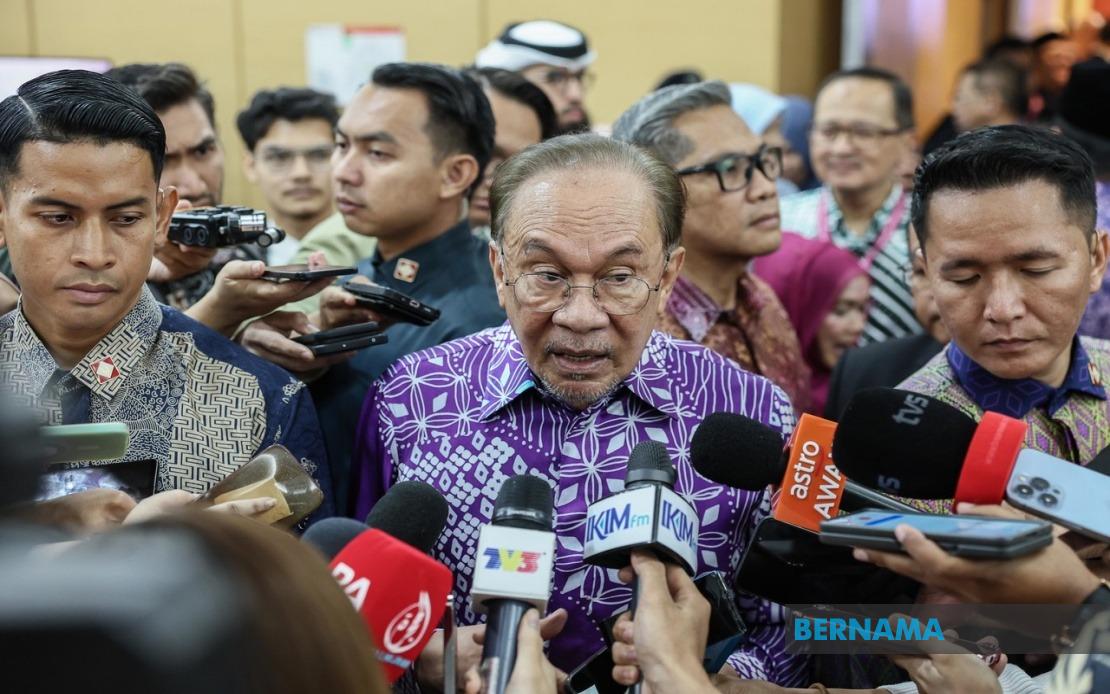
Prime Minister Datuk Seri Anwar Ibrahim has delivered a pointed message to policymakers and business leaders: Malaysia's pursuit of economic advancement must never lose sight of its ultimate obligation to improve the lives and dignity of ordinary citizens. Speaking at the Humane Economy Global Discourse (HEGD) 2026 in Kuala Lumpur on July 23, he articulated a philosophical reframing of how nations should approach development in an era of unprecedented technological upheaval.
The Prime Minister's remarks strike at a fundamental tension in modern economic policy. While nations worldwide scramble to harness artificial intelligence, renewable energy systems, advanced manufacturing capabilities and biotechnology to maintain competitive advantage, Anwar warned that such pursuits become hollow if disconnected from a deeper moral foundation. His intervention reflects growing concern among policymakers across Asia that the relentless focus on gross domestic product growth and technological metrics can obscure questions about whether ordinary people genuinely benefit from such progress.
Anwar emphasised that Malaysia must indeed remain globally competitive, maintain high productivity levels, and continue attracting foreign investment to survive and thrive in an increasingly interconnected world economy. However, he drew a critical distinction between these objectives and the ultimate purpose they should serve. Economic policies, he suggested, have been instrumentalised too often—treated as ends in themselves rather than as tools for achieving the authentic goal of human flourishing. This philosophical repositioning is particularly relevant for Malaysia as the country navigates its own development trajectory.
The technological transformation driving global economic change represents both opportunity and risk for a middle-income nation like Malaysia. Advanced manufacturing, artificial intelligence applications, and biotechnology could generate substantial wealth and employment, yet without intentional governance frameworks rooted in human values, these sectors may concentrate benefits among elites whilst leaving broader populations vulnerable to disruption. Anwar's emphasis on reconnecting economics to moral purpose addresses this concern directly, signalling that the government understands the social contract extends beyond quarterly earnings reports.
Malaysia's context makes this message particularly timely. The country has experienced decades of sustained growth, yet challenges persist in wealth distribution, equitable access to opportunity, and regional development disparities. As new technologies reshape labour markets and create entirely new categories of work, the risk emerges that without explicit attention to human dignity and wellbeing outcomes, technological gains could exacerbate inequality rather than ameliorate it. Anwar's framework suggests that economic policy should be evaluated not merely by what it produces but by how it affects the lived experiences of all Malaysians.
The gathering itself carried symbolic weight. Minister in the Prime Minister's Department (Religious Affairs) Dr Zulkifli Hasan and Forum Ekonomi Manusiawi (FEM) Chairman Professor Datuk Dr Saadiah Mohamad were present, indicating government buy-in for this conceptual approach. The institutional involvement suggests this is not merely rhetorical positioning but reflects serious consideration of how Malaysia might institutionalise human-centred economic thinking across government agencies and private sector leadership.
For regional observers and policymakers across Southeast Asia grappling with similar challenges, Anwar's intervention provides intellectual ballast for questioning the assumption that unfettered growth automatically improves societal wellbeing. Thailand, Indonesia, Vietnam and the Philippines all confront comparable questions about whether rapid technological adoption and economic expansion genuinely enhance human dignity or simply accelerate disruption without adequate social safeguards. Malaysia's attempt to articulate a framework that prioritises humanity within economic decision-making could influence regional policy conversations.
The phrase "to reclaim humanity is to recover a simple but too often neglected truth" encapsulates Anwar's central argument with elegant simplicity. It acknowledges that economic systems exist within human societies and are ultimately accountable to human purposes. When economic policy becomes disconnected from this fundamental reality, it produces systems that might generate impressive statistics whilst failing to deliver meaningful improvement in how people actually live, work, and experience opportunity.
Implementing this philosophical commitment presents substantial challenges. Economic systems possess their own internal logics and momentum. Capital flows according to profit expectations, technologies diffuse according to efficiency calculations, and markets respond to price signals rather than moral directives. Reconciling these powerful forces with broader human-centred objectives requires sophisticated policy design, genuine political commitment, and willingness to constrain certain economic freedoms in service of broader social values. Whether Malaysia can translate this rhetorical commitment into concrete policy mechanisms remains the critical question.
Moving forward, Malaysian policymakers will be tested on whether this framework influences actual governance decisions. Taxation policy, labour regulations, environmental standards, technology governance, and social safety net design all reflect choices about whether economic growth is truly subordinated to human wellbeing or whether such language merely accompanies conventional growth maximisation. For Malaysia and the broader region, Anwar's address represents an important statement that development discourse is shifting beyond simplistic growth obsession toward more nuanced questioning of what economies are ultimately for.

