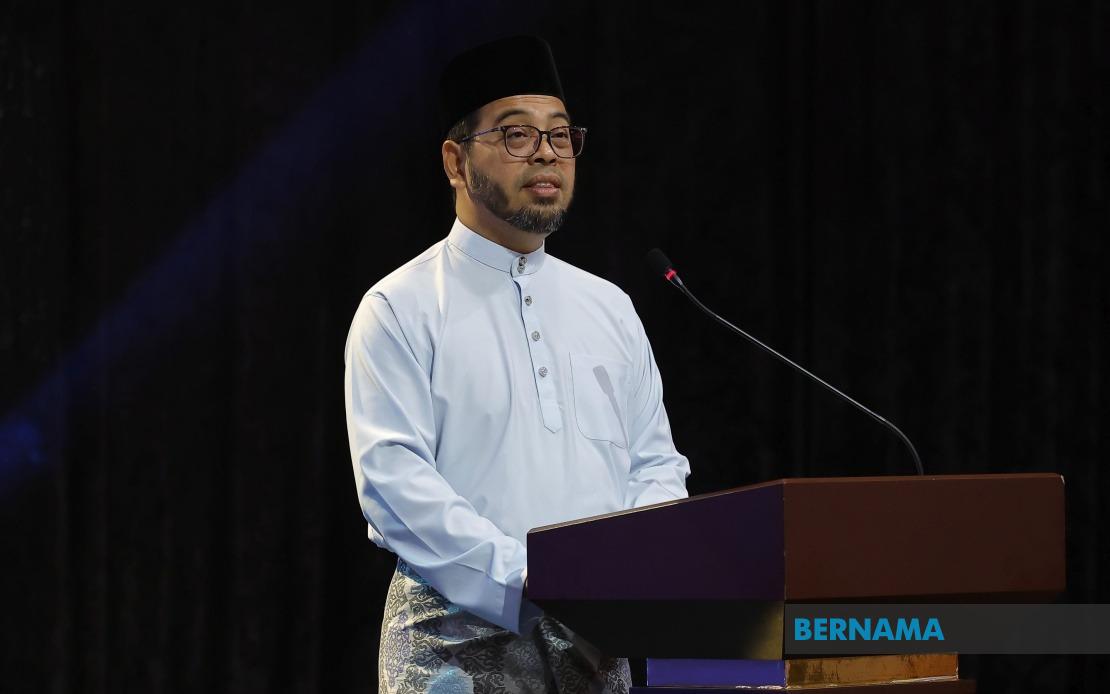
Malaysia's Muslim community must overcome lingering tensions and resolve disputes to build a stronger, more resilient ummah capable of tackling the mounting complexities of the modern world, Religious Affairs Minister Dr Zulkifli Hasan declared at a national celebration in Putrajaya. Speaking at the Maal Hijrah 1448H/2026M commemoration held at Putra Mosque, Dr Zulkifli stressed that meaningful progress across Malaysian society depends fundamentally on internal transformation at the individual level, encompassing intellectual growth, spiritual enrichment, and moral fortitude.
The event, themed "MADANI Dihayati, Ummah Diberkati", drew senior government figures including Sultan Nazrin Shah of Perak and Deputy Prime Minister Datuk Seri Fadillah Yusof. The gathering underscored the government's commitment to positioning Islamic values and community cohesion as pillars of national development during a period marked by geopolitical uncertainty and economic volatility across Southeast Asia and beyond.
Dr Zulkifli articulated a compelling vision of communal strength, arguing that a unified Muslim community would generate beneficial outcomes for all members, while fragmentation would perpetuate suffering and diminish national resilience. His remarks reflected growing official concern about the divisive impact of ideological disagreements, sectarian tensions, and competing visions within Malaysia's diverse Muslim population—issues that have simmered beneath the surface of public discourse for years.
The minister contextualised his appeal within the broader framework of Malaysia's contemporary challenges. Supply chain disruptions stemming from regional tensions, fluctuating commodity prices, and economic uncertainty affecting trading partners have intensified pressure on Malaysian households and businesses. In this environment, Dr Zulkifli suggested, social cohesion becomes not merely a religious virtue but an economic necessity, enabling collective problem-solving and resilience-building across communities.
Calling on all Malaysians to support government initiatives aimed at safeguarding Islamic dignity and ensuring the continued influence of Islamic principles within Malaysian public life, Dr Zulkifli positioned religious unity as instrumental to these policy objectives. His statement carries particular weight given the ministry's expanded mandate under the current administration to coordinate religious affairs and Islamic development across federal agencies and state religious bodies.
A central element of Dr Zulkifli's address involved reframing the classical Islamic concept of hijrah for contemporary application. Rather than understanding hijrah solely as the Prophet Muhammad's physical migration from Mecca to Medina, the minister articulated hijrah as an ongoing personal and collective journey—a continuous process of renouncing harmful behaviours, destructive attitudes, and corrosive practices while cultivating virtues and character that nurture inter-communal harmony among Muslims. This interpretation resonates with MADANI (Memperkasa Bersama, Anakanda Negara, Disejahterakan, Ihsan, Negara) principles that the government has adopted as its development framework.
The implications of Dr Zulkifli's reinterpretation are significant for Malaysian Muslim civil society. By framing hijrah as transformation rather than migration, religious authorities signal openness to progressive interpretations of Islamic teachings that accommodate Malaysia's plural, urbanised society. Simultaneously, the emphasis on renouncing "harmful behaviour" implies critique of extremism, sectarian violence, and religiously-motivated intolerance—persistent challenges that have occasionally flared into public controversy.
Dr Zulkifli emphasised that enhanced communal unity becomes prerequisite for effectively implementing efforts to elevate and protect Islamic values within Malaysia's institutional and cultural spheres. This formulation inverts typical causal reasoning: rather than strong Islamic values automatically generating unity, the minister suggests that Muslims must first achieve unity before successfully institutionalising and defending religious principles. The logic underscores that Islam in Malaysia functions not as an abstract theological framework but as embedded within plural social structures requiring consensus to influence policy.
Acknowledging Malaysia's multicommunal and multifaith character, Dr Zulkifli broadened his appeal beyond the Muslim community, asserting that all citizens regardless of religious background share responsibility for maintaining peace, stability, and shared prosperity. This inclusive rhetoric reflects constitutional commitments to religious freedom and harmonious coexistence, while subtly asserting that Islam occupies a constitutionally-recognised special position within the Malaysian federation—a nuanced positioning that has long characterised official Malaysian political discourse.
The ceremony recognised outstanding Islamic scholarship and leadership through presentation of national and international awards. Prof Emeritus Datuk Dr Osman Bakar, Rector of the International Islamic University Malaysia (IIUM), received the National Tokoh Maal Hijrah award, honouring his scholarly contributions to Islamic thought within Southeast Asia. Moroccan Islamic scholar Dr Ahmad Al-Raysuni was presented with the International Tokoh Maal Hijrah award, symbolising Malaysia's engagement with contemporary Islamic intellectual discourse at global level.
These selections carry symbolic weight beyond ceremonial recognition. Dr Osman Bakar's work integrates classical Islamic knowledge with contemporary scientific and philosophical inquiry, embodying the intellectual synthesis that Dr Zulkifli advocates. Dr Ahmad Al-Raysuni's international recognition signals Malaysia's commitment to participating in broader Muslim intellectual networks while advancing Islamic jurisprudence responsive to modern circumstances. Together, these awards reflect official priorities regarding the character and direction of Islamic thought within Malaysia and the wider region.

%22%2F%3E%3C%2Fpattern%3E%3C%2Fdefs%3E%3Crect%20width%3D%22100%25%22%20height%3D%22100%25%22%20fill%3D%22url(%23ph21o2sg)%22%2F%3E%3Crect%20width%3D%22100%25%22%20height%3D%22100%25%22%20fill%3D%22url(%23ph21o2sp)%22%2F%3E%3Ctext%20x%3D%2250%25%22%20y%3D%2250%25%22%20text-anchor%3D%22middle%22%20dominant-baseline%3D%22central%22%20fill%3D%22rgba(255%2C255%2C255%2C0.95)%22%20font-family%3D%22Georgia%2C%20'Times%20New%20Roman'%2C%20serif%22%20font-weight%3D%22700%22%20font-size%3D%22170%22%20letter-spacing%3D%22-0.02em%22%3EGabungan%3C%2Ftext%3E%3C%2Fsvg%3E)