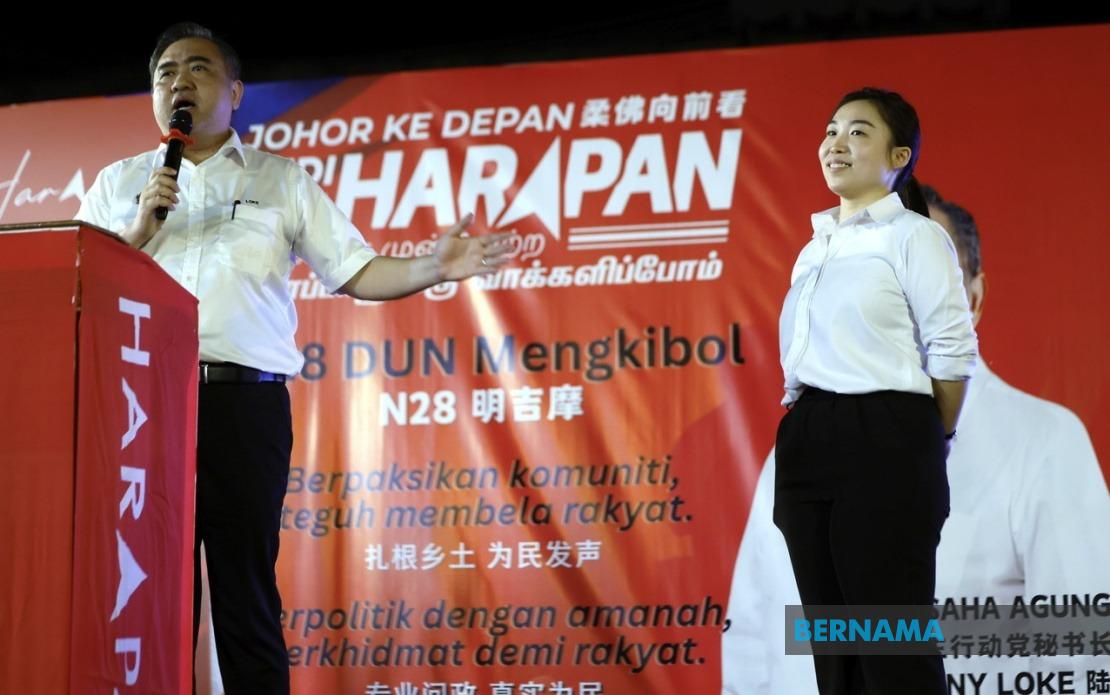
The Democratic Action Party has unveiled 33-year-old lawyer Chu Poh Yee as its inaugural candidate for the upcoming Johor state election, with the party committing her to contest the Mengkibol constituency. The announcement was made at a ceremony in Kluang, where party secretary-general Anthony Loke explained the strategic reasoning behind the move to position a fresh face in a seat the party has held for two consecutive terms.
Incumbent assemblyman Chew Chong Sin, who has represented Mengkibol through two full electoral cycles, will vacate the seat to pursue a higher office. Loke outlined plans for Chew's transition to the Labis parliamentary seat in the next general election, following the decision by sitting MP Pang Hok Liong to step down. This orchestrated shift reflects the party's broader talent management strategy, moving experienced lawmakers into stronger positions while creating opportunities for emerging voices at the state level.
The party's leadership attributed Chu's selection to her demonstrated expertise in legal services, particularly her work assisting elected representatives with legal aid matters affecting constituents. Loke emphasised that her educational qualifications and fluency across multiple languages strengthen her candidacy. Beyond professional credentials, the party highlighted her established connections within the Mengkibol constituency, suggesting she has already cultivated ground-level relationships necessary for effective representation.
Chu's nomination signals DAP's deliberate expansion of female representation within its electoral strategy. Loke framed the decision as aligned with the party's stated commitment to creating meaningful opportunities for women candidates at all levels of governance. This move resonates with broader discussions within Malaysian politics about gender representation, where female candidates remain proportionally underrepresented despite comprising roughly half the voting population.
The Mengkibol contest represents one element of DAP's comprehensive campaign architecture for the Johor election. The party has finalised candidates across 17 state seats encompassing three distinct categories: ten seats currently held by the party including Mengkibol itself, four previously lost constituencies the party intends to recapture, and three additional seats identified as expansion opportunities. This portfolio reflects DAP's confidence in defending existing strongholds whilst pursuing strategic gains in targeted areas.
Loke announced that four additional candidates would be unveiled on Saturday for the constituencies of Tiram, Johor Jaya, Senai, and Bukit Permai. This phased disclosure strategy creates sustained media momentum leading into the election period, allowing each candidate announcement to receive focused attention. The remaining candidates would be presented jointly alongside nominees from coalition partner Pakatan Harapan, with the Prime Minister leading that coordinated unveiling on Monday.
For Malaysian voters tracking Johor's electoral landscape, the Mengkibol announcement illustrates how parties balance continuity with renewal. Chew's transition upward creates a vacancy, but rather than installing a veteran politician, DAP opted for someone with emerging credentials but demonstrated community ties. This approach carries inherent risks and opportunities—Chu lacks frontline elective experience, yet her professional background in legal services may resonate with constituents seeking representation focused on substantive casework rather than political grandstanding.
The timing of these announcements positions DAP as an organised force actively preparing its machinery for state-level competition. The deliberate rollout of candidates over several days suggests disciplined coordination with coalition partners, avoiding candidate overlap or confusion that might undermine combined messaging. The Prime Minister's involvement in the final batch of announcements underscores the significance of this election within Pakatan Harapan's broader narrative around governance and inclusive representation.
Chew's elevation to Labis represents a calculated deployment of incumbent advantage, where an assemblyman with proven electoral appeal graduates to parliamentary-level contests. Labis has not recently featured prominently in national political discourse, making it a constituency where a newcomer with established stature might succeed. Conversely, Mengkibol's transition to Chu introduces uncertainty that opposition parties may attempt to exploit, requiring DAP to invest organisational resources in consolidating this seat even as it pursues other gains.
The emphasis on Chu's multilingual capabilities addresses a practical dimension of representation in Malaysia's diverse constituencies. Johor's Mengkibol seat encompasses communities where proficiency in Malay, English, and Chinese languages facilitates more effective constituent communication and advocacy. For legal practitioners particularly, linguistic versatility directly enhances their capacity to serve diverse clients and communities with varying preferred languages for official dealings.
DAP's focus on female candidates reflects international trends among progressive parties, yet carries specific resonance in Malaysian contexts where gender roles in politics remain subject to traditional assumptions. Positioning Chu prominently demonstrates the party's commitment to this demographic shift, potentially mobilising female voters who see enhanced representation as personally significant. However, such symbolic advancement carries expectations that female candidates will substantively address gender-related policy concerns beyond their presence on ballots.
The Johor state election carries significance beyond the state itself, serving as a barometer for federal political dynamics and coalition stability. DAP's performance here will partly indicate whether Pakatan Harapan can maintain electoral momentum in key states, or whether challenges to federal coalition governance are eroding component parties' grassroots standing. Chu's success or failure will thus feedback into national political calculations about the viability of current governing arrangements.
As the state election campaign develops, Mengkibol will merit close observation as a seat where generational and gender transitions intersect. Chu's campaign will test whether relatively inexperienced candidates with strong professional credentials can translate educational achievement and legal expertise into electoral success. Her performance may influence how Malaysian parties calibrate candidate selection between proven vote-getters and promising newcomers, shaping the composition of future state legislatures across the country.

%22%2F%3E%3C%2Fpattern%3E%3C%2Fdefs%3E%3Crect%20width%3D%22100%25%22%20height%3D%22100%25%22%20fill%3D%22url(%23ph21o2sg)%22%2F%3E%3Crect%20width%3D%22100%25%22%20height%3D%22100%25%22%20fill%3D%22url(%23ph21o2sp)%22%2F%3E%3Ctext%20x%3D%2250%25%22%20y%3D%2250%25%22%20text-anchor%3D%22middle%22%20dominant-baseline%3D%22central%22%20fill%3D%22rgba(255%2C255%2C255%2C0.95)%22%20font-family%3D%22Georgia%2C%20'Times%20New%20Roman'%2C%20serif%22%20font-weight%3D%22700%22%20font-size%3D%22170%22%20letter-spacing%3D%22-0.02em%22%3EGabungan%3C%2Ftext%3E%3C%2Fsvg%3E)