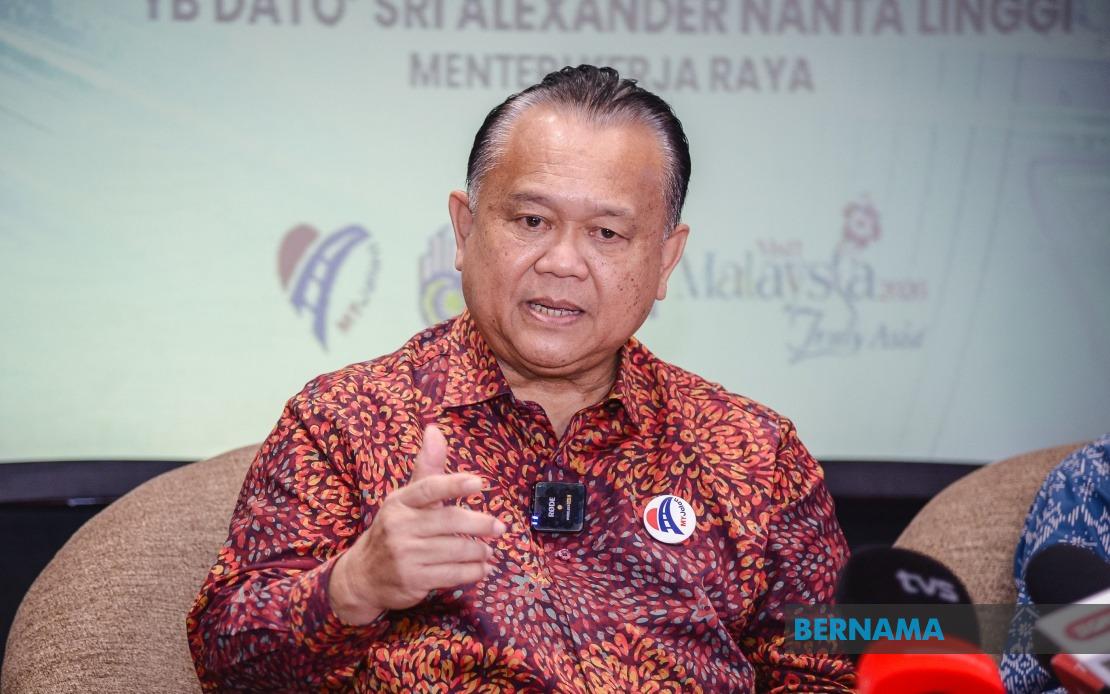
The Works Ministry (KKR) is integrating the construction sector's strategic vision into next year's budget planning, having received 30 major wishlists from industry stakeholders aimed at strengthening the nation's building and infrastructure capabilities. Datuk Seri Alexander Nanta Linggi, the ministry's leader, announced that these submissions will undergo careful evaluation to ensure compatibility with the government's MADANI Economy framework, which seeks to generate substantial growth while preserving the health of the broader industrial ecosystem. This inclusive consultation process reflects a recognition that infrastructure development requires active partnership between government planners and private sector experts who understand on-the-ground realities and emerging challenges.
The ministry has crystallised its Budget 2027 strategy around five interconnected transformation pillars that together represent a comprehensive reimagining of how Malaysia develops its physical infrastructure. Strengthening the national road network and executing high-impact flagship projects form the foundation, reflecting the economic importance of reliable transportation corridors and visible infrastructure milestones. Equally important is advancing sustainable development in alignment with Malaysia's energy transition commitments, signalling that future growth must occur within environmental boundaries. The digitalisation agenda—encompassing Building Information Modelling, the Internet of Things and artificial intelligence—addresses the sector's competitive disadvantage relative to global peers. Empowering contractors at the G1 to G4 tiers recognises that smaller firms drive employment and innovation at the grassroots level. Finally, the MYJalan initiative addresses road safety, a persistent challenge across Malaysian highways that claims lives and reduces productivity.
Nanta emphasised that these five priorities should not be viewed as isolated initiatives but rather as interconnected dimensions of a fundamental shift in how government approaches infrastructure planning, construction, maintenance and lifecycle management. This systems-based thinking matters significantly for Malaysia, where fragmented sectoral approaches have occasionally resulted in duplicated investments, coordination failures and suboptimal resource allocation. By positioning these elements as mutually reinforcing, the ministry signals intent to break down traditional silos and encourage more holistic project development from inception through completion.
A critical reorientation outlined by the minister concerns measurement and accountability frameworks. Rather than emphasising budget volume—how many ringgit the government deploys—the ministry aims to pivot toward impact metrics that quantify outcomes delivered per unit of public expenditure. This represents a maturation of budget discipline and reflects lessons learned from previous cycles where large allocations sometimes yielded modest real-world improvements. For Malaysian taxpayers and policymakers, this shift promises greater transparency about whether infrastructure spending genuinely improves living standards, business efficiency and regional competitiveness.
The minister made clear that competitive advantage in the construction sector must migrate beyond price competition, which traps Malaysian firms in a low-margin, low-innovation equilibrium. Local companies must build capabilities in Building Information Modelling, artificial intelligence, green technology and Industrialised Building Systems, enabling them to compete on dimensions of productivity, technological sophistication, quality and value creation. This capability-building imperative is particularly significant for Malaysia's aspirations to move up global value chains and reduce dependence on commodity-style infrastructure contracting. International competitiveness increasingly hinges on innovation intensity and sophisticated project management, areas where Malaysia can develop genuine advantages if industry invests strategically.
Beyond the five pillars, the broader feedback received by KKR reveals the sector's most pressing operational constraints. By early August, the ministry had collected 117 total submissions, with 87 originating directly from industry participants, indicating robust engagement. Industry representatives highlighted governance and contract-management improvements as foundational, reflecting frustrations with administrative complexity and payment delays that constrain cash flow. Workforce development emerged as urgent, with calls for more skilled technicians and inclusive training pathways that broaden participation. Operating costs, materials expenses and logistics challenges rank among the highest practical barriers facing firms, particularly smaller operators lacking economies of scale. Additionally, industry voices advocated for accelerating sustainability and ESG adoption, recognising that environmental credentials increasingly influence customer preferences and investment decisions globally.
Small contractors, consulting firms, workers and localised industry participants occupy a distinct position requiring targeted attention, according to Nanta. Not all market participants enjoy identical starting positions—some lack steady cash flow, others struggle to access modern technology, and many face regulatory and administrative burdens disproportionate to their size. Approval timelines for projects, utility connection procedures and road maintenance standards disproportionately affect smaller players competing against larger firms with dedicated compliance and project management teams. By deliberately supporting inclusive growth among G1-G4 contractors and other local stakeholders, the government can broaden the base of economic beneficiaries while creating employment opportunities in regions beyond major urban centres.
The minister rejected arguments that fiscal constraints should diminish Malaysia's infrastructure ambitions, instead advocating for creative prioritisation and resourcefulness in maximising impact per ringgit invested. This stance reflects understanding that infrastructure competitiveness increasingly depends not on budget size but on strategic focus and execution excellence. Smaller, better-targeted investments often yield superior outcomes compared to diffuse spending across numerous marginal projects. Malaysia's experience has demonstrated that disciplined project selection and disciplined implementation frequently prove more valuable than simply increasing budget envelopes.
Context surrounding Budget 2026 allocations provides perspective on resource availability. The Works Ministry received RM10.692 billion under the previous budget, representing a 3.3 percent increase year-on-year, demonstrating sustained albeit modest growth in infrastructure investment. Within this envelope, RM9.607 billion was directed toward development expenditure supporting new initiatives and continuation of ongoing infrastructure schemes. This funding level, while substantial in absolute terms, must stretch across a nation of 34 million people with aging infrastructure requiring maintenance alongside new projects addressing population growth and economic diversification.
The Budget 2027 framework will be formally presented to the Dewan Rakyat on October 9, initiating parliamentary scrutiny and debate. This forthcoming budget cycle represents an opportunity for Malaysia to recalibrate infrastructure investment toward greater efficiency, technological sophistication and inclusive participation. The industry consultation process underway signals that the government recognises construction sector expertise as essential to effective policy design. As Malaysia navigates post-pandemic economic recovery and global economic uncertainties, infrastructure investment decisions carry outsized importance for long-term competitiveness and living standards—making the thoughtful integration of industry perspectives into Budget 2027 particularly consequential for the nation's development trajectory.

