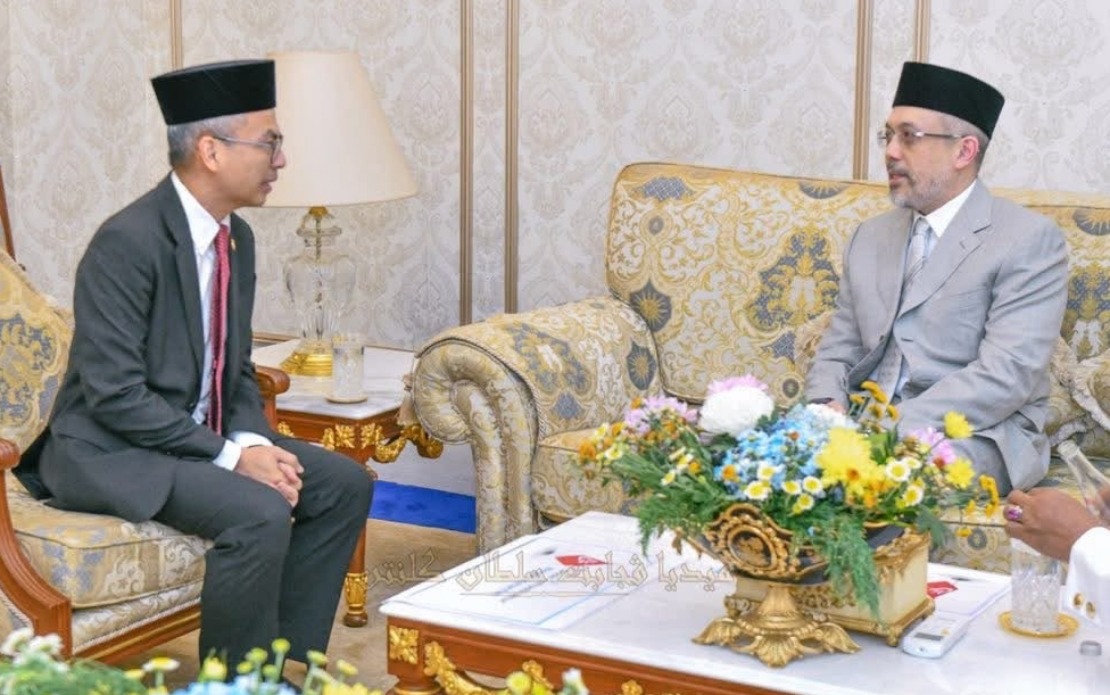
The Regent of Kelantan, Tengku Muhammad Fakhry Petra, received Communications Minister Datuk Fahmi Fadzil at Kota Lama Palace in Kota Bharu on June 16, underscoring growing official concern about the proliferation of fake accounts and malicious content on digital platforms. The formal audience, which commenced at 5 pm, reflected the government's heightened focus on coordinating efforts to safeguard the nation's institutions from coordinated online campaigns designed to undermine their credibility and standing among the public.
The Ministry of Communications leveraged the audience to brief the Regent on recent developments within its purview, providing an overview of current operational priorities and emerging challenges in the digital landscape. This engagement demonstrates how state-level coordination between federal ministers and royal institutions has become essential in addressing threats that transcend traditional administrative boundaries. The decision to brief the Regent directly signals the seriousness with which the government views the deteriorating information environment and recognises the symbolic importance of maintaining public confidence in constitutional institutions.
Among the substantive matters under discussion was the escalating menace of fraudulent social media accounts that systematically circulate false narratives and inflammatory content targeting Malaysia's Royal Institution. The proliferation of such accounts represents a sophisticated threat that extends beyond isolated incidents of misinformation to constitute a coordinated challenge to institutional integrity. Fake accounts often leverage stolen identities, automated bot networks, and sophisticated engagement tactics to amplify divisive narratives and erode public trust in foundational constitutional structures.
The specific focus on content targeting the Malaysian Royal Institution reflects official recognition that this category of disinformation poses unique risks to national cohesion. Unlike isolated false claims about commercial products or public figures, systematic attacks on the monarchy strike at constitutional foundations and can generate social tensions with destabilising potential. The rapid replication and algorithmic amplification of such content across platforms create cascading effects that outpace conventional regulatory responses, necessitating coordinated high-level intervention.
The hour-long meeting also encompassed broader issues in the communications portfolio, indicating that digital threats form only one dimension of a complex policy landscape. The government continues to grapple with how to balance the imperative to combat harmful content against the principles of free expression and open digital discourse. This tension has become increasingly acute as platform algorithms reward sensational and divisive content, creating structural incentives for the generation and distribution of misinformation.
Fahmi's decision to present a memento to the Regent underscored the diplomatic dimensions of the engagement and the importance of maintaining strong relationships between federal and state-level institutions in addressing transnational digital challenges. Such gestures, while ceremonial, reinforce institutional alignment on matters of national significance. The attendance of senior officials from both the Communications Ministry and the Kelantan Sultan's Office further highlighted the collaborative framework through which the government seeks to address these emerging threats.
The growing problem of fake accounts has prompted significant policy discussions across Southeast Asia, where similar challenges plague Indonesia, Philippines, and Thailand. The region's young, digitally-native populations and rapid social media penetration create conditions where coordinated disinformation campaigns can achieve substantial reach with minimal investment. Malaysia's experience mirrors broader regional patterns where election cycles, communal sensitivities, and institutional vulnerabilities intersect with platform affordances to create fertile ground for organised inauthentic behaviour.
From a Malaysian perspective, the communications ministry's approach reflects a strategic recognition that addressing disinformation requires engagement across governmental levels and institutional hierarchies. While federal regulatory frameworks provide legal tools, their effectiveness depends substantially on social reinforcement and institutional coordination that the palace represents. By briefing the Regent, the ministry signals that combating false narratives requires legitimacy that transcends bureaucratic authority and derives instead from consensus among Malaysia's constitutional guardians.
The challenge of fake accounts extends beyond simple content moderation into questions of platform accountability, algorithmic transparency, and the adequacy of existing legal frameworks. Malaysian law provides mechanisms for prosecuting deliberate false statements that threaten public order, yet enforcement remains constrained by jurisdictional complications when accounts operate across borders or through distributed networks. Regulators must increasingly contend with sophisticated actors who employ technical methods to obscure their origins and evade attribution.
Government officials across Malaysia have grown increasingly vocal about the inadequacy of platform self-regulation in addressing coordinated campaigns targeting the nation's institutions. The meeting between Fahmi and the Regent reflects this frustration and the search for alternative mechanisms—including state-level engagement, royal institutional visibility, and potentially enhanced coordination with international counterparts—to address threats that national authorities cannot unilaterally contain. How effectively these approaches reduce the velocity and reach of harmful content remains an open question as platform dynamics and adversarial tactics continue to evolve.

%22%2F%3E%3C%2Fpattern%3E%3C%2Fdefs%3E%3Crect%20width%3D%22100%25%22%20height%3D%22100%25%22%20fill%3D%22url(%23ph21o2sg)%22%2F%3E%3Crect%20width%3D%22100%25%22%20height%3D%22100%25%22%20fill%3D%22url(%23ph21o2sp)%22%2F%3E%3Ctext%20x%3D%2250%25%22%20y%3D%2250%25%22%20text-anchor%3D%22middle%22%20dominant-baseline%3D%22central%22%20fill%3D%22rgba(255%2C255%2C255%2C0.95)%22%20font-family%3D%22Georgia%2C%20'Times%20New%20Roman'%2C%20serif%22%20font-weight%3D%22700%22%20font-size%3D%22170%22%20letter-spacing%3D%22-0.02em%22%3EGabungan%3C%2Ftext%3E%3C%2Fsvg%3E)