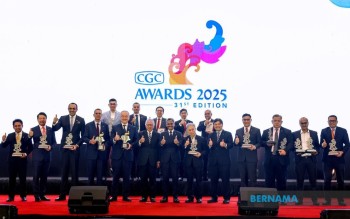
Malaysia's enterprise development sector took centre stage this week as Credit Guarantee Corporation Malaysia Bhd (CGC) presented its 31st annual awards, recognising 32 businesses and financial players who have demonstrated exceptional performance in supporting the country's micro, small and medium enterprise ecosystem. The ceremony in Kuala Lumpur underscored the critical role that MSMEs play in Malaysia's economy whilst celebrating those organisations that have actively contributed to inclusive and sustainable business growth across the nation.
CGC chairman Datuk Mohammed Hussein used the occasion to articulate a broader vision of enterprise resilience that extends well beyond access to financing. In his remarks, he contended that true resilience emerges from the character, discipline and adaptive capacity of business owners themselves, traits that prove decisive when enterprises encounter market turbulence or operational challenges. This framing represents a subtle but important shift in how policymakers understand MSME success, moving beyond purely financial metrics to encompass the human and organisational qualities that distinguish thriving businesses from those that falter.
The chairman's address reflected a systemic understanding of enterprise development, emphasising that no single institution bears sole responsibility for building a resilient SME sector. Instead, he articulated an ecosystem model requiring coordinated action across multiple stakeholders. Government must establish the regulatory and policy foundations for commercial activity; research bodies must convert scientific innovation into commercially viable products; large corporations must extend supply chain opportunities to smaller partners; and financial institutions must provide the capital structures necessary for enterprise expansion. This integrated approach suggests recognition that Malaysia's MSME competitiveness depends on how effectively these various actors collaborate rather than operating in isolation.
CGC's performance in supporting Bumiputera-owned enterprises demonstrates measurable progress in advancing inclusive economic participation. During the previous financial year, the corporation channelled RM223 million in guarantees to 27 Bumiputera companies, indicating both the scale of support and the focus placed on this demographic category. Beyond traditional lending, CGC also expanded its environmental, social and governance-linked guarantee offerings to RM1.2 billion, surpassing its initial target of RM1 billion. This expansion reflects growing market demand for financing structures that incorporate sustainability and responsible business practice considerations, signalling that Malaysian entrepreneurs increasingly view ESG compliance not as regulatory burden but as competitive necessity.
The awards themselves were distributed across three distinct categories, each recognising different dimensions of the MSME support ecosystem. Alliance Bank Malaysia Bhd and CIMB Islamic Bank Bhd jointly received recognition as best financial partners, whilst OCBC Al-Amin Bank Bhd earned the dedicated Bumiputera SMEs Award. These selections acknowledge that conventional and Islamic banking channels both play essential roles in Malaysia's financial ecosystem, and that specialised focus on Bumiputera participation generates measurable business outcomes. Maybank Islamic Bhd received special recognition for its Bumiputera-focused initiatives, reinforcing the broader pattern of Islamic financial institutions carving out prominent roles in supporting indigenous Malaysian entrepreneurs.
The financial institution awards spanned multiple banking categories and institutional types, reflecting the diversity of Malaysia's credit landscape. Beyond conventional banking leaders Alliance Bank Malaysia and Public Bank, recognition extended to Islamic banking specialists including CIMB Islamic Bank, OCBC Al-Amin, and Standard Chartered Saadiq. Development financial institutions also featured prominently, with Bank Simpanan Nasional and the Small Medium Enterprise Development Bank Malaysia receiving top partner designations. This inclusive recognition pattern demonstrates that CGC operates within a multi-channel financial system where specialised institutions serve particular entrepreneur demographics and credit needs, creating complementary rather than competitive relationships.
The award ceremony served as launch platform for a significant new financing initiative: the RM10 billion Bank Negara Malaysia-CGC Portfolio Guarantee and Portfolio Guarantee-i schemes. These programmes represent coordinated policy action aimed at channelling substantially increased capital to the MSME sector through a structured risk-sharing arrangement with participating financial institutions. The Portfolio Guarantee mechanism is designed to reduce perceived risk for lenders, thereby enabling credit expansion to businesses that might otherwise struggle to access conventional financing on competitive terms. Portfolio Guarantee-i, the Islamic variant, addresses the same challenge within the Islamic banking framework, ensuring that Muslim entrepreneurs have equivalent access to enhanced financing opportunities.
The scale of this initiative warrants careful attention from Malaysian policymakers and development practitioners. The schemes target delivery of RM10 billion in guaranteed financing to approximately 12,100 MSMEs, suggesting an average facility size of roughly RM825,000 per business. This structuring indicates focus on small and medium enterprises rather than microenterprises, potentially affecting businesses with existing operational infrastructure and growth potential but insufficient collateral to secure conventional lending. The initiative encompasses key economic sectors, though specific sector designations remain undefined in current announcement materials, suggesting that participating financial institutions retain discretion in capital allocation decisions.
CGC's strategic priorities extend beyond immediate credit provision to encompass broader objectives of economic modernisation and sustainability transition. The financing is explicitly designed to support business expansion, productivity enhancement, sustainability-related investments and overall competitive positioning. This multi-objective framework reflects recognition that Malaysian MSMEs operate in an increasingly competitive regional environment where competitiveness depends not merely on production capacity but on technological sophistication, environmental responsibility and market-responsive innovation. Businesses unable to transition toward sustainability risk losing access to supply chains, procurement contracts and consumer markets, making transition financing a practical rather than idealistic priority.
The broader CGC Group 2030 strategy articulates ambitious goals for deepening institutional impact on the MSME landscape whilst advancing financial inclusion objectives. This long-term orientation suggests that the awards and new guarantee schemes form components of a multi-year institutional evolution rather than discrete policy interventions. Deepening MSME impact implies moving beyond narrowly-defined credit guarantees toward more comprehensive support encompassing business development services, market linkages, technology adoption and ecosystem participation. Financial inclusion advancement, particularly in light of Bumiputera participation emphasis, acknowledges that Malaysia's demographic diversity creates both commercial opportunity and equity imperative, positioning inclusive participation as both economically rational and socially essential.
For Malaysian entrepreneurs and regional observers, these developments signal that policymakers maintain strong commitment to MSME sector development despite broader economic uncertainties. The RM10 billion commitment, combined with RM223 million in Bumiputera-focused guarantees and expanding ESG-linked instruments, indicates that financing constraints need not be insurmountable barriers to enterprise growth. However, access to capital alone cannot ensure business success; the CGC chairman's emphasis on entrepreneur character and adaptability reminds stakeholders that institutional support succeeds only when coupled with capable, committed business leadership. As Malaysia navigates regional economic competition and domestic transformation priorities, the health and growth of its MSME sector will prove increasingly consequential for employment, innovation and inclusive prosperity.

