Cambodia is pursuing an economic transformation that could reshape its manufacturing landscape, targeting South Korean investment in automotive components, electric vehicle systems, and healthcare technology as it seeks to break free from decades of dependency on labour-intensive garment production. Deputy Prime Minister Sun Chanthol spearheaded a major investment promotion mission to South Korea in mid-June, leading a high-level delegation through company visits and an investment roadshow in Incheon, where he assured Korean manufacturers that Cambodia's government stands ready to facilitate expansion into higher-value sectors.
The timing of this outreach reflects broader regional shifts in manufacturing investment patterns, particularly as global automotive supply chains undergo fundamental restructuring around electric vehicle technology and advanced electronics. For Cambodia, which has long relied on its comparative advantage in cheap labour to attract textile and footwear makers, this strategy represents a deliberate attempt to climb the manufacturing value chain while competing against other Southeast Asian nations similarly pursuing electronics and automotive component assembly. Sun Chanthol's engagement with companies already operating in Cambodia—such as Daejoo KC Group and Kyungshin Co., Ltd.—signals that the government's approach is not entirely speculative; these firms provide tangible proof of concept that Cambodia can host sophisticated industrial operations.
Daejoo KC Group exemplifies the kind of industrial anchor Cambodia hopes to leverage. The South Korean conglomerate operates two Cambodian subsidiaries: Camko Motor, which assembles Hyundai vehicles for domestic consumption and manufactures automotive wire harnesses for export while generating nearly 500 jobs, and Camko Infracore, which handles vehicle importation, maintenance and parts distribution. By visiting Daejoo's management during the roadshow, Sun Chanthol made a pointed pitch for the group to deepen its Cambodian footprint across multiple operational domains where it already maintains expertise in South Korea. This strategy recognises that multinational firms with established operations are more likely to expand incrementally than to make entirely new commitments in unfamiliar markets.
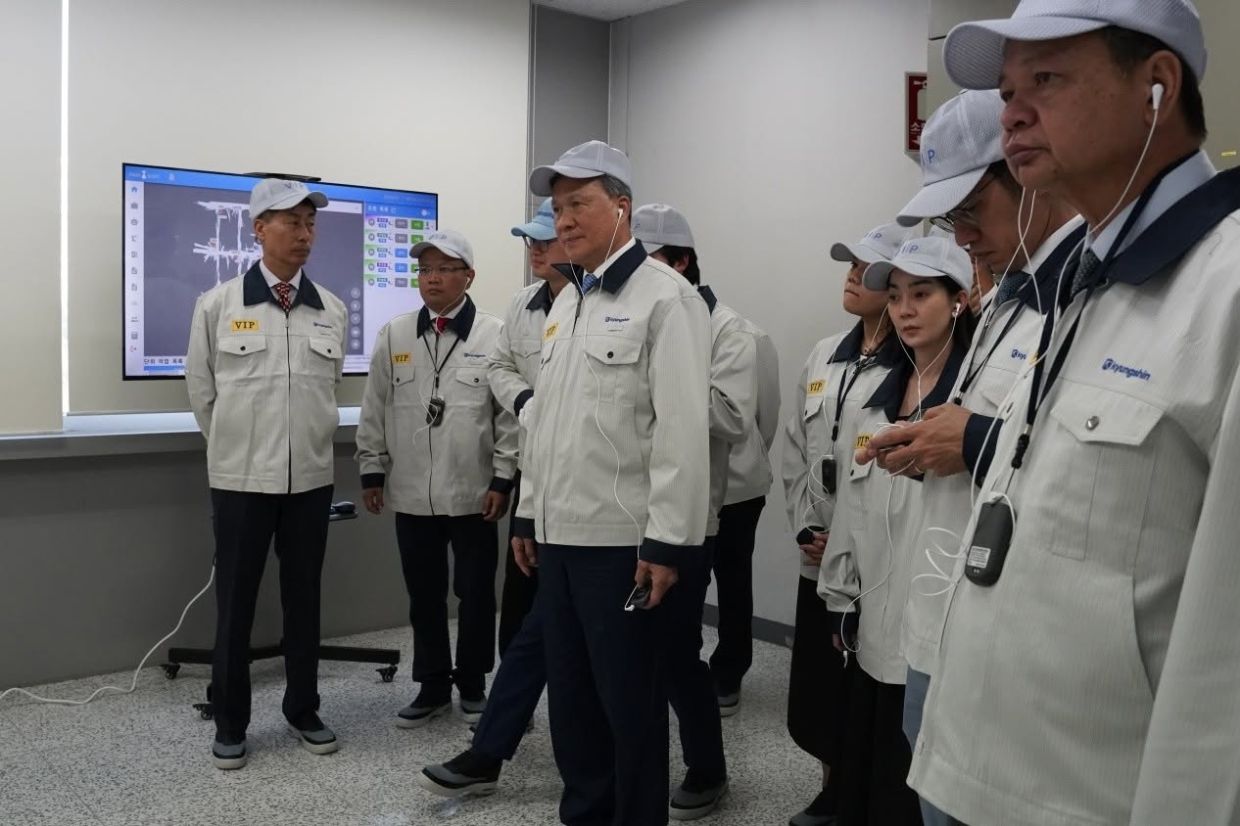
The delegation's encounter with Kyungshin Co., Ltd. underscores Cambodia's specific interest in capturing market share within the global electric vehicle supply chain. Founded in 1974, Kyungshin specialises in manufacturing wiring harnesses, connectors, junction blocks, and electrical systems for electric vehicles, while simultaneously developing advanced technologies for future mobility solutions. The company already maintains a substantial presence in Cambodia through a wire harness factory in Kandal province, which has invested approximately US$20 million and currently employs 1,467 workers. Kyungshin's twelve-year operational history in the Kingdom provides evidence that Cambodia can sustain the technical requirements and workforce stability that automotive electronics manufacturers demand, even as the sector's technology complexity continues to escalate.
Cambodia's pitch extends beyond manufacturing assembly to encompass the full technological ecosystem that companies require. By visiting Incheon Baek Hospital, Sun Chanthol demonstrated that the government recognises Korea's competitive advantage in medical technology and digital healthcare systems, while simultaneously identifying another sector where Cambodia seeks technology transfer and knowledge exchange. The healthcare initiative reflects sophisticated economic thinking: as manufacturing becomes more automated and skill-intensive, a nation's ability to attract and retain skilled workers depends partly on the quality of medical services, educational infrastructure, and lifestyle amenities available to employees and their families. By pursuing partnerships with advanced hospitals, Cambodia signals its intent to build human capital development systems that modern manufacturers expect.
The investment roadshow framework itself—organised by Cambodia's Council for the Development of Cambodia in cooperation with the Incheon Chamber of Commerce and Industry—represents a substantial institutional effort to coordinate diplomatic, policy, and commercial promotion. The participation of Cambodia's ambassador to South Korea, CDC officials, Ministry of Commerce representatives, and representatives of the Korean Chamber of Commerce in Cambodia created a unified messaging platform that communicates governmental seriousness and policy stability to Korean business decision-makers. This coordination suggests that Cambodia understands how multinational corporations evaluate investment destinations: not merely on the basis of labour costs, but through a holistic assessment of political stability, regulatory consistency, and government commitment to infrastructure and institutional development.
Cambodia's economic diversification imperative stems from the particular vulnerabilities that have accompanied its historical reliance on garment manufacturing. The global garment industry has faced sustained pressure from labour rights activism, environmental regulations, and the inexorable march of automation, all of which squeeze margins and threaten employment growth in countries competing primarily on wage competitiveness. Myanmar and Bangladesh, Cambodia's regional competitors, have periodically experienced political instability that disrupted supply chains, a dynamic that has occasionally benefited Cambodian manufacturers but also demonstrated the fragility of countries dependent on a single industrial sector. By developing automotive components, EV systems, logistics, energy, and healthcare technology capabilities, Cambodia reduces its exposure to sector-specific shocks while positioning itself to capture higher value-added work.
The electric vehicle transition presents Cambodia with a time-sensitive opportunity. Major automotive manufacturers are shifting capital investment toward EV component suppliers at an accelerating pace, and supply chain decisions made over the next three to five years will largely determine which countries capture significant market share in this growing sector. Korean companies, which have substantial expertise in EV batteries, electronics, and related systems, are natural partners for Cambodia to engage. South Korea's broader economic influence in Cambodia—evident through the presence of Korean automotive firms, manufacturers, and retailers—means that Korean investors already possess local market knowledge and familiarity with Cambodia's operating environment that firms from other countries might lack. This existing commercial network reduces risk for Korean firms considering Cambodian expansion, while giving Cambodia a realistic chance of capturing investment that might otherwise go to Vietnam, Thailand, or Indonesia.
The investment law framework that Sun Chanthol referenced during the roadshow—the Law on Investment of the Kingdom of Cambodia—provides the formal institutional foundation for the government's recruitment efforts. The legislation offers incentive packages, tax benefits, macroeconomic stability assurances, and investment protection mechanisms that Cambodia uses to compete for footloose multinational capital. However, the effectiveness of such legal frameworks depends heavily on practical implementation, bureaucratic efficiency, and consistency in application. Korean companies already operating in Cambodia possess firsthand knowledge of how reliably the government honours such commitments, which may explain why targeting established Korean manufacturers represents a more realistic strategy than attempting to attract entirely new foreign investors unfamiliar with Cambodian regulatory and operational realities.
The broader question facing Cambodia's diversification effort involves whether the nation can realistically build competitive advantage in advanced manufacturing sectors where it lacks historical expertise, established supply chains, or a domestic pool of highly skilled workers. South Korean partnerships offer a potential pathway by bringing capital, technology, and international market connections that Cambodia cannot generate domestically. However, such partnerships succeed only if Cambodia simultaneously invests in technical education, port and logistics infrastructure, reliable electrical power systems, and institutional frameworks that enable knowledge transfer and worker skill development. The healthcare and hospital visits during the delegation's mission suggest that policymakers recognise these complementary investments are essential; medical systems and educational quality directly influence whether skilled foreign workers and local engineers will accept positions in Cambodia.
The mission also signals Cambodia's strategic positioning within broader Indo-Pacific geopolitical and economic competition. As relations between Western nations and China become more contentious, multinational companies increasingly seek to diversify supply chains away from concentration in any single country or region. Cambodia, benefiting from proximity to both Thailand and Vietnam while maintaining relatively stable relationships with major trading powers, presents an attractive alternative location for companies seeking supply chain resilience. By actively courting Korean investors, Cambodia positions itself as a reliable ASEAN partner for companies looking to deepen their Southeast Asian manufacturing footprint, a calculation that extends beyond economic logic to encompass strategic hedging.
Success in this diversification strategy remains uncertain. Vietnam, Thailand, and Indonesia all offer larger markets, more developed infrastructure, and deeper pools of skilled workers, advantages that will not easily be overcome. However, Cambodia's combination of lower costs than Vietnam or Thailand, government determination to support manufacturing-led growth, and demonstrated ability to host sophisticated automotive and electronics operations creates a viable niche. The key variable will be whether Cambodia can maintain regulatory consistency, continue infrastructure investment, and develop sufficient human capital to support industrial operations that demand more skill and technical sophistication than traditional garment manufacturing. If the government sustains its commitment to this agenda and successfully collaborates with Korean and other multinational partners, Cambodia could over the coming decade achieve meaningful economic diversification and positioning within high-value regional and global supply chains.

%22%2F%3E%3C%2Fpattern%3E%3C%2Fdefs%3E%3Crect%20width%3D%22100%25%22%20height%3D%22100%25%22%20fill%3D%22url(%23ph21o2sg)%22%2F%3E%3Crect%20width%3D%22100%25%22%20height%3D%22100%25%22%20fill%3D%22url(%23ph21o2sp)%22%2F%3E%3Ctext%20x%3D%2250%25%22%20y%3D%2250%25%22%20text-anchor%3D%22middle%22%20dominant-baseline%3D%22central%22%20fill%3D%22rgba(255%2C255%2C255%2C0.95)%22%20font-family%3D%22Georgia%2C%20'Times%20New%20Roman'%2C%20serif%22%20font-weight%3D%22700%22%20font-size%3D%22170%22%20letter-spacing%3D%22-0.02em%22%3EGabungan%3C%2Ftext%3E%3C%2Fsvg%3E)