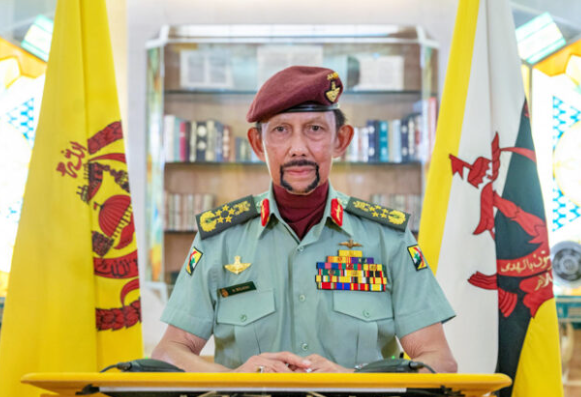
Brunei's Sultan Hassanal Bolkiah has urged the nation to harness the dawn of the Islamic New Year 1448 Hijrah as an opportunity for deeper commitment to both economic progress and spiritual advancement, cautioning that meaningful transformation demands sustained dedication rather than superficial gestures. In a speech marking the occasion, the monarch positioned the new year not merely as a temporal marker but as a renewed covenant with the Almighty, inviting citizens to channel their collective will toward tangible improvements across multiple dimensions of national life.
The Sultan articulated a comprehensive vision of development spanning two interconnected spheres. The material realm encompasses the nation's economic vitality and infrastructure expansion—the tangible pillars upon which prosperity rests. Simultaneously, the spiritual dimension encompasses knowledge acquisition, educational advancement, and dakwah, or Islamic propagation, which the Sultan presented as equally fundamental to national wellbeing. This dual-track approach reflects Brunei's philosophical framework, wherein economic competitiveness and religious consciousness are portrayed as complementary rather than competing priorities.
The monarch's framing of the new year carried particular weight in his assertion that citizens should view this moment as a renewal of existing commitments rather than a commencement point. The distinction carries implicit messaging about national discipline and consistency—suggesting that progress accumulates through continuous application of principles rather than episodic bursts of effort. By emphasising gratitude to the Almighty for the privilege of welcoming another Islamic year, the Sultan grounded the entire message within a theological context that positions national achievement as inseparable from spiritual accountability.
Contextualising Brunei's position within a turbulent global landscape, the Sultan acknowledged that international conflicts and regional instability create cascading challenges affecting nations across the world. His observations about the universal suffering spawned by warfare underscored the precariousness of peace, positioning Brunei's relative stability as a distinctive blessing requiring active protection rather than passive assumption. This acknowledgment of global volatility resonates particularly with Southeast Asian readers accustomed to monitoring geopolitical tensions that ripple across the region, from maritime disputes to great power competition.
Critically, the Sultan attributed Brunei's freedom from the devastation of natural disasters and sustained territorial peace to divine providence facilitated through religious devotion. He specifically referenced the protective qualities of prayer, remembrance of God through zikir, and Quranic recitation as spiritual mechanisms undergirding national security. This theological interpretation frames religious practice not as private observance but as a collective security investment, subtly reinforcing the interconnection between individual piety and state stability.
Yet the Sultan's address pivoted sharply toward identifying crime as an internal threat requiring immediate, multi-sectoral intervention. His explicit naming of drug-related offences, theft, and other criminal activity as damaging to Brunei's international reputation and fundamentally repugnant to Islamic teaching indicated growing concern about criminal penetration into society. This focus on internal security mirrors preoccupations across Southeast Asia, where drug trafficking, organised crime, and property crimes strain law enforcement resources and undermine public confidence in state institutions.
The monarch's call for coordinated action by security agencies and religious authorities represented a deliberate allocation of responsibility. Security forces were tasked with enforcement capacity, while religious institutions received a mandate to strengthen educational programmes and awareness-raising campaigns designed to inoculate society against criminal inclination. This division of labour suggests that the Sultan views crime prevention as requiring both deterrence and reformation—addressing both the enforcement gap and the ideological vulnerabilities that permit criminal activity to flourish.
Particularly significant was the Sultan's emphasis on intensifying religious education and dakwah specifically as crime-prevention mechanisms. Rather than framing religious instruction solely in terms of spiritual development, he positioned it as instrumental to public safety. This rhetorical move connects religious engagement directly to tangible, measurable state interests in security and order, potentially strengthening institutional support for religious education initiatives that might otherwise face questions about resource allocation.
The Sultan's invocation of collective responsibility for safeguarding both the Muslim community and the nation represents a deliberate effort to bind individual piety to civic duty. His assertion that protection depends upon sustained vigilance, prayer, and remembrance rather than complacency injects an element of participatory obligation into the security framework. Citizens are not merely passive beneficiaries of state protection but active contributors through spiritual discipline and communal watchfulness.
For regional observers, Brunei's emphasis on balancing material and spiritual progress while confronting crime offers instructive parallels to challenges facing Malaysia and other Southeast Asian nations. The Sultan's framework suggests that sustainable development requires simultaneous attention to economic modernisation and religious vitality, a proposition increasingly central to policy discussions across the Muslim-majority region. His articulation of crime as a collective responsibility problem rather than purely a law-enforcement matter reflects emerging perspectives on public safety that privilege community engagement and moral education alongside institutional capacity.
The Sultan's New Year address ultimately projects an image of Brunei as a nation aware of external threats and internal vulnerabilities, yet resolved to navigate both through strengthened institutional coordination and deepened spiritual commitment. The framing anticipates challenges while maintaining confidence in the nation's capacity to surmount them through unified effort grounded in Islamic principle. For a small oil-rich monarchy navigating regional competition and global economic uncertainty, this message of consolidated purpose carries considerable strategic significance.

%22%2F%3E%3C%2Fpattern%3E%3C%2Fdefs%3E%3Crect%20width%3D%22100%25%22%20height%3D%22100%25%22%20fill%3D%22url(%23ph21o2sg)%22%2F%3E%3Crect%20width%3D%22100%25%22%20height%3D%22100%25%22%20fill%3D%22url(%23ph21o2sp)%22%2F%3E%3Ctext%20x%3D%2250%25%22%20y%3D%2250%25%22%20text-anchor%3D%22middle%22%20dominant-baseline%3D%22central%22%20fill%3D%22rgba(255%2C255%2C255%2C0.95)%22%20font-family%3D%22Georgia%2C%20'Times%20New%20Roman'%2C%20serif%22%20font-weight%3D%22700%22%20font-size%3D%22170%22%20letter-spacing%3D%22-0.02em%22%3EGabungan%3C%2Ftext%3E%3C%2Fsvg%3E)