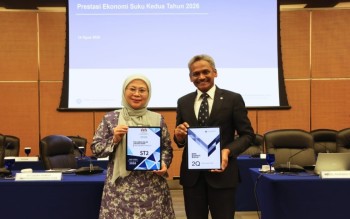
Bank Negara Malaysia sees no immediate need to adjust its 2026 gross domestic product growth projection, maintaining confidence that the nation's economy will expand by approximately five per cent this year. Governor Datuk Seri Abdul Rasheed Ghaffour made this statement following the release of Malaysia's second-quarter economic data, which came in stronger than anticipated at 6.0 per cent expansion, eclipsing the Department of Statistics Malaysia's earlier forecast of 5.8 per cent. The central bank's steadfast outlook reflects optimism about the underlying momentum propelling Southeast Asia's third-largest economy, though officials acknowledge that adjustments to forecasts typically occur during formal budget announcements rather than in interim reviews.
The Malaysian economy's consistent outperformance over recent quarters has reinforced the central bank's conviction that current growth trajectories remain sustainable. Abdul Rasheed highlighted that the nation has exceeded expectations not just in the most recent quarter but across the previous three consecutive periods, suggesting a durable expansion rather than a temporary surge. This sustained momentum carries particular significance for policymakers and investors tracking Malaysia's economic resilience amid volatile global conditions, demonstrating that domestic fundamentals remain sufficiently robust to support medium-term growth targets despite external headwinds.
Domestic demand has emerged as the primary engine driving this economic expansion, providing a counterweight to uncertainties emanating from the international sphere. The central bank governor underscored that internal consumption patterns, capital formation, and domestic investment have collectively anchored growth, whilst external markets have furnished supplementary support. This composition is noteworthy because it indicates Malaysia has not become excessively dependent on volatile export flows alone, instead benefiting from a more balanced growth architecture that reduces vulnerability to sudden swings in global trade sentiment.
Household consumption, a critical barometer of consumer confidence and economic health, has demonstrated exceptional resilience. Registering expansion of 4.8 per cent in the second quarter, this component reflects multiple reinforcing factors underpinning spending behaviour. Abdul Rasheed attributed this strength to three principal supports: rising household incomes, accumulated savings that provide purchasing power, and deliberate government policy interventions designed to sustain consumer activity. Notably, he stressed that household borrowing contributes only marginally to consumption growth, indicating that the expansion rests on fundamentally sound foundations rather than debt-fuelled excess that could prove unsustainable.
The export sector has similarly contributed to Malaysia's broad-based economic expansion, though this contribution has become increasingly diversified rather than concentrated in traditional powerhouses. Both electrical and electronics products, Malaysia's historical export mainstay, and non-electrical and electronics categories have expanded in tandem, signalling healthy demand across manufacturing segments. Concurrent growth in information and communications technology services further illustrates how Malaysia's export profile has evolved beyond simple resource extraction or routine manufacturing toward higher-value activities that generate superior margins and employment quality.
Yet the central bank's continued confidence exists within a framework of acknowledged uncertainty regarding the global operating environment. Abdul Rasheed cautioned that geopolitical tensions and economic volatility in major trading partners represent material risks that could impose restraint on Malaysia's growth trajectory. The complexity of international relations, particularly concerning commerce and supply chain logistics, introduces an element of unpredictability that limits how far forward policymakers can project with certainty. This measured tone reflects institutional prudence rather than complacency, recognising that external shocks can transmit rapidly across integrated financial and commercial networks.
Concern about El Niño weather patterns adds another dimension to the risk landscape confronting Malaysian policymakers and business leaders. The central bank governor indicated that climate disruptions stemming from this phenomenon would likely manifest gradually within the economy rather than producing instantaneous shocks, with agricultural sectors facing the most direct exposure. This lag effect means that adaptation strategies and preventive measures implemented now could significantly mitigate eventual damage. Abdul Rasheed urged both businesses and households to undertake advance preparations and develop contingency approaches, recognising that proactive rather than reactive responses typically produce superior outcomes when environmental disruptions occur.
The breadth of Malaysia's economic expansion across multiple sectors and demand components provides reassurance regarding growth sustainability throughout 2026. Rather than relying narrowly on individual sectors or sources of demand, the current expansion draws support from consumption, investment, trade, and services simultaneously. This diversification suggests that weakness in any single component would not precipitate an economy-wide contraction, instead potentially being offset by strength elsewhere. For foreign investors and multinational corporations evaluating Malaysia's attractiveness, this resilience across growth drivers offers confidence about the reliability of demand conditions and macroeconomic stability.
The central bank's decision to preserve its growth forecast pending the Budget announcement reflects institutional practice and data-collection cycles rather than any diminution in analytical rigour. Formal GDP revisions typically synchronise with major fiscal announcements when governments articulate spending and revenue intentions that could materially influence growth trajectories. Maintaining existing projections at this juncture does not preclude upward revisions should economic data continue improving, nor does it foreclose downward adjustments should new information warrant recalibration. This flexible framework allows monetary authorities to balance decisiveness with appropriate caution, avoiding premature signal changes that might confuse markets or policy stakeholders.
For Malaysia's regional standing within Southeast Asia, the continued positive economic momentum enhances the nation's position as an anchoring economy within ASEAN. Consistent growth coupled with diversified expansion across multiple sectors reinforces perceptions of Malaysia as a stable destination for foreign direct investment and regional commerce hubs. The central bank's measured optimism, grounded in concrete economic data rather than aspirational projections, communicates to international audiences that Malaysian leadership possesses realistic rather than inflated confidence about economic prospects. This calibrated messaging becomes particularly valuable when regional competitors face their own challenges, as it subtly positions Malaysia as a relatively dependable performer within an economically heterogeneous region.

