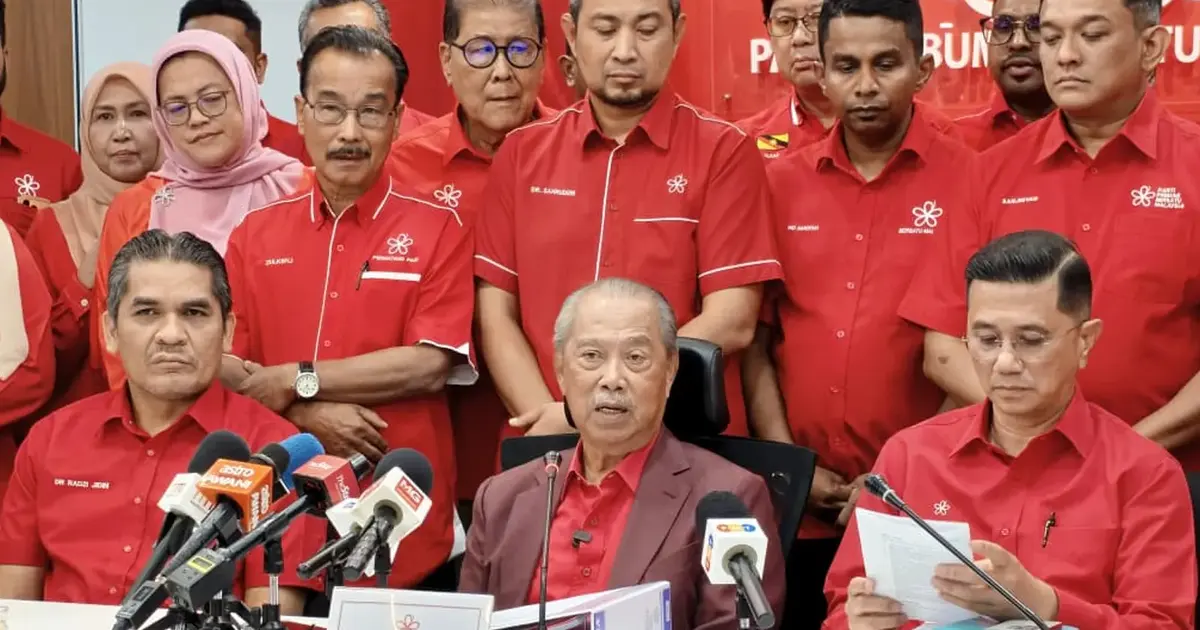
Bersatu president Muhyiddin Yassin has firmly restated the party's intention to maintain its membership within the Perikatan Nasional coalition, declaring that this position reflects the coalition's standing among the Malaysian electorate. The announcement underscores the stability of a political grouping that has become increasingly central to the country's power dynamics since the coalition's emergence as a significant force in recent electoral cycles.
The decision to remain within Perikatan Nasional comes at a juncture when Malaysia's political landscape continues to shift following successive general elections that have fractured traditional power bases. Muhyiddin's statement serves both as a reassurance to coalition partners and a signal to rival political formations that Bersatu views its future as inextricably linked to the broader Perikatan Nasional project. The party has consistently sought to position itself as essential to the coalition's electoral viability and governance capacity.
Muhyiddin's assertion that the coalition enjoys public acceptance reflects a particular interpretation of Malaysian voter sentiment. This framing suggests that Bersatu leadership believes the electorate has validated Perikatan Nasional's policy platform and political direction, distinguishing it from competing coalitions. Such public confidence would theoretically provide the coalition with legitimacy for pursuing its strategic objectives and maintaining party discipline among its constituent members.
For Bersatu specifically, the commitment to Perikatan Nasional represents continuity after a period of strategic uncertainty. The party has navigated complex negotiations within Malaysia's fractious political environment, where coalition membership can prove unstable as parties continuously evaluate their electoral prospects and policy alignment. By anchoring itself to Perikatan Nasional, Bersatu signals that it views the coalition as the optimal vehicle for advancing its political and governance ambitions.
The broader context for this declaration involves the competitive dynamics between Malaysia's major political blocs. Perikatan Nasional has positioned itself as an alternative to Pakatan Harapan, with distinct policy priorities and governance philosophies. The coalition brings together parties with diverse constituencies and regional strongholds, creating both opportunities for broad-based representation and challenges in maintaining internal cohesion around unified messaging and decision-making.
Public perception of political coalitions in Malaysia remains shaped by economic performance, governance effectiveness, and alignment with voter priorities on key issues such as development, religious matters, and social stability. Muhyiddin's reference to public acceptance likely encompasses polling data and electoral feedback that Bersatu's leadership interprets as validating the coalition's direction. However, Malaysian voters have demonstrated capacity to reassess their political preferences between elections, making sustained coalition relevance contingent on continued delivery of perceived benefits.
For regional observers, Perikatan Nasional's composition and stability carry implications beyond Malaysia's domestic politics. The coalition's approach to governance, trade policy, and regional engagement influences Malaysia's position within ASEAN and its relationships with major powers. Coalition decisions on economic management and development priorities therefore hold significance for the broader Southeast Asian context, particularly given Malaysia's role in regional institutions and trade networks.
The commitment to Perikatan Nasional also reflects internal party dynamics within Bersatu, where leadership has sought to consolidate control and marginalize dissenting voices regarding coalition strategy. By reaffirming the party's position through its president, the leadership establishes a clear party line that members are expected to follow, reducing space for alternative proposals or coalition switching discussions among party figures.
Looking forward, Bersatu's place within Perikatan Nasional will likely depend on the coalition's capacity to sustain electoral competitiveness and deliver governance outcomes that resonate with its support base. Political coalitions in Malaysia have historically proven vulnerable to defections and realignments when parties perceive superior opportunities elsewhere. Muhyiddin's statement should therefore be understood as expressing current strategic preference while acknowledging that Malaysia's fluid political environment could prompt reassessment if circumstances change substantially.
The timing of this reaffirmation may also reflect efforts to project stability ahead of state elections, by-elections, or other political contests where coalition unity becomes operationally important. Maintaining public messaging of solidarity within Perikatan Nasional supports coalition campaign efforts and discourages opponents from exploiting any perception of internal fracture. For Bersatu members and supporters, the statement provides clarity about their party's ongoing political identity and alliance structure.

%22%2F%3E%3C%2Fpattern%3E%3C%2Fdefs%3E%3Crect%20width%3D%22100%25%22%20height%3D%22100%25%22%20fill%3D%22url(%23ph21o2sg)%22%2F%3E%3Crect%20width%3D%22100%25%22%20height%3D%22100%25%22%20fill%3D%22url(%23ph21o2sp)%22%2F%3E%3Ctext%20x%3D%2250%25%22%20y%3D%2250%25%22%20text-anchor%3D%22middle%22%20dominant-baseline%3D%22central%22%20fill%3D%22rgba(255%2C255%2C255%2C0.95)%22%20font-family%3D%22Georgia%2C%20'Times%20New%20Roman'%2C%20serif%22%20font-weight%3D%22700%22%20font-size%3D%22170%22%20letter-spacing%3D%22-0.02em%22%3EGabungan%3C%2Ftext%3E%3C%2Fsvg%3E)