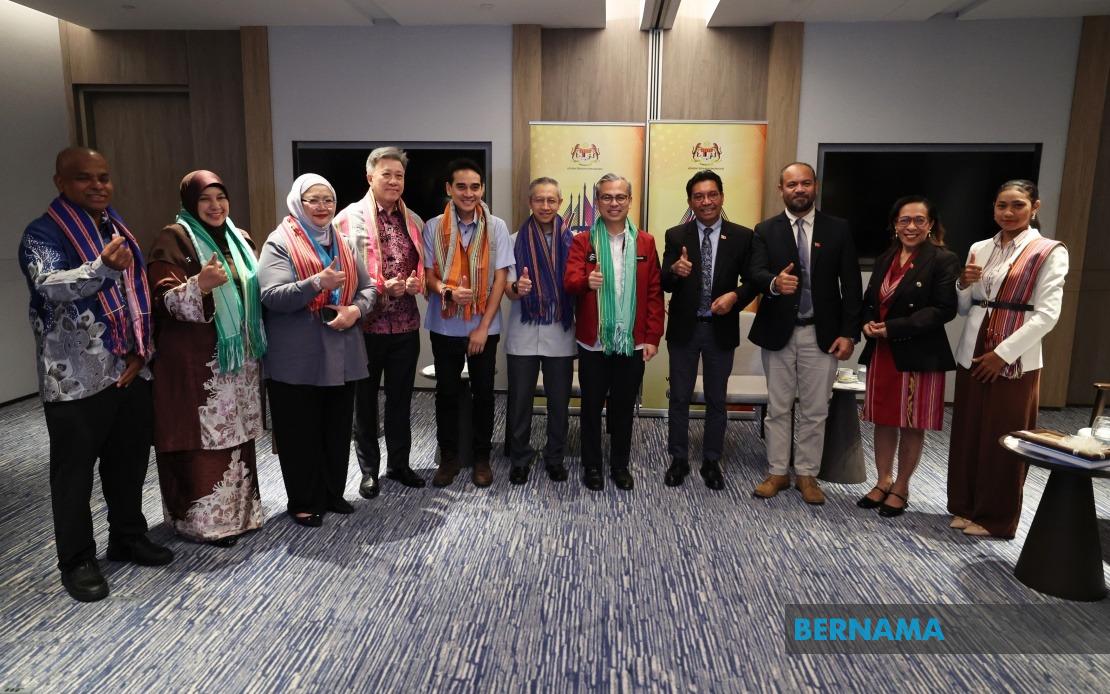
Malaysia's national news agency Bernama and Timor-Leste's news organisation TATOLI have formalized a strategic partnership designed to amplify the voice of Southeast Asian journalism across the region and beyond. The memorandum of understanding, signed at a ceremony in Butterworth during the National Journalists' Day celebration, represents a significant step in deepening ties between the two ASEAN member states through enhanced media collaboration.
The agreement, brokered under the observation of Prime Minister Datuk Seri Anwar Ibrahim and Communication Minister Datuk Fahmi Fadzil, commits both agencies to systematic cooperation across multiple dimensions of news operations. Rather than merely exchanging wire feeds, the partnership encompasses shared resources in photography, multimedia content, and comprehensive training programmes tailored to build professional capacity at TATOLI. This multifaceted approach reflects a broader recognition that media sustainability in developing nations requires not just content distribution but institutional strengthening.
Bernama Chief Executive Officer Datin Paduka Nur-ul Afida Kamaludin articulated a strategic vision extending beyond bilateral benefit. She emphasized that when ASEAN's official news agencies coordinate their editorial efforts and narrative frameworks, the region gains greater autonomy in shaping how its story reaches international audiences. Currently, much Southeast Asian news passes through global wire services based in Western capitals; this initiative inverts that pattern by positioning regional actors as primary storytellers for their own communities and the wider world.
The practical dimensions of this collaboration address immediate capacity needs facing TATOLI, which was established only in 2016. Bernama's institutional infrastructure—encompassing specialized editors, training faculty, and multimedia production expertise across online, broadcast, and print platforms—will be mobilized to upgrade TATOLI's operational capabilities. Already, a contingent of Timorese reporters is scheduled to undertake intensive training at Bernama facilities before year's end, gaining exposure to standards and workflows at one of Southeast Asia's most established news organizations.
Language represents both an opportunity and a complexity within this partnership. TATOLI currently distributes content in Tetum, Portuguese, Bahasa Indonesia, and English, reflecting Timor-Leste's unique linguistic heritage. Bernama's existing output spans six languages including Bahasa Melayu, Tamil, Mandarin, and Arabic. The MoU has prompted Bernama to contemplate adding Portuguese-language services, a decision that would extend Malaysian news access to Portuguese-speaking communities globally while honoring Timor-Leste's colonial legacy and current linguistic reality. Such expansion demonstrates how regional cooperation can inadvertently reshape a news agency's global reach.
The timing of this initiative carries particular significance given Timor-Leste's recent accession to ASEAN in October 2025. TATOLI began exploring partnership possibilities with Bernama even before formal membership materialized, suggesting both organizations recognized the strategic value of established relationships within the regional bloc. For Timor-Leste, affiliation with ASEAN's institutional media infrastructure provides legitimacy and connectivity; for Bernama, engaging new ASEAN members strengthens its position as the regional news anchor.
TATOLI President Noémio Mateus Soares Falcão framed the partnership within broader concerns about information integrity in an age of rapid digital dissemination. He highlighted how professional journalism standards serve as counterweight to misinformation and sensationalism proliferating across social media platforms. Both agencies share commitment to press freedom, editorial independence, and the public's right to verified information—principles increasingly tested as digital platforms democratize content creation while eroding traditional gatekeeping.
Bernama's credentials for training provision rest on substantial institutional experience. The agency, established in 1967 as Malaysia's official news provider, operates the Bernama School of Journalism and maintains the Bernama Excellence Centre, accumulating more than two decades of formal training delivery. This experience positions Bernama as a credible mentor for newsroom practices, from story verification protocols to multimedia integration, digital platform management, and ethical decision-making under competitive pressure.
The broader context illuminates why this partnership matters for Malaysian readers and Southeast Asian media development. Regional news agencies often lack resources to compete with global competitors for exclusive content and expert analysis. By coordinating, they enhance bargaining power with international news sources, reduce redundant coverage through strategic specialization, and maintain distinct regional perspectives rather than simply republishing wire agency dispatches. When Bernama content reaches Timor-Leste audiences through TATOLI platforms, it strengthens ASEAN's collective media voice while allowing each nation's citizens to understand their neighbors through trusted local intermediaries.
For journalism professionals across the region, this partnership opens training pathways and creates opportunities for knowledge transfer that strengthen the sector's overall capacity. Young journalists from Timor-Leste gaining experience at Bernama return home with enhanced skills applicable to their own contexts. Over time, such exchanges build informal professional networks that transcend formal organizational boundaries, creating communities of practice that elevate journalistic standards across participating countries.
The initiative also reflects pragmatic recognition that smaller nations' official news agencies require support to maintain relevance and credibility. TATOLI, responsible for disseminating Timor-Leste government information, faces inherent challenges in projecting editorial independence while serving state interests. Partnerships with established agencies like Bernama, which despite state affiliation maintains professional newsroom operations, provide models for balancing these tensions. Training staff on international journalistic standards and best practices encourages institutional cultures that prioritize accuracy and verification regardless of political pressures.
Moving forward, the success of this collaboration will be measured not merely by content exchange volume but by the professional development outcomes achieved and the degree to which TATOLI's journalism quality and audience reach expand. The partnership's longevity depends on both organizations deriving genuine operational benefits—reduced costs, expanded reach, enhanced credibility—rather than treating the MoU as a ceremonial gesture. For Malaysian stakeholders, supporting ASEAN media development aligns with broader regional integration objectives and Malaysia's positioning as a Southeast Asian leader in institutional capability.