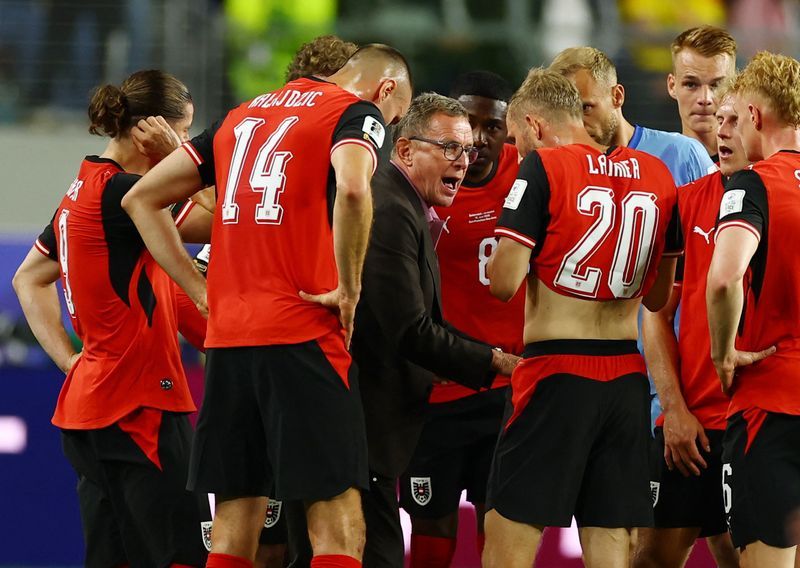
Austria's journey through the World Cup has taken an unexpectedly bumpy road despite expectations running high following their impressive showing at Euro 2024. In Santa Clara on Tuesday, Ralf Rangnick's side managed to see off World Cup newcomers Jordan, but the 3-1 scoreline flatters the Austrian performance in a match that exposed significant vulnerabilities in their gameplay. The decisive moment came through substitute Marko Arnautovic's penalty deep into the second half's stoppage period, a clincher that masked the struggles Austria faced against opponents making their debut appearance on football's grandest stage.
Jordan's bold approach to the contest rattled the supposedly stronger European side throughout. The Jordanian team displayed a coherent tactical structure and attacking ambition that consistently tested Austria's defensive organisation, forcing Rangnick to respond to what proved to be a far sterner examination than many had anticipated. Rather than deflecting responsibility onto external circumstances, the Austrian coach publicly acknowledged the quality of opposition his team had encountered, offering generous praise for Jordan's tactical discipline and competitive spirit.
Rangnick's assessment provides valuable insight into the tournament's evolving dynamics. When questioned about Austria's uncharacteristic performance, he attributed much of the struggle to Jordan's exceptional execution and game plan. The coach emphasised that while bookmakers and analysts may have favoured Austria, the actual contest revealed a different reality on the pitch. His willingness to credit the opponent rather than blame his own players demonstrates both sportsmanship and a clear-eyed recognition of football's changing landscape.
The expansion of the World Cup to include 48 teams rather than the traditional 32 has proven consequential in ways that extend beyond mere numbers. Rangnick articulated genuine enthusiasm for this format modification, describing it as an enriching experience that democratises participation in world football's premier competition. This perspective carries significant weight coming from a coach managing one of Europe's established footballing nations, suggesting that even traditional powerhouses recognise value in the tournament's broader inclusivity.
Beyond Austria's narrow escape against Jordan, Rangnick pointed to several other results that illustrated the competitive uplift across nations previously considered minnows. Spain's unexpected stalemate with Cape Verde, Australia's dramatic victory over Turkey, and Haiti's determined performance against Scotland all reinforced his central argument: the gap between established and emerging footballing nations has contracted markedly over the past fifteen years. These outcomes represent not isolated upsets but rather symptomatic indicators of genuine improvement in global football standards.
The coach's thesis about competitive convergence carries particular relevance for Southeast Asian football enthusiasts and observers tracking the region's development pathways. If smaller nations across Africa, the Caribbean, and Oceania have elevated their capabilities to the point where they can challenge established European and Asian powers, the implications for regional competitions and participation strategies merit serious consideration. Teams that previously faced near-certain defeat now demonstrate the tactical sophistication and physical conditioning to compete effectively.
Austria's immediate challenge involves confronting Group J leaders Argentina, who dispatched Algeria with a convincing 3-0 victory. The contrast between Argentina's clinical performance and Austria's laboured win illustrates the tournament's compressed quality levels. While some observers might interpret Tuesday's display as a warning sign heading into the Argentina encounter, Rangnick's framing suggests Austria must respect opponents fundamentally differently than coaching manuals from previous decades suggested.
The implications of Rangnick's observations extend beyond Austria's tournament ambitions. Tournament organisers and governing bodies have long debated whether expanded formats dilute quality or enhance the competition's global character. The Austrian coach's testimony suggests the answer involves both elements: the expanded tournament does provide more nations meaningful participation opportunities, yet simultaneously the participants themselves have developed to levels requiring genuine tactical preparation and respect.
For Malaysian readers and Southeast Asian observers, the Jordan versus Austria encounter offers instructive lessons about investment in youth development, coaching infrastructure, and systematic preparation. Jordan's creditable display despite inferior overall resources demonstrates that structured football programmes yield tangible results even among nations without traditional football legacies. The competitive elevation Rangnick described didn't occur accidentally but resulted from decades of deliberate capacity-building across multiple dimensions of professional football.
Looking forward, Rangnick's pragmatic acknowledgement of the tournament's competitive reality may influence how other coaches approach unfamiliar opponents. The days when coaches could prepare for Group J opposition by treating them as inevitable wins have demonstrably passed. Every team arriving at a World Cup tournament now arrives with identifiable strengths, tactical coherence, and competitive intent that demands serious preparation and execution.
Austria's path to progressing from their group now intersects with performances from multiple competing nations, all of whom have demonstrated they possess the capability to hurt established sides. The narrow margin of Tuesday's victory, despite the final scoreline, serves as a cautionary reminder that football's hierarchy has undergone subtle but meaningful realignment. Rangnick's generous assessment of Jordan ultimately reflects this broader recognition that the modern World Cup features fundamentally different competitive dynamics than tournaments of the recent past.

%22%2F%3E%3C%2Fpattern%3E%3C%2Fdefs%3E%3Crect%20width%3D%22100%25%22%20height%3D%22100%25%22%20fill%3D%22url(%23ph21o2sg)%22%2F%3E%3Crect%20width%3D%22100%25%22%20height%3D%22100%25%22%20fill%3D%22url(%23ph21o2sp)%22%2F%3E%3Ctext%20x%3D%2250%25%22%20y%3D%2250%25%22%20text-anchor%3D%22middle%22%20dominant-baseline%3D%22central%22%20fill%3D%22rgba(255%2C255%2C255%2C0.95)%22%20font-family%3D%22Georgia%2C%20'Times%20New%20Roman'%2C%20serif%22%20font-weight%3D%22700%22%20font-size%3D%22170%22%20letter-spacing%3D%22-0.02em%22%3EGabungan%3C%2Ftext%3E%3C%2Fsvg%3E)