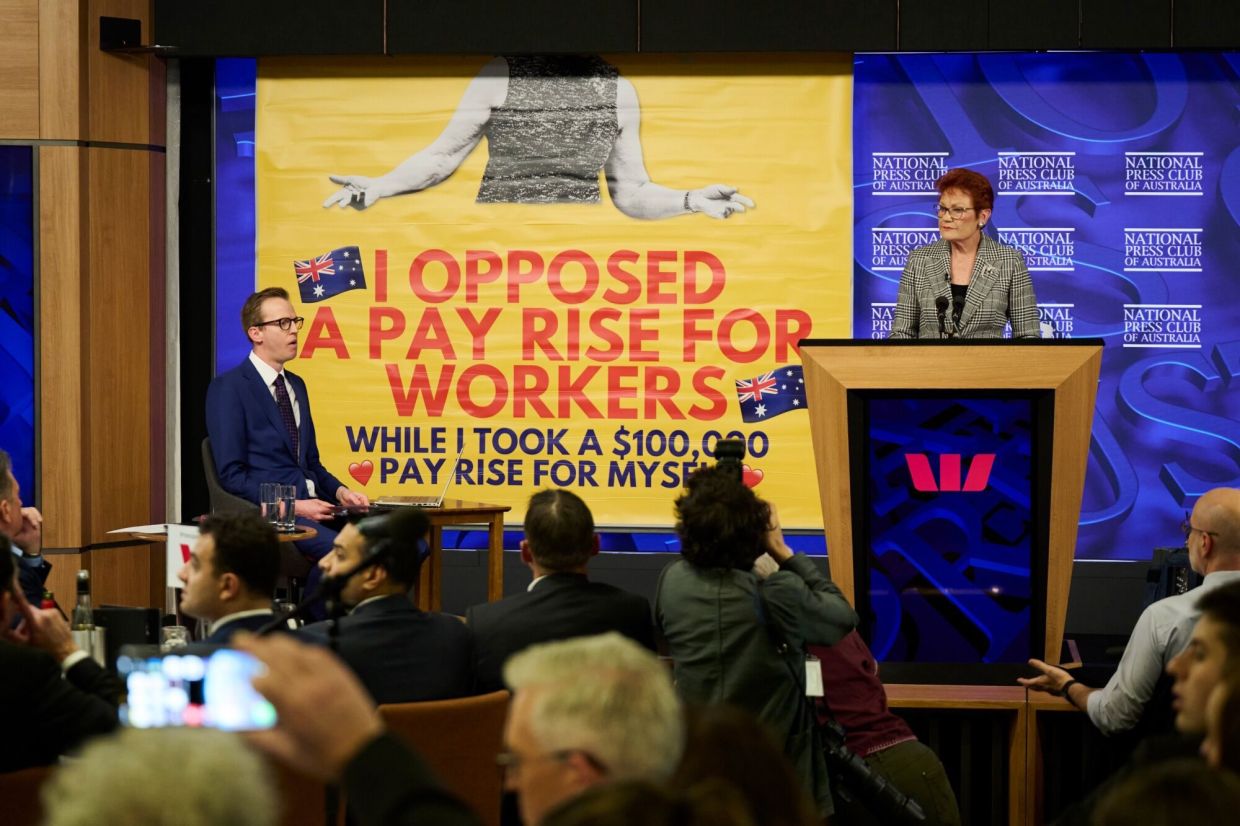
At the National Press Club in Canberra on Wednesday, Pauline Hanson, leader of Australia's hard-right populist One Nation party, has fundamentally challenged the nation's foundational approach to cultural identity and social integration. In remarks that mark her first appearance at the prestigious venue after three decades in politics, Hanson articulated a vision for a "monocultural" Australia, effectively rejecting the multicultural framework that has governed immigration and integration policy since the 1970s. The distinction she drew between being multiracial and monocultural represents a deliberate rhetorical repositioning, suggesting that while racial diversity might be inevitable, a unified cultural identity should prevail.
Hanson's argument explicitly connects Australia's current housing affordability crisis to what she characterises as an "utterly flawed policy" of multiculturalism. By positioning migration levels as a core driver of property market pressures, she has tapped into a growing source of anxiety among Australian voters grappling with soaring rental costs and declining homeownership prospects. This framing transforms immigration from a demographic issue into an immediate economic concern for households struggling with shelter costs. Her call to "slash" migration signals an intention to substantially reduce current intake numbers, departing markedly from bipartisan consensus that has largely supported skilled and family migration programs across the political spectrum.
A particularly contentious element of Hanson's platform involves proposed restrictions on entry from nations she characterises as "immersed in extremism like radical Islam." This language echoes her earlier political positions and reflects ongoing anxieties about security and cultural assimilation in multicultural democracies. The phrasing, however, conflates geographic and religious identity with extremism, a connection that civil liberties advocates and Muslim community groups have consistently contested. For Malaysia and other Southeast Asian countries with significant Muslim populations, such rhetoric carries particular relevance, as it signals how immigration debates in Western nations increasingly intersect with religious profiling and securitisation discourse.
One Nation's ascending position in Australian opinion polling reflects deeper structural changes in the nation's electoral landscape. The party's resurgence accelerated following the centre-right coalition government's electoral collapse in May of the previous year, suggesting that traditional conservative voters have become receptive to more radical messaging. This trajectory parallels populist movements across developed democracies, where economic insecurity has eroded faith in establishment parties. Hanson's enhanced political standing indicates that messaging around immigration, cultural change, and economic hardship resonates powerfully with a segment of the Australian electorate feeling left behind by globalisation and rapid social change.
The timing of Hanson's speech coincides with converging economic pressures afflicting Australian households. Resurgent inflation, elevated interest rates applying downward pressure on mortgage availability, and spiking fuel costs—exacerbated by geopolitical tensions in the Middle East—have created a cascade of cost-of-living challenges. These material circumstances provide fertile ground for populist messaging that attributes complex economic problems to single, identifiable causes. Hanson's explicit attribution of these pressures to immigration and renewable energy transition costs offers voters a straightforward explanation and a seemingly actionable response through policy changes at the ballot box.
Prime Minister Anthony Albanese's Labor government has attempted to address immediate cost pressures through targeted fiscal interventions, including a temporary reduction in fuel excise taxation and regulatory reforms aimed at improving housing supply and affordability. These measures represent conventional policy responses within mainstream economic frameworks. However, Albanese has also explicitly called out the rise of "simplistic grievance-based politics," suggesting he views Hanson's approach as exploiting voter frustration rather than solving underlying structural issues. His diagnosis—that the economy increasingly fails to function for ordinary Australians—acknowledges legitimate grievances while disputing that immigration represents the primary culprit.
The housing affordability debate stands at the intersection of multiple causal factors, making attributions to any single policy particularly contestable. While immigration does increase population and housing demand, other drivers include zoning restrictions limiting supply, foreign investment rules, construction industry capacity constraints, and long-term undersupply relative to population growth. Similarly, inflation and interest rate rises stem from global monetary conditions and commodity price shocks rather than immigration policy alone. Yet the emotional immediacy of housing costs—affecting renters' monthly budgets and homebuyers' ability to access property markets—means that explanations linking these pressures directly to visible population changes can prove politically potent regardless of causal complexity.
For Southeast Asian observers, particularly Malaysian policymakers and analysts, Hanson's resurgence illustrates how immigration and multiculturalism debates have intensified in developed nations that historically positioned themselves as immigration destinations. The framing of multiculturalism as a "flawed policy" represents a substantial rhetorical reversal from the 1980s and 1990s, when Australian political leaders across parties championed multicultural integration as both ethically sound and economically beneficial. This ideological shift suggests that economic hardship and rapid demographic change have eroded support for pro-immigration consensus that once seemed settled.
The broader context matters for understanding Australian political trajectories. Unlike Malaysia, where communal politics operates within a constitutionally enshrined framework balancing multiple ethnic and religious communities, Australia's political system has treated multiculturalism as a policy choice rather than constitutional principle. This distinction means that demographic and cultural policy shifts face fewer structural constraints, potentially enabling more radical reorientations toward homogeneity. The vulnerability of multicultural frameworks to populist challenge depends partly on whether they remain embedded only in policy rather than deeper constitutional or national identity commitments.
One Nation's polling strength also reflects the intersection of economic grievance, cultural anxiety, and political opportunity. When major parties appear unable or unwilling to address voter frustrations directly, space emerges for challengers offering clearer solutions and more expressive validation of community concerns. Hanson's willingness to explicitly critique multiculturalism—a position mainstream politicians have long avoided—positions her as authentically representing voter sentiment previously excluded from mainstream political discourse. This dynamic reproduces patterns observed across Western democracies, where populist parties gain traction by articulating previously marginalised perspectives.
The implications for Australia's actual immigration and integration policy remain uncertain pending electoral outcomes and legislative developments. One Nation's strength in polls does not guarantee parliamentary seats or governing capacity given Australia's preferential voting system. However, even without forming government, the party can pressure the major parties to shift rhetoric and policy positions rightward on immigration matters. Already, discussions of migration levels have moved toward more restrictive frameworks, suggesting that electoral pressure from One Nation influences mainstream political calculations. This dynamic demonstrates how populist movements can reshape policy terrain even without directly assuming power, forcing establishment parties to incorporate elements of challenger messaging to retain electoral viability.

%22%2F%3E%3C%2Fpattern%3E%3C%2Fdefs%3E%3Crect%20width%3D%22100%25%22%20height%3D%22100%25%22%20fill%3D%22url(%23ph21o2sg)%22%2F%3E%3Crect%20width%3D%22100%25%22%20height%3D%22100%25%22%20fill%3D%22url(%23ph21o2sp)%22%2F%3E%3Ctext%20x%3D%2250%25%22%20y%3D%2250%25%22%20text-anchor%3D%22middle%22%20dominant-baseline%3D%22central%22%20fill%3D%22rgba(255%2C255%2C255%2C0.95)%22%20font-family%3D%22Georgia%2C%20'Times%20New%20Roman'%2C%20serif%22%20font-weight%3D%22700%22%20font-size%3D%22170%22%20letter-spacing%3D%22-0.02em%22%3EGabungan%3C%2Ftext%3E%3C%2Fsvg%3E)