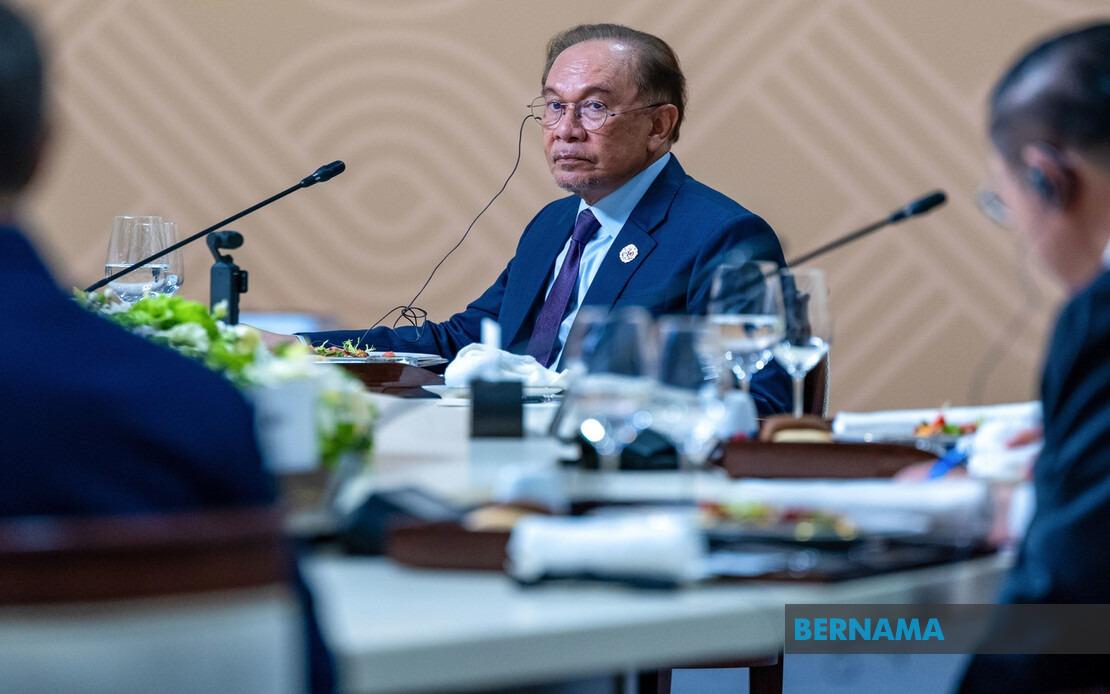
Prime Minister Datuk Seri Anwar Ibrahim has called for ASEAN and the Shanghai Cooperation Organisation to combine their resources in combating transnational crime and deepening energy cooperation, stressing that such challenges demand unified regional responses. Speaking during the ASEAN-Russia working lunch in Kazan on June 18, Anwar highlighted how criminal activities and energy security concerns have become increasingly complex, requiring nations to move beyond bilateral approaches and establish stronger multilateral mechanisms.
The foundation for such cooperation already exists through the 2005 memorandum of understanding between the two organisations, which covers counter-terrorism, drug and narcotic control, money laundering, and energy cooperation including hydroelectric power and biofuel initiatives. However, Anwar emphasised that merely having these frameworks is insufficient without focused implementation and resource allocation. He advocated for channelling attention and resources into select priority areas where concrete, measurable outcomes can be achieved within specific timeframes, moving away from broad, unfocused cooperation arrangements that often produce limited tangible results.
The transnational crime challenge has become particularly urgent across Southeast Asia and the broader Indo-Pacific region. Online scams, illicit financial transfers, and human trafficking operations now traverse borders with alarming speed, often outpacing the institutional capacity of individual nations to respond effectively. Anwar stressed that criminals exploit gaps between national regulatory systems and the limitations of isolated law enforcement efforts, making intelligence sharing and capacity-building initiatives essential. By establishing formal mechanisms for cross-border intelligence exchange and harmonising investigative procedures, ASEAN and SCO members could significantly improve their ability to track and dismantle criminal networks operating across multiple jurisdictions.
Energy cooperation represents another critical area where regional collaboration offers substantial benefits. The SCO encompasses major energy-producing nations and countries with advanced technological expertise in energy systems, creating exceptional opportunities for knowledge transfer and infrastructure development. Anwar, who also serves as Finance Minister, outlined multiple dimensions of practical energy cooperation that could yield immediate benefits. These include improving energy efficiency across industrial and domestic sectors, strengthening grid reliability to prevent blackouts and supply disruptions, expanding liquefied natural gas and gas infrastructure, integrating renewable energy sources more effectively into existing grids, and building institutional capacity around energy safety and system resilience.
Malaysia's position as an energy trader and developing economy makes such cooperation particularly relevant to national interests. The country imports significant energy resources and faces the dual challenge of meeting growing domestic demand while transitioning toward cleaner energy sources to meet climate commitments. Enhanced technical cooperation with major energy producers and technology leaders within the SCO framework could accelerate Malaysia's energy transition while ensuring supply security. Knowledge-sharing arrangements regarding renewable energy integration, energy storage technologies, and grid management systems would benefit Malaysian utilities and reduce long-term energy costs for consumers and businesses.
Beyond security and energy, Anwar extended his case for deepened cooperation to the Eurasian Economic Union, where ASEAN nations already maintain established frameworks for engagement. He argued that existing institutional structures must be activated more aggressively to strengthen business confidence and stimulate genuine commercial expansion. The private sector, rather than governments alone, should drive this engagement through regular meetings and participation in regional trade and investment forums. The Eastern Economic Forum and the St Petersburg International Economic Forum represent concrete venues where ASEAN and Eurasian business communities could establish networks, identify investment opportunities, and negotiate partnerships that expand bilateral and multilateral trade flows.
Small and medium-sized enterprises from both ASEAN and the Eurasian Economic Union face particular challenges in penetrating each other's markets due to limited market information, technological gaps, and insufficient technical expertise. Anwar identified targeted support for these smaller firms as a key priority, encompassing market access facilitation, technology transfer mechanisms, and skills development programmes. Creating dedicated business matchmaking events and capacity-building initiatives would enable smaller enterprises to compete effectively in both regions, potentially unlocking significant economic growth and job creation opportunities across the wider Eurasian and Southeast Asian geographical space.
Emerging digital economy challenges and opportunities represent a final frontier requiring coordinated regional approaches. Artificial intelligence development, cybersecurity standards, and food security concerns increasingly demand collective attention as they transcend borders and affect multiple nations simultaneously. The digital economy presents opportunities for entrepreneurial growth and efficiency gains, yet also poses risks related to cybercrime, data protection, and technological dominance by major powers. Establishing joint research initiatives, harmonising cybersecurity standards, and developing shared approaches to artificial intelligence governance could position both ASEAN and the Eurasian Economic Union advantageously within the rapidly evolving global digital landscape.
Food security has emerged as a critical concern for Southeast Asian nations, particularly given supply chain vulnerabilities exposed during recent global disruptions. Collaboration with Eurasian agricultural producers and technology leaders could enhance regional food production capacity while building resilience against supply shocks. Knowledge-sharing regarding agricultural innovations, sustainable farming practices, and food processing technologies would strengthen domestic production capacity while reducing dependence on distant suppliers. This cooperation carries direct relevance for Malaysia's food security strategy and broader regional stability across Southeast Asia.
Anwar's remarks during the ASEAN-Russia Commemorative Summit reflect a pragmatic recognition that regional challenges have outgrown the capacity of individual nations or bilateral relationships to address effectively. The multilateral framework approach he advocates requires sustained political commitment from participating governments and genuine resource allocation to implementation mechanisms. Success will depend on whether ASEAN and its partners can translate rhetorical commitments into operational programmes, establish regular consultation mechanisms, and demonstrate measurable progress that convinces sceptical stakeholders of the cooperation's genuine value.
For Malaysia specifically, participating actively in these expanded cooperative frameworks offers strategic opportunities to enhance national security, ensure energy supply reliability, strengthen trade relationships, and position the country as a bridge between Southeast Asia and the broader Eurasian region. The initiatives Anwar outlined reflect both Malaysia's geographic position in a globalised economy and its interests in maintaining regional stability and prosperity. Implementation of these priorities will require coordination among multiple Malaysian government agencies, encouragement of private sector participation, and sustained diplomatic engagement with ASEAN partners and external stakeholders.

%22%2F%3E%3C%2Fpattern%3E%3C%2Fdefs%3E%3Crect%20width%3D%22100%25%22%20height%3D%22100%25%22%20fill%3D%22url(%23ph21o2sg)%22%2F%3E%3Crect%20width%3D%22100%25%22%20height%3D%22100%25%22%20fill%3D%22url(%23ph21o2sp)%22%2F%3E%3Ctext%20x%3D%2250%25%22%20y%3D%2250%25%22%20text-anchor%3D%22middle%22%20dominant-baseline%3D%22central%22%20fill%3D%22rgba(255%2C255%2C255%2C0.95)%22%20font-family%3D%22Georgia%2C%20'Times%20New%20Roman'%2C%20serif%22%20font-weight%3D%22700%22%20font-size%3D%22170%22%20letter-spacing%3D%22-0.02em%22%3EGabungan%3C%2Ftext%3E%3C%2Fsvg%3E)