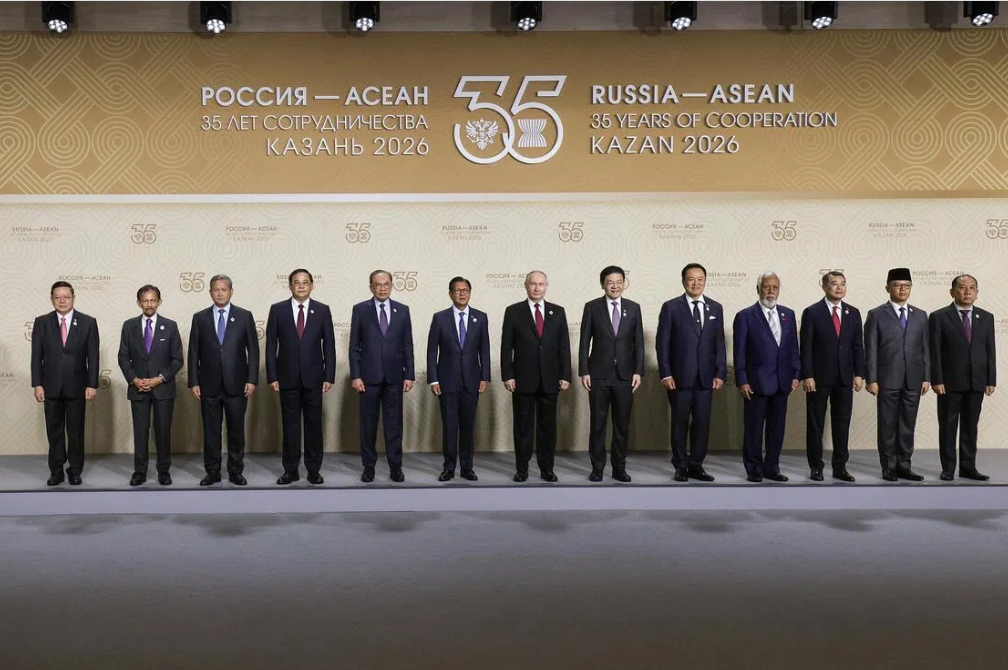
The Asean-Russia relationship entered a new chapter this week as leaders from the Southeast Asian bloc gathered in Kazan to reaffirm their commitment to expanding ties across multiple sectors. The Asean-Russia Commemorative Summit, convened on June 17 and 18, served as the capstone to three decades of formal dialogue partnership and three and a half decades of broader diplomatic engagement, providing an occasion for both sides to take stock of achievements and plot a course for intensified cooperation.
Three substantive documents emerged from the Kazan gathering, signalling the serious intent behind the assembled delegations' rhetoric. The Kazan Declaration functions as the blueprint for future relations, cataloguing the progress achieved since ties first began and establishing priorities for the years ahead. Alongside this sits a Joint Statement on Cultural Cooperation, recognising that sustained people-to-people connections form the bedrock of enduring international relationships. Most ambitiously, the Asean-Russia Comprehensive Plan of Action spanning 2026 through 2030 translates broad partnership commitments into specific operational guidelines, ensuring that diplomatic warmth translates into concrete initiatives across defence, maritime affairs, commerce, investment, energy infrastructure, connectivity projects, educational exchanges, and cultural programming.
Singapore's Prime Minister Lawrence Wong delivered remarks that captured both the optimism and pragmatism underpinning Asean's approach to Moscow. He acknowledged that whilst countries inevitably harbour divergent positions on particular matters, substantial room exists for constructive engagement where interests align and shared benefits can accrue. Wong's framing suggested that Asean views Russia as a meaningful partner in stability architecture, particularly given Russia's acknowledged support for the concept of Asean Centrality—the principle that the bloc should serve as the driving force for regional order-building. This endorsement matters considerably within Southeast Asian diplomatic circles, where affirmation from major powers validates the region's autonomous role-setting ambitions.
The summit's agenda reflected genuine areas of mutual utility. Disaster management cooperation carries particular salience for Southeast Asia, where typhoons, flooding, and seismic activity pose recurring challenges requiring sophisticated coordination mechanisms and shared expertise. Similarly, the shared commitment to combating narcotics trafficking acknowledges a concrete transnational threat that neither side can address effectively in isolation. The expansion of education and cultural exchange programmes, including ongoing participation by Russian officials in civil service training initiatives across the bloc, demonstrates a willingness to invest in mutual understanding at institutional and personal levels.
Yet beneath this harmonious surface runs an undercurrent of significant tension rooted in fundamentally divergent assessments of contemporary international law and geopolitical legitimacy. Singapore maintains a carefully calibrated public stance on the Ukraine conflict, justified through appeal to universal principles rather than strategic alignment. The Republic has imposed sanctions against Russia that remain firmly in place, and its government explicitly characterised the invasion as a breach of international law. This positioning reflects Singapore's strategic calculation that the rules-based international order—anchored in concepts of sovereign equality and territorial integrity—serves small states' interests more reliably than might-makes-right geopolitics.
Wong's bilateral meeting with President Vladimir Putin, arranged at Russia's initiative, provided an opportunity to explore whether pragmatic cooperation could coexist alongside principled disagreement. The exchange underscored the value of maintaining dialogue channels even amid substantial discord, a lesson particularly resonant for Southeast Asian nations that depend on international stability for their own security and prosperity. Wong's subsequent social media reflection that "our discussion underscored the value of dialogue and engagement, even when countries do not see eye to eye on every issue" captured this delicate balancing act—treating Russia as a necessary interlocutor without abandoning core commitments.
The summit's timing carries significance within the broader context of Southeast Asian diplomacy. Singapore assumes the Asean rotating chairmanship in 2027, an annual responsibility that confers both prestige and considerable organisational burden. Wong's explicit invitations to Russia to participate in the East Asia Summit and Asean Regional Forum during the Philippines' 2024 chair, and his anticipated deepening of such engagement during Singapore's tenure, signal that Asean intends to preserve Moscow's voice within regional mechanisms despite contentious international issues. This reflects a conscious choice to pursue inclusive rather than exclusionary diplomacy, betting that channelling Russia's participation through established forums creates better conditions for restraint and dialogue than isolation might.
The bilateral component involving Wong and Rustam Minnikhanov, the Rais of Tatarstan, illustrates how Asean-Russia ties extend beyond Moscow's central government to regional actors within the Russian Federation. The invocation of former Minister Mentor Lee Kuan Yew's 2007 visit to Tatarstan signals long institutional memory and deliberate cultivation of these subnational relationships. Such diversified engagement patterns create multiple nodes of contact and cooperative opportunity, potentially buffering against periodic tensions at the federal level.
For Malaysian observers and others across Southeast Asia, the summit's outcomes present both opportunities and complexities. The comprehensive action plan through 2030 creates frameworks through which bilateral and regional relationships can expand in domains where strategic interests genuinely converge—energy cooperation holds particular importance for import-dependent economies, whilst maritime security concerns resonate across an archipelagic region traversed by vital shipping lanes. Educational and cultural programming can facilitate deeper understanding and create generations of officials and academics with personal stakes in positive relations.
Simultaneously, the summit underscores tensions inherent in Asean's non-aligned positioning within an increasingly bipolar geopolitical environment. The bloc seeks to maintain productive relationships with all major powers whilst adhering to principle-based positions on core international law questions. This balancing act grows increasingly demanding as global fractures deepen and pressure mounts on countries to declare explicit allegiances. Singapore's conduct at Kazan—warmly engaging Russia operationally whilst maintaining clear positions on Ukraine and international law—exemplifies the navigation strategy Asean nations employ, though this approach invites criticism from all quarters.
Looking forward, the Asean-Russia partnership's trajectory will likely follow a pattern of expanding practical cooperation in depoliticised domains whilst managing underlying disagreements through mature diplomatic channels. Energy security, maritime safety, counternarcotics, and cultural exchange represent genuine shared interests that can advance without requiring either side to compromise fundamental positions. The real test of this recalibrated partnership lies in whether both sides can maintain this compartmentalisation when fresh geopolitical shocks inevitably emerge, testing whether the commitments restated in Kazan prove durable enough to withstand renewed global turbulence.