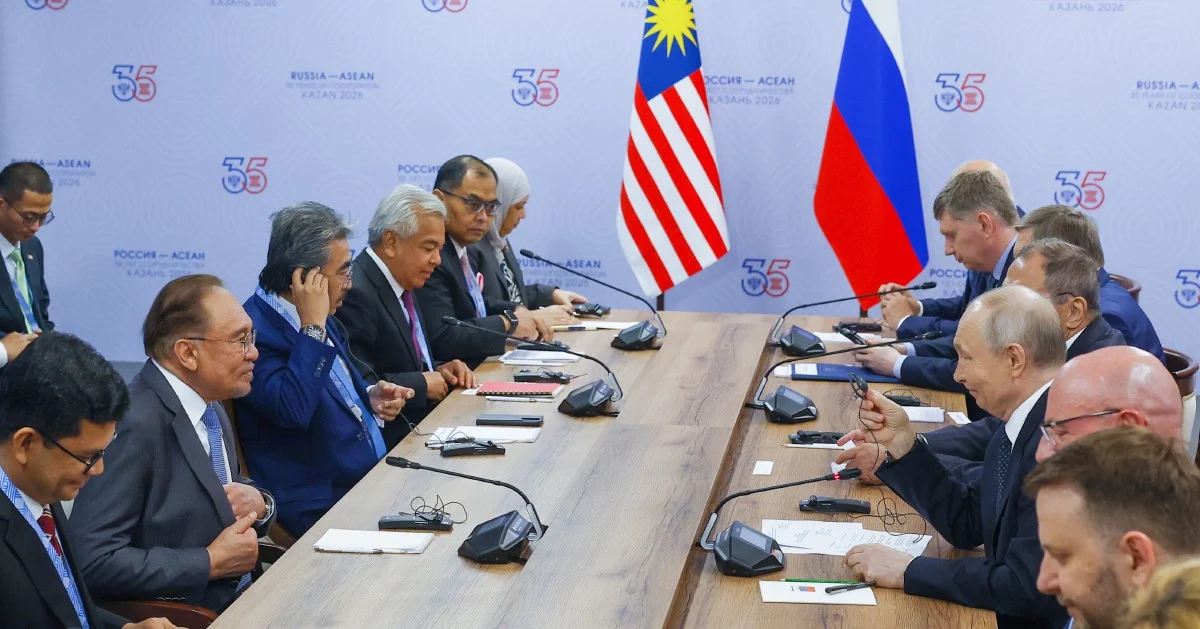
Prime Minister Datuk Seri Anwar Ibrahim has expressed gratitude to Russian President Vladimir Putin for backing Malaysia's push to deepen energy partnerships, particularly through Petroliam Nasional Bhd, as both nations seek to expand cooperation in one of the global economy's most critical sectors. The acknowledgement, made during discussions in Kazan, reflects an emerging alignment between Kuala Lumpur and Moscow on resource development and reflects the prime minister's broader strategy to diversify Malaysia's international partnerships beyond traditional Western relationships.
The endorsement from Russia's leadership carries significance for Petronas, which operates across multiple continents and faces mounting pressure to secure long-term energy supplies and partnerships amid global energy transitions. By securing backing from a major global energy producer, the Malaysian national champion gains credibility in negotiating complex international ventures. This positioning proves particularly valuable as traditional energy markets undergo structural shifts and nations reassess supply chain vulnerabilities exposed by recent geopolitical tensions.
Malaysia's energy sector has increasingly sought partnerships with non-traditional partners, reflecting both pragmatism and the reality that hydrocarbon producers worldwide must collaborate to maintain market relevance. Russia's support for Malaysian energy interests signals mutual recognition that established trade relationships remain mutually beneficial despite broader geopolitical divisions. Such cooperation models offer both parties alternatives to exclusive bloc-based arrangements that have characterised recent international relations.
The timing of Anwar's appreciation underscores Malaysia's diplomatic balancing act in a multipolar world. Rather than aligning exclusively with any single power, the government has pursued what officials describe as principled pragmatism—maintaining relationships with diverse partners based on national interest. Energy security qualifies as a core national interest, justifying engagement with all capable partners regardless of their broader geopolitical alignment. This approach has allowed Malaysia to maintain substantial trade and investment relationships while preserving strategic autonomy.
Petronas specifically brings considerable advantages to any bilateral energy arrangement. The company operates major liquefied natural gas export terminals in Sarawak and Sabah, controls exploration licences across Southeast Asia and beyond, and possesses technical expertise accumulated over decades of operations in challenging environments. These capabilities make it an attractive partner for nations seeking reliable energy supplies and technically competent operators for development projects. Russian acknowledgement of these strengths validates Malaysia's positioning within regional and global energy markets.
The geopolitical context surrounding this cooperation deserves careful consideration. Western sanctions on Russian energy exports following military operations in Ukraine have created openings for alternative partnerships between Russia and Asian nations. Malaysia, maintaining no formal sanctions regime against Russia, can engage without the legal constraints facing Western firms. This positioning provides opportunities for Malaysian firms to access projects and technologies otherwise unavailable, though it also invites scrutiny from countries prioritising unified responses to Russian actions.
Energy cooperation frameworks between nations typically encompass multiple dimensions beyond simple commerce. They may include joint exploration and development ventures, technology transfer arrangements, training programmes, and infrastructure investments. Such partnerships often require long-term commitments and involve substantial capital. Russian support for deepening these ties with Petronas suggests serious intentions regarding sustained engagement rather than transactional interactions. This matters because energy infrastructure and supply agreements often lock in relationships for decades.
For Southeast Asia more broadly, diversified energy partnerships prove strategically important. The region's rapidly industrialising economies require reliable, affordable energy supplies to maintain growth trajectories. Petronas plays crucial roles in regional supply chains, and its international capabilities influence energy security across the broader region. Russian backing for Petronas therefore carries implications extending beyond bilateral Malaysia-Russia relations into broader Southeast Asian energy security calculations.
The acknowledgement also reflects Malaysia's standing among global energy producers. While not ranking among the world's largest oil and gas exporters, Malaysia maintains sufficient production and strategic positioning to warrant attention from major energy-importing and exporting nations alike. This status derives from both current output and expectations regarding future discoveries and development potential, particularly in deepwater fields where Malaysian expertise proves valuable.
Looking forward, the appreciation expressed in Kazan likely signals the beginning rather than the culmination of enhanced energy cooperation. Substantive partnerships require detailed negotiations, regulatory approvals, and investment decisions extending across multiple years. Malaysian officials will presumably pursue formal agreements translating political support into concrete commercial arrangements. The degree to which these talks advance will depend on commercial logic, regulatory compatibility, and the persistence of political will on both sides.
For Malaysian observers and policymakers, Anwar's engagement with Putin in the energy domain illustrates how contemporary international relations increasingly operate across multiple channels simultaneously. Traditional security alliances coexist with pragmatic economic partnerships, sometimes with the same countries. Malaysia's approach demonstrates that nations need not choose between geopolitical blocs when energy security and economic interests justify selective engagement. This flexibility carries both advantages—access to diverse opportunities—and risks, requiring sophisticated navigation of competing interests and values.

%22%2F%3E%3C%2Fpattern%3E%3C%2Fdefs%3E%3Crect%20width%3D%22100%25%22%20height%3D%22100%25%22%20fill%3D%22url(%23ph21o2sg)%22%2F%3E%3Crect%20width%3D%22100%25%22%20height%3D%22100%25%22%20fill%3D%22url(%23ph21o2sp)%22%2F%3E%3Ctext%20x%3D%2250%25%22%20y%3D%2250%25%22%20text-anchor%3D%22middle%22%20dominant-baseline%3D%22central%22%20fill%3D%22rgba(255%2C255%2C255%2C0.95)%22%20font-family%3D%22Georgia%2C%20'Times%20New%20Roman'%2C%20serif%22%20font-weight%3D%22700%22%20font-size%3D%22170%22%20letter-spacing%3D%22-0.02em%22%3EGabungan%3C%2Ftext%3E%3C%2Fsvg%3E)