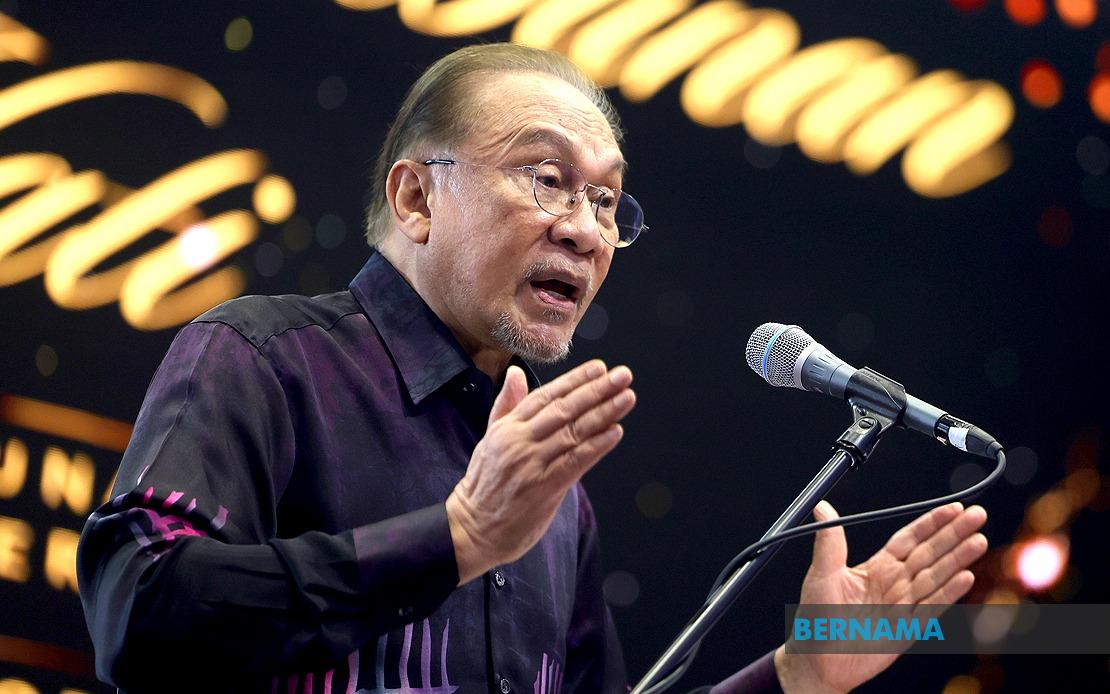
Prime Minister Datuk Seri Anwar Ibrahim has made an impassioned plea to citizens across all ethnic groups to protect Malaysia's foundational unity and resist attempts by certain leaders to sow racial discord and suspicion. Speaking at a dinner hosted by Pertubuhan Lima Generasi Malaysia in Seremban on June 20, Anwar framed the nation's multicultural fabric not as a source of vulnerability, but as one of its most valuable competitive advantages on the global stage.
The prime minister's remarks come amid ongoing concerns about inflammatory rhetoric in domestic politics, where some figures have sought to weaponise ethnic grievances for electoral advantage. Anwar's intervention signals the government's determination to counter divisive narratives that pit communities against one another, a particularly sensitive issue in a nation where communal harmony remains constitutionally enshrined and politically consequential. His appeal directly challenged what he characterised as deliberate attempts to fracture social cohesion by fostering animosity between Malays, Chinese, Indians, and the diverse indigenous communities across East Malaysia.
Central to Anwar's message is the assertion that Malaysia's strength derives not from ethnic separation or zero-sum competition, but from genuine cooperation across demographic lines. The prime minister articulated a vision where members of different communities work collectively toward shared national objectives, rejecting the false premise that advancing one group's interests requires diminishing another's. This framing reflects a broader philosophical approach to nation-building that prioritises inclusive development over communal particularism, an approach that carries significance for Malaysia's trajectory as a developing economy increasingly dependent on social stability for attracting investment and talent.
Anwar's emphasis on mutual understanding represents an acknowledgment that legislative measures alone cannot sustain harmony; rather, the willingness of leaders to consistently articulate messages of inclusion and explicitly reject divisive rhetoric plays a crucial role in setting the tone for public discourse. The dinner, which drew over 1,000 members of the Pertubuhan Lima Generasi Malaysia, provided a platform to reinforce these principles before a sympathetic audience, though the challenge extends far beyond such gatherings to reach communities susceptible to polarising messaging through social media and informal networks.
The event was also attended by Negeri Sembilan Menteri Besar Datuk Seri Aminuddin Harun, underlining the participation of state-level leadership in reinforcing messages of unity. This multi-level engagement reflects a recognition that preserving communal harmony requires consistent advocacy across different tiers of government and within civil society organisations. The Pertubuhan Lima Generasi Malaysia, as a civic organisation, serves as one vehicle through which these messages circulate, though such platforms remain limited in their reach compared to the pervasive influence of digital media and political campaigns.
For Malaysian readers and the broader Southeast Asian context, Anwar's intervention touches on enduring tensions around how diverse nations manage ethnic and religious pluralism. Malaysia's constitutional arrangement guarantees special positions for Malays and indigenous peoples while protecting minority rights, creating inherent tensions that require skilled political management. When leaders abandon that middle ground to pursue communal advantage, they risk unravelling the delicate consensus that has generally held since independence, as evidenced by periodic episodes of communal tension throughout the nation's history.
The implicit critique directed at those "who want us to hate one another" suggests frustration with political competitors who employ identity-based mobilisation strategies. This reflects a broader global pattern where populist and nationalist movements have increasingly relied on ethnic or religious grievance narratives. In Malaysia's context, such approaches threaten not only social peace but also the pragmatic cooperation required to address shared challenges including economic inequality, environmental degradation, and regional geopolitical pressures that affect all communities alike.
Anwar's invocation of unity across Malays, Chinese, Indians, Kadazans and others notably includes reference to East Malaysian indigenous groups, reflecting an attempt to frame national integration as encompassing the entire federation. This geographical and demographic inclusivity is symbolically important in a nation where regional disparities and occasional perception of marginalisation in East Malaysia have occasionally fuelled separatist sentiment. By prominently naming these communities as partners in a collective national project, Anwar signals commitment to inclusive federalism that transcends mere acknowledgment to embrace genuine partnership.
The sustainability of such appeals ultimately depends on whether they translate into concrete policy outcomes that materially benefit citizens across different communities. Citizens increasingly judge political rhetoric against lived experience; if certain groups perceive that their economic circumstances are deteriorating while others advance, or if they feel systematically excluded from opportunities and decision-making, appeals to unity risk appearing hollow and self-serving. This implies that maintaining communal harmony requires not only rhetorical commitment but sustained delivery of equitable development outcomes and inclusive governance.
As Malaysia navigates its post-pandemic recovery and faces intensifying competition in the regional economy, the stability that interethnic cooperation enables becomes economically as well as socially important. Foreign investors assess political risk partly through the lens of communal stability; domestic entrepreneurs from all communities require confidence that the operating environment will not suddenly become hostile based on ethnicity or religion. In this sense, Anwar's advocacy for unity carries instrumental value beyond its moral dimension, touching on the nation's capacity to generate the inclusive growth required to maintain competitiveness and improve living standards broadly.
The challenge ahead involves translating such public advocacy into sustained institutional and cultural change that resists the periodic eruption of divisive rhetoric, particularly during electoral cycles when incentives to mobilise along communal lines intensify. This requires not only prime ministerial pronouncements but consistent action by all political actors, media organisations, and civil society to marginalise rather than amplify voices that profit from division. Whether Malaysian society can sustain this commitment in coming years remains an open question with significant implications for regional stability.