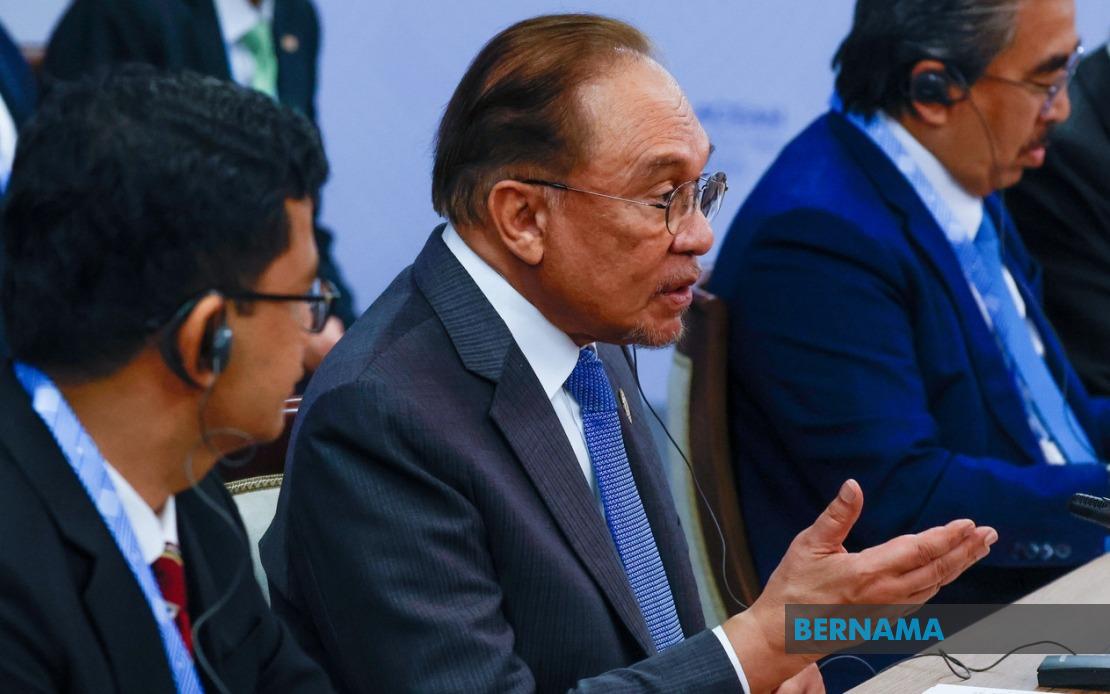
Prime Minister Datuk Seri Anwar Ibrahim travelled to Kazan this week to meet with Russian President Vladimir Putin, where he seized the opportunity to voice Malaysia's appreciation for Moscow's approach to two of the most pressing geopolitical challenges confronting the Middle East. In opening remarks at their bilateral dialogue, Anwar specifically acknowledged what he characterised as Russia's principled consistency in addressing both the ongoing Gaza crisis and the broader geopolitical complications surrounding Iran. The exchange underscores Malaysia's diplomatic positioning as it navigates relationships with major powers while advocating for measured, dialogue-driven solutions to regional conflicts that have drawn the intense focus of Washington, Beijing, and Moscow alike.
Anwar's commendation extended beyond mere pleasantries, framing Russia's approach as one worthy of emulation in a region fractured by competing interests and military posturing. He stressed that the Malaysian people, alongside many others across the developing world, recognised and valued Putin's steadfastness in adhering to principled positions rather than shifting with political winds or external pressure. This language carried particular weight coming from a leader of a Muslim-majority Southeast Asian nation with significant stakes in Middle Eastern stability, suggesting that Malaysia views Russia's diplomatic consistency as preferable to what it may perceive as more erratic or interest-driven stances taken by Western powers.
The bilateral meeting in the Russian city of Kazan represents part of a broader pattern of Malaysian engagement with Russia at the highest levels, a relationship that has deepened in recent years despite Malaysia's traditional Western security alignments. Anwar's visit and the substance of his remarks signal that Kuala Lumpur sees value in coordinating with Moscow on matters where their positions align, particularly regarding conflicts where Malaysia has championed humanitarian access and the rights of affected civilian populations. The timing of such diplomatic engagement also reflects a broader Southeast Asian recalibration, with regional powers seeking to maintain pragmatic relationships across the geopolitical spectrum rather than aligning exclusively with any single bloc.
Russia's position on Gaza has indeed emphasised the need for immediate humanitarian ceasefires, unobstructed access for aid organisations serving Palestinian populations, and a return to diplomatic frameworks rather than military solutions. Moscow has positioned itself as an advocate for what it terms a principled approach grounded in international law and the rights of civilian non-combatants, a framing that resonates with countries like Malaysia that have historically supported Palestinian causes and viewed the conflict through a humanitarian and anti-colonial lens. This alignment of rhetorical positions, though not necessarily requiring coordinated action, provides a foundation for diplomatic coordination and mutual affirmation on forums such as the United Nations.
Simultaneously, Russia's handling of its relationship with Iran reflects a strategic partnership that Moscow has cultivated over decades, based on shared regional interests, energy cooperation, and a common desire to counterbalance Western influence in the broader Middle East. While Western nations, particularly the United States, have pursued confrontational policies toward Tehran, Russia has maintained diplomatic channels and advocated for negotiated settlements even as it manages its own complex relationship with Iran. Anwar's praise for this consistency suggests Malaysia views such diplomatic engagement as preferable to the escalatory cycles that military confrontation and economic sanctions can produce.
For Malaysia, a nation dependent on stable global energy markets and trade routes that run through the Middle East and beyond, the stakes of regional conflict are tangible. Disruptions in the Gulf, escalations between Iran and Western powers, or broader instability stemming from unresolved Palestinian grievances all carry implications for Malaysian commerce, energy security, and the broader Indo-Pacific stability upon which Malaysian prosperity depends. By publicly affirming Russia's diplomatic approach, Anwar signals that Malaysia favours dialogue and multilateral problem-solving over unilateral action or military escalation, positioning his nation as a voice for restraint and negotiated resolution.
The meeting also reflects Malaysia's careful balancing act in a multipolar world where relationships with the United States, China, Russia, and regional neighbours all demand attention. While Malaysia maintains defence partnerships with Western nations and has security concerns related to Chinese assertiveness in Southeast Asia, it is simultaneously unwilling to become a proxy in great power competition. Anwar's diplomatic engagement with Putin, framed around appreciation for principled positions on Middle Eastern conflicts, allows Malaysia to maintain its distinct voice while strengthening relationships with non-Western powers without appearing to abandon its broader international commitments.
For regional observers, Anwar's remarks carry implications beyond bilateral Malaysia-Russia relations. They suggest that Southeast Asian nations are increasingly confident in articulating independent positions on global issues, drawing inspiration from and coordination with powers that align with their stated principles rather than simply following the preferences of traditional Western partners. This independence reflects both the rising economic and political confidence of Southeast Asian states and the genuine complexity of managing relationships across a fractured international order where simple alignment with one bloc is neither possible nor desirable.
Looking forward, the depth of Malaysian-Russian engagement on Middle Eastern issues may influence how Malaysia approaches voting in international forums, participates in multilateral discussions about sanctions or military interventions, and frames its public diplomacy on these sensitive topics. The signals exchanged during such high-level meetings establish parameters for subsequent lower-level diplomatic work and help shape the narratives that nations project about their foreign policy priorities. For Malaysia, consistently emphasising its alignment with Russia on questions of humanitarian access, ceasefire advocacy, and diplomatic resolution serves both to reinforce its identity as a voice for the Global South and to strengthen its claim to independent, principled foreign policy-making distinct from either Western or Chinese spheres of influence.

%22%2F%3E%3C%2Fpattern%3E%3C%2Fdefs%3E%3Crect%20width%3D%22100%25%22%20height%3D%22100%25%22%20fill%3D%22url(%23ph21o2sg)%22%2F%3E%3Crect%20width%3D%22100%25%22%20height%3D%22100%25%22%20fill%3D%22url(%23ph21o2sp)%22%2F%3E%3Ctext%20x%3D%2250%25%22%20y%3D%2250%25%22%20text-anchor%3D%22middle%22%20dominant-baseline%3D%22central%22%20fill%3D%22rgba(255%2C255%2C255%2C0.95)%22%20font-family%3D%22Georgia%2C%20'Times%20New%20Roman'%2C%20serif%22%20font-weight%3D%22700%22%20font-size%3D%22170%22%20letter-spacing%3D%22-0.02em%22%3EGabungan%3C%2Ftext%3E%3C%2Fsvg%3E)